India and Russia Discuss Trade Tariffs and Connectivity Corridors
Source:The Hindu ↗
Why It Matters
This is critical for understanding how India manages its multi-aligned foreign policy—deepening economic and energy ties with Russia through new FTAs and connectivity routes (like the INSTC) while mitigating trade deficits and navigating the impacts of Western sanctions and US protectionism.
Summary
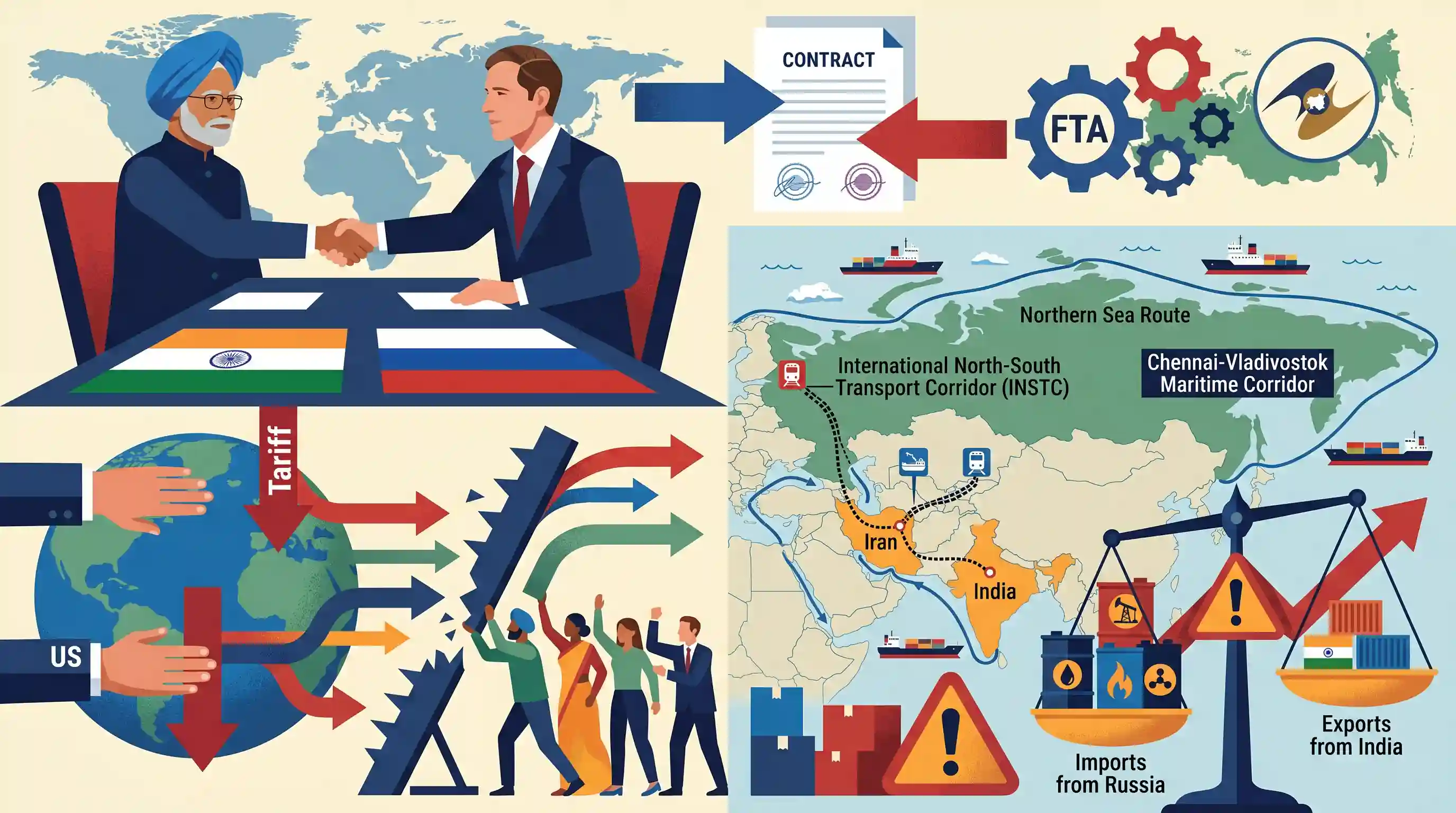
During a visit to Moscow, External Affairs Minister S. Jaishankar met with Russian First Deputy PM Denis Manturov to discuss trade relations amidst global protectionist pressures, notably US tariff hikes. Jaishankar emphasized the need to remove tariff and non-tariff barriers and called for the swift conclusion of a Free Trade Agreement (FTA) between India and the Eurasian Economic Union to help diversify trade. To boost supply chain resilience, they focused on developing key connectivity initiatives like the International North-South Transport Corridor (INSTC), the Northern Sea Route, and the Chennai-Vladivostok Corridor. India also formally raised concerns over the massive $58.9 billion trade deficit, primarily driven by large-scale Russian hydrocarbon imports.
Key Points
- External Affairs Minister S. Jaishankar highlighted the pressing need to address tariff and non-tariff barriers to expand India-Russia trade.
- Discussions touched upon the external challenge of US President Donald Trump's new protectionist tariffs, necessitating stronger bilateral economic frameworks.
- Jaishankar strongly advocated for the early conclusion of a Free Trade Agreement (FTA) between India and the Eurasian Economic Union.
- Both nations agreed to resolve logistics bottlenecks and promote strategic connectivity corridors, including the INSTC, the Northern Sea Route, and the Chennai-Vladivostok Maritime Corridor.
- India expressed concern over its widening trade deficit with Russia (reaching $58.9 billion out of $68 billion total trade), which is largely skewed by massive Indian imports of Russian hydrocarbons.
Important Terms
Eurasian Economic Union (EAEU)

An international economic union of five post-Soviet states—Russia, Armenia, Belarus, Kazakhstan, and Kyrgyzstan—ensuring free movement of goods, services, capital, and labor within an integrated single market.
UPSC context
GS Paper II (International Relations). Tests knowledge of regional economic integration and India's strategic interests in Central Asia and Eastern Europe.
India-EAEU Free Trade Agreement (FTA)
A proposed trade pact between India and the EAEU aimed at reducing tariffs and non-tariff barriers to diversify trade, enhance market access, and secure long-term energy supplies.
UPSC context
GS Paper II (IR). Evaluates understanding of bilateral trade diplomacy, economic diversification, and India's efforts to balance global trade pressures.
International North-South Transport Corridor (INSTC)
A 7,200 km multimodal transit network linking India to Russia and Europe via Iran and Azerbaijan, significantly reducing shipping costs and time compared to the Suez Canal route.
UPSC context
GS Paper II (IR) and Paper III (Infrastructure). Focuses on strategic connectivity and India’s efforts to bypass traditional trade bottlenecks.
Chennai-Vladivostok Corridor
A strategic 5,600 nautical mile sea route, also known as the Eastern Maritime Corridor, connecting India’s east coast with Russia’s Far East to facilitate energy and commodity trade.
UPSC context
GS Paper II (IR). Tests India’s Act East policy and energy security through direct maritime links with Russia’s resource-rich regions.
Northern Sea Route (NSR)
A 5,600 km Arctic shipping passage linking the Barents and Bering Seas, offering a significantly shorter alternative to the Suez Canal for trade between Europe and Asia-Pacific.
UPSC context
GS Paper I (Geography) and Paper II (IR). Concerns Arctic geopolitics, energy security, and the impact of climate change on global trade.
Prelims Trap
The Eurasian Economic Union (EAEU) includes all five Central Asian Republics.
The EAEU includes only Kazakhstan and Kyrgyzstan from Central Asia, alongside Russia, Belarus, and Armenia. Tajikistan, Turkmenistan, and Uzbekistan are not members.
Static Concepts Connected
What is the Eurasian Economic Union (EAEU) and who are its members?
- Origin: Established in 2015 to create a single integrated regional market.
- Members: Comprises Armenia, Belarus, Kazakhstan, Kyrgyzstan, and Russia.
- Framework: Ensures free movement of goods, services, capital, and labor among post-Soviet member states.
What are the key strategic transit routes connecting India and Russia?
- INSTC: A 7,200-km multi-mode network connecting India to Russia via Iran, effectively bypassing the Suez Canal.
- Chennai-Vladivostok Corridor: Passes through the Malacca Strait and Sea of Japan, cutting transit time from 40 to 24 days.
- Northern Sea Route: An Arctic coast shipping lane offering significant distance savings for Asia-Europe transit as polar ice melts.
Cross-Topic Patterns
Melting Ice and Arctic Trade Routes
The push for the Northern Sea Route intertwines IR with climate change geography, as melting Arctic ice makes this alternative to the Suez Canal commercially viable.
Trade Deficits and Vostro Accounts
The massive $58.9 billion trade deficit with Russia causes Rupee accumulation in Special Vostro Accounts, directly linking geopolitical energy imports to macroeconomic balance of payments challenges.

Expect a multi-statement Prelims question in 2026 overlapping EAEU membership, INSTC transit routes, and the Chennai-Vladivostok path.
Linked PYQs · 4
Linked PYQs · 4
- 2025MainsGS3
What are the challenges before the Indian economy when the world is moving away from free trade and multilateralism to protectionism and bilateralism? How can these challenges be met?
- 2025MainsGS2
"Energy security constitutes the dominant kingpin of India's foreign policy, and is linked with India's overarching influence in Middle Eastern countries.” How would you integrate energy security with India's foreign policy trajectories in the coming years?
- 2024MainsGS2
Critically analyse India's evolving diplomatic, economic and strategic relations with the Central Asian Republics (CARs) highlighting their increasing significance in regional and global geopolitics.
- 2018PrelimsGS1
Consider the following countries: 1. Australia 2. Canada 3. China 4. India 5. Japan 6. USA Which of the above are among the 'free-trade partners' of ASEAN?
