Scientists issue manifesto against militarisation of quantum research
Source:The Hindu ↗
Why It Matters
This development touches upon the crucial intersection of emerging technologies (GS3), global geopolitics (GS2), and ethical considerations in scientific research (GS4). It requires aspirants to understand the dual-use nature of quantum technology, India's National Quantum Mission, and the ethical dilemmas posed by the militarisation of basic science.
Summary
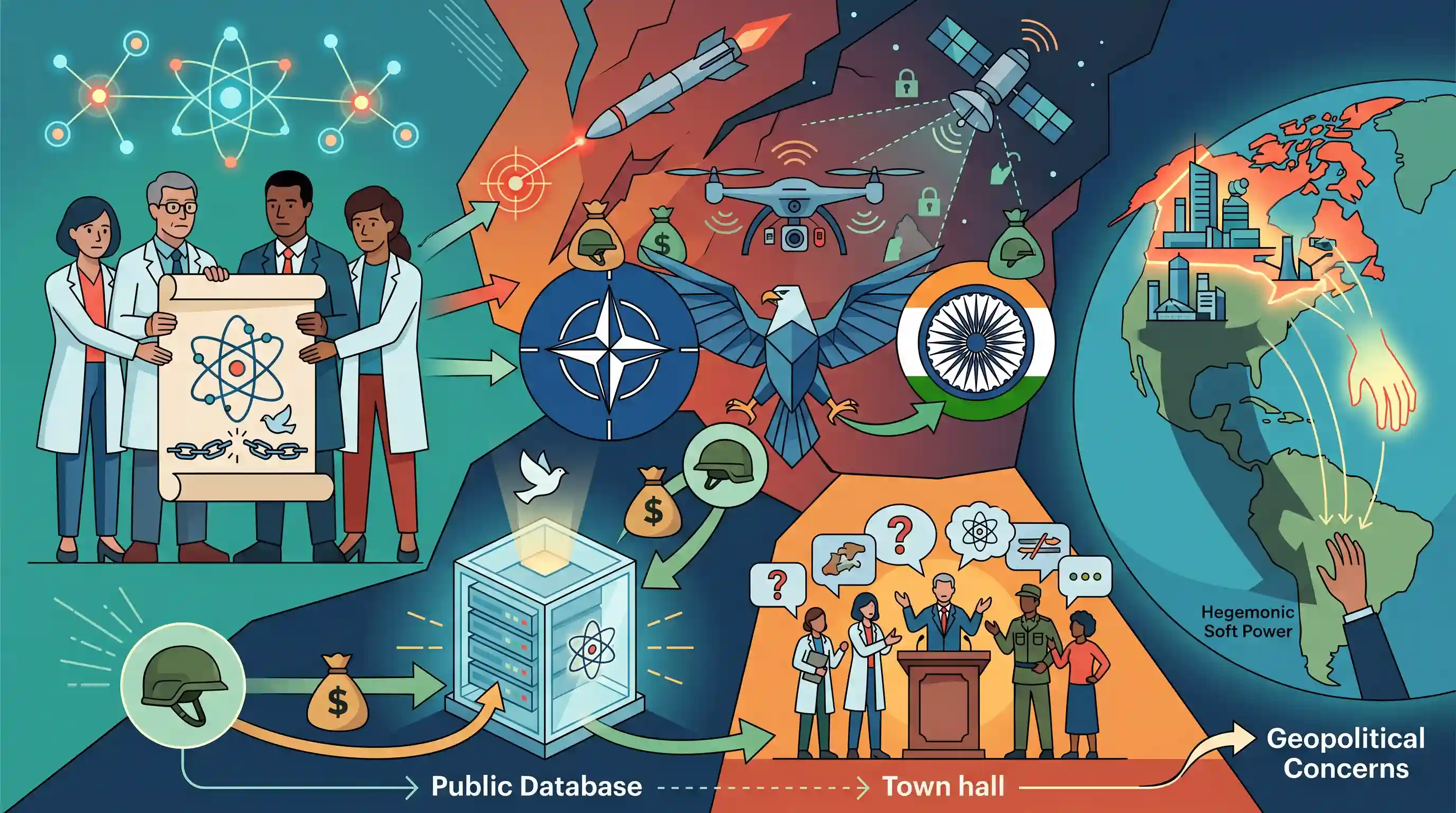
A newly released manifesto by 'Quantum Scientists for Disarmament' raises ethical and geopolitical concerns regarding the increasing militarisation of quantum technology. Researchers from various global institutions advocate for a public database of defence-funded university projects and urge the scientific community to engage in transparent debates on the dual-use nature of quantum research. The manifesto highlights global initiatives, including India's 'Military Quantum Mission Policy Framework', NATO's disruptive technologies agenda, and DARPA's investments, warning against the potential for asymmetric military-academic partnerships to exert hegemonic soft power over the Global South.
Key Points
- A group called 'Quantum Scientists for Disarmament' has issued a manifesto opposing the militarisation of quantum technology.
- The manifesto calls for transparent ethical debates, tracking of defence funding at public universities, and a collective stand against the development of quantum weapons.
- The movement points to military focus on disruptive tech globally, noting India's 'Military Quantum Mission Policy Framework' and the broader 'National Quantum Mission'.
- Major global entities like NATO, the European Commission, and DARPA are increasingly embedding quantum sensors and technologies into their military and disruptive technology agendas.
- The scientists also highlighted concerns regarding dual-use technology and how asymmetric military-academic partnerships might act as soft power over the Global South.
Important Terms
Military Quantum Mission (MQM) Policy Framework

Released in January 2026 by India's Chief of Defence Staff, this roadmap integrates quantum technologies (communication, computing, sensing, and materials) into the military for "battlefield superiority."
UPSC context
GS3 (S&T/Defence). Tests knowledge of India's strategic tech-modernization and transition toward "quantum warfare" doctrines.
National Quantum Mission (NQM)
India's flagship initiative launched in 2023 (₹6,003 crore) to seed and scale quantum R&D, targeting development of intermediate-scale quantum computers and secure communications by 2031.
UPSC context
GS3 (S&T). Foundational pillar for S&T; tests awareness of institutional frameworks and national-level technology missions.
Quantum Scientists for Disarmament
A global collective of researchers that published a 2026 manifesto opposing the "militarization" of quantum science, urging for ethical transparency and demilitarized research.
UPSC context
GS4 (Ethics)/GS3 (S&T). Relevant for discussing the "dual-use" dilemma and social responsibility of scientists.
Civil-Military Fusion
A strategic model integrating civilian R&D (academia, startups, industry) with military requirements to accelerate the transition of laboratory research into operational defense assets.
UPSC context
GS3 (Defence/Security). Essential for analyzing modern industrial-military complexes and technology deployment strategies.
NATO’s Quantum Technologies Strategy
A 2024 policy to make the alliance "quantum-ready" by fostering a secure transatlantic ecosystem, specifically targeting quantum-safe cryptography and superior sensing capabilities.
UPSC context
GS2 (International Relations). Highlights the shift of quantum technology into a locus of global strategic competition.
Quantum Key Distribution (QKD)
A secure communication method using quantum entanglement to share encryption keys; it is theoretically unhackable as any interception attempt alerts the users.
UPSC context
GS3 (S&T/Security). Frequently tested term in Prelims and Mains (Cybersecurity); most mature quantum application today.
Prelims Trap
"India's National Quantum Mission (NQM) is a defense-exclusive initiative governed by the Ministry of Defence."
The NQM is a civilian initiative led by the Department of Science & Technology (DST). The militarisation aspect falls under a separate 'Military Quantum Mission Policy Framework'.
Static Concepts Connected
What is the SCOMET list and how does it relate to dual-use technology?
- SCOMET Acronym: Stands for Special Chemicals, Organisms, Materials, Equipment and Technologies. It is India's national export control list.
- Dual-Use Regulation: Regulates exports of items with both civilian and military applications (like quantum sensors and advanced cryptography) to prevent unregulated proliferation.
- Global Commitments: Aligns India's export controls with multilateral non-proliferation regimes, notably the Wassenaar Arrangement.
What are the fundamental principles underlying Quantum Computing?
- Qubits: The basic unit of quantum information, which differs fundamentally from classical binary computing bits.
- Superposition: The ability of a quantum system to exist in multiple states (e.g., both 0 and 1) simultaneously, enabling exponentially faster calculations.
- Entanglement: A phenomenon where qubits become interconnected, such that changing the state of one instantly affects the other, regardless of distance.
Cross-Topic Patterns
Dual-Use Tech & Global South Soft Power
Technological monopolies by advanced nations risk creating deep dependencies in the Global South, shifting Ethics in Science (GS4) directly into Geopolitics and Soft Power (GS2).
NQM vs. Defence Indigenisation
The overlap between India's ₹6,000Cr civilian NQM and its 'Military Quantum Mission' mirrors the civil-military fusion dilemmas historically seen in India's space and nuclear sectors.

Expect a 2026 GS3 question evaluating the civil-military convergence in India's National Quantum Mission alongside SCOMET export controls.
Linked PYQs · 3
Linked PYQs · 3
- 2024MainsGS4
The application of Artificial Intelligence as a dependable source of input for administrative rational decision-making is a debatable issue. Critically examine the statement from the ethical point of view.
- 2020MainsGS2
What is the significance of Indo-US defence deals over Indo-Russian defence deals? Discuss with reference to stability in the Indo-Pacific region.
- 2022MainsGS4
Online methodology is being used for day-to-day meetings, institutional approvals in the administration and for teaching and learning in education sector to the extent telemedicine in the health sector is getting popular with the approvals of the competent authority. No doubt, it has advantages and disadvantages for both the beneficiaries and the system at large. Describe and discuss the ethical issues involved in the use of online method particularly to the vulnerable section of the society.
