Due Process Versus Media Trials in Judicial Proceedings
Source:Indian Express ↗
Why It Matters
The conflict between freedom of the press and the right to a fair trial is a frequent theme in both GS2 (Judiciary/Polity) and GS4 (Media Ethics). Understanding the constitutional mandate of due process (Article 21) versus the impact of media trials is essential for addressing questions on judicial independence and democratic rights.
Summary
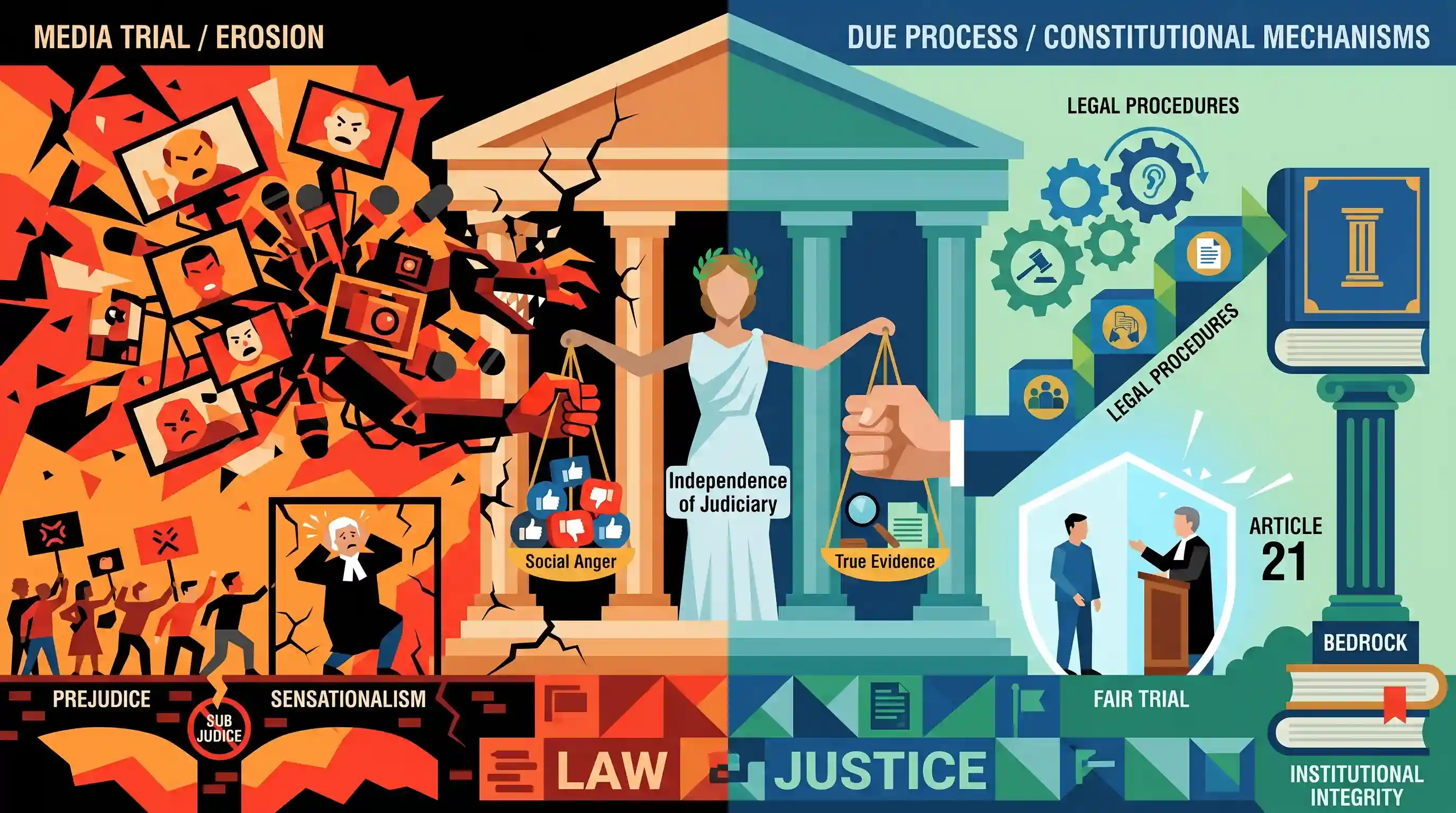
The article highlights the critical tension between media trials and the due process of law in the context of the Justice Varma case. It argues that justice can only be served when legal procedures and institutional integrity take precedence over the court of public opinion. Emphasizing the principles of Article 21 and a fair trial, the piece cautions against media interference and sensationalism, which risk prejudicing judicial outcomes and eroding the independence of the judiciary. The author stresses that established constitutional mechanisms, rather than public trials by media, remain the bedrock of a just democratic society.
Key Points
- The fundamental right to a fair trial is rooted in the due process of law, which cannot be compromised by external pressures.
- Media trials often substitute institutional fact-finding with sensationalism, prejudicing the public and potentially influencing legal outcomes.
- Judicial independence must be safeguarded against the court of public opinion to maintain the integrity of the justice system.
- Adhering to constitutional procedures (under Article 21) is essential for delivering true justice and upholding the rule of law.
Important Terms
Due Process of Law

A legal doctrine ensuring that any law depriving life or liberty must be fair, just, and reasonable, checking both procedural and substantive aspects.
UPSC context
GS Paper II: Essential for understanding the expansion of Article 21 since the Maneka Gandhi (1978) case.
Media Trial
Extensive media coverage that creates a public perception of guilt or innocence before a court verdict, potentially prejudicing the right to a fair trial.
UPSC context
GS Paper II & IV: Tests understanding of media ethics, sub judice matters, and judicial independence.
Article 21
The constitutional provision stating no person shall be deprived of life or personal liberty except according to procedure established by law.
UPSC context
GS Paper II: Fundamental Rights. Considered the 'heart' of the Indian Constitution with ever-expanding scope.
Judicial Independence
A constitutional principle and part of the Basic Structure ensuring the judiciary functions without pressure from the executive or legislature.
UPSC context
GS Paper II: Core tenet of separation of powers and the Basic Structure doctrine.
Procedure Established by Law
The literal requirement that deprivations of liberty follow a validly enacted law; historically narrower than Due Process in Indian jurisprudence.
UPSC context
GS Paper II: Evolution of judicial review from the AK Gopalan to Maneka Gandhi cases.
Presumption of Innocence
A fundamental principle of criminal law where an accused is considered innocent until guilt is established beyond reasonable doubt in court.
UPSC context
GS Paper II: Justice administration and the impact of sensationalized media reporting.
In-House Procedure
The internal mechanism within the higher judiciary to investigate allegations of misconduct against sitting judges, maintaining institutional integrity and confidentiality.
UPSC context
GS Paper II: Accountability mechanisms in the higher judiciary and self-regulation vs parliamentary inquiry.
Prelims Trap
"The phrase 'Due Process of Law' is explicitly mentioned in Article 21 of the Indian Constitution."
Article 21 explicitly states 'procedure established by law'. The Supreme Court interpreted 'due process' into it during the 1978 Maneka Gandhi case; it is not written in the text.
Static Concepts Connected
What distinguishes 'Due Process' from 'Procedure Established by Law'?
- Procedure Established: Checks if a law was enacted correctly by the competent legislature. It has British origins.
- Due Process: Checks if the substantive law itself is fair, just, and not arbitrary. It has American origins.
- Indian Context: The Supreme Court expanded Article 21 to include Due Process in the Maneka Gandhi case (1978), broadening judicial review.
How is 'Contempt of Court' regulated in India?
- Constitutional Backing: Articles 129 and 215 grant the Supreme Court and High Courts inherent power to punish for contempt of themselves.
- Statutory Basis: The Contempt of Courts Act, 1971 defines and limits the powers of certain courts in punishing contempts (Civil and Criminal).
- Speech Restriction: Contempt of court is a constitutionally permitted 'reasonable restriction' on the freedom of speech under Article 19(2).
Cross-Topic Patterns
Media Trials & Right to Privacy
Media sensationalism directly conflicts with the Right to Privacy (Art 21) established in Puttaswamy. Courts increasingly balance this against the press's freedom of speech (Art 19(1)(a)).
Contempt: Constitution vs. Statute
UPSC frequently tests the source of institutional powers. The power to punish for contempt is constitutional (Art 129), while its specific definitions (civil/criminal) are statutory.

Expect a Prelims question testing the explicit constitutional mentions of 'Contempt' versus its statutory definitions under the 1971 Act.
Linked PYQs · 4
Linked PYQs · 4
- 2023MainsGS2
“Constitutionally guaranteed judicial independence is a prerequisite of democracy.” Comment.
- 2025MainsGS4
In the present digital age, social media has revolutionised our way of communication and interaction. However, it has raised several ethical issues and challenges. Describe the key ethical dilemmas in this regard.
- 2023PrelimsGS1
In essence, what does 'Due Process of Law' mean?
- 2021PrelimsGS1
'Right to Privacy' is protected under which Article of the Constitution of India?
