Uttar Pradesh Signs Green Hydrogen Pact in Japan
Source:Indian Express ↗
Why It Matters
Demonstrates the increasing role of Indian states in foreign policy (para-diplomacy or sub-national diplomacy) by directly engaging with foreign regions to secure critical technologies like green hydrogen, vital for India's renewable energy transition and strategic partnerships.
Summary
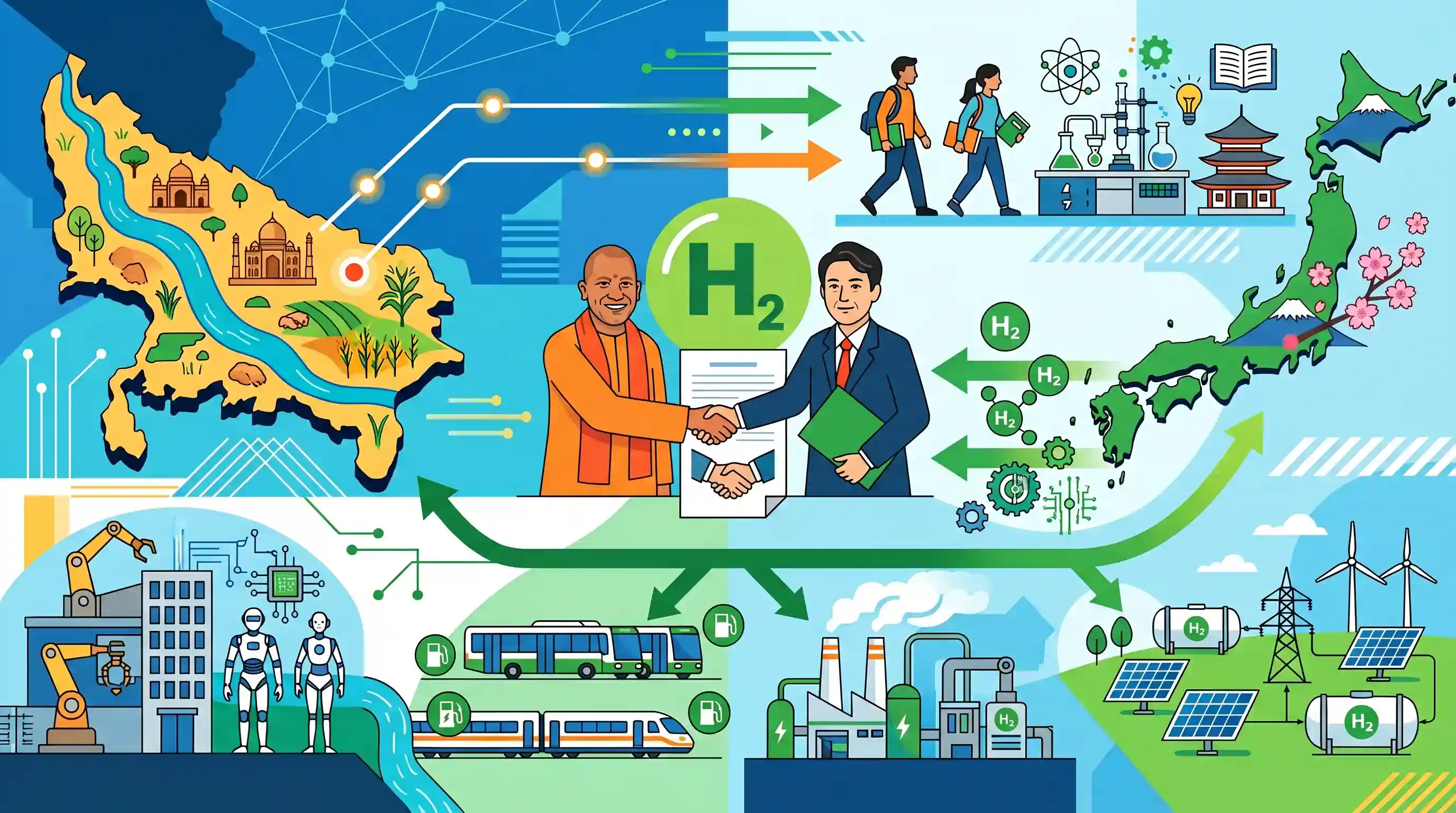
Uttar Pradesh Chief Minister Yogi Adityanath signed a Memorandum of Understanding (MoU) with Japan's Yamanashi prefecture to collaborate on green hydrogen technology. The partnership will enable students from UP to receive advanced training in Japan, while the technology will be integrated into the state's public transport, industry, and energy sectors. Additionally, the UP government announced plans to establish a centre of excellence for robotics. The visit highlights the growing significance of sub-national diplomacy in strengthening India-Japan bilateral ties, facilitating technology transfer, and advancing India's goals for energy self-reliance.
Key Points
- Uttar Pradesh Chief Minister Yogi Adityanath signed an MoU with Japan's Yamanashi prefecture focusing on green hydrogen technology.
- The agreement facilitates advanced training in Japan for students from UP's technical institutions.
- The technology transfer will be implemented in Uttar Pradesh's industry, public transport, and energy sectors.
- UP is also setting up a centre of excellence for robotics as part of its focus on future technologies.
- This engagement exemplifies 'sub-national diplomacy', where state governments directly collaborate with foreign provinces to attract investment and foster technological cooperation.
Important Terms
MoU on green hydrogen technology

A formal agreement between Uttar Pradesh and Japan's Yamanashi prefecture to collaborate on hydrogen production, storage, and application in transport and industry.
UPSC context
GS Paper III: Energy Security and Environment. Tests knowledge of the National Green Hydrogen Mission and international tech-transfer.
Sub-National Diplomacy
The practice of regional or provincial governments (like UP) engaging directly with foreign counterparts to promote trade, investment, and technological exchange.
UPSC context
GS Paper II: International Relations. Focuses on federalism and the decentralization of Indian foreign policy.
Yamanashi Prefecture
A Japanese prefecture and global leader in clean energy, particularly known for its 'Power-to-Gas' hydrogen systems and advanced automation industries.
UPSC context
GS Paper II: Bilateral Relations. Represents a key strategic partner for Indian states in high-tech manufacturing.
FANUC Corporation
A Japanese multinational specializing in robotics and factory automation; its Yamanashi headquarters is a model for UP’s planned Robotics Centre of Excellence.
UPSC context
GS Paper III: Science & Technology. Relevant for Industrial Revolution 4.0 and indigenous manufacturing (Make in India).
Centre of Excellence (CoE)
Specialized hubs (planned for IIT Kanpur and Gorakhpur) dedicated to research, skill development, and industrial application of green hydrogen and robotics.
UPSC context
GS Paper III: Infrastructure and Education. Tests understanding of institutional frameworks for fostering innovation.
Indian Embassy in Japan
The primary diplomatic mission in Tokyo that facilitates G2G (Government-to-Government) and G2B (Government-to-Business) interactions for Indian state delegations.
UPSC context
GS Paper II: International Relations. Role of institutional machinery in managing bilateral economic diplomacy.
Prelims Trap
State governments in India have the constitutional authority to independently negotiate and sign binding international treaties.
Foreign affairs is exclusively a Union Subject (Entry 10, Union List). State-level MoUs (paradiplomacy) require mandatory prior political clearance from the MEA before execution.
Static Concepts Connected
What is the institutional framework for 'Paradiplomacy' in India?
- Union Subject: Foreign affairs, international treaties, and agreements fall exclusively under the Union List (Entries 10 and 14, Seventh Schedule) of the Indian Constitution.
- MEA States Division: Established in 2014, this MEA division coordinates and facilitates external engagements, FDI attraction, and sister-city/province agreements for Indian states.
- Political Clearance: Despite actively pursuing foreign investments, state governments must obtain mandatory prior political clearance from the MEA before signing MoUs with foreign entities.
How does Green Hydrogen differ from Grey and Blue variants?
- Grey Hydrogen: Produced from natural gas using steam methane reforming (SMR) with no carbon capture. It emits significant greenhouse gases.
- Blue Hydrogen: Produced similarly to grey hydrogen from natural gas, but the resulting carbon emissions are captured and stored using CCUS technology.
- Green Hydrogen: Produced by splitting water via electrolysis using strictly renewable electricity (solar or wind), resulting in zero carbon emissions.
Cross-Topic Patterns
Demographic dividend meets tech aging
India-Japan partnerships structurally pair India’s surplus youth workforce needing advanced tech-skilling with Japan’s aging population and capital abundance.
Sub-national FDI and competitive federalism
State-led global roadshows and foreign MoUs reflect competitive federalism, where states bypass traditional union-led bureaucracy to directly attract FDI, tech transfers, and green energy investments.

Expect a GS-2 Mains question in 2026 analyzing the rise of 'paradiplomacy' and the role of MEA's States Division in India's foreign policy.
Linked PYQs · 2
Linked PYQs · 2
- 2019MainsGS2
‘The time has come for India and Japan to build a strong contemporary relationship, one involving global and strategic partnership that will have a great significance for Asia and the world as a whole.’ Comment.
- 2022MainsGS3
Do you think India will meet 50 percent of its energy needs from renewable energy by 2030 ? Justify your answer. How will the shift of subsidies from fossil fuels to renewables help achieve the above objective ? Explain.
