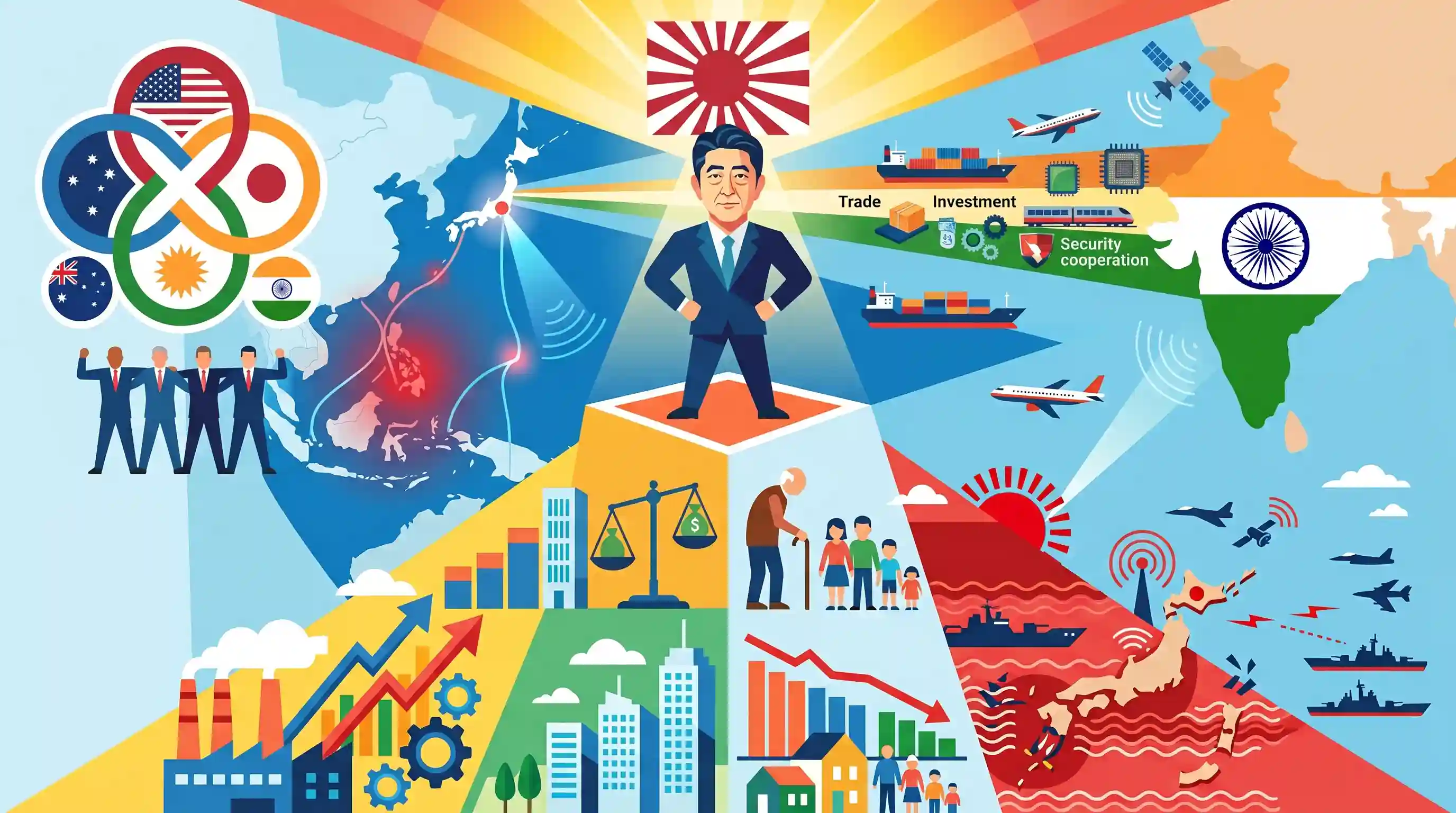
Japan new leadership faces economic demographic and defense challenges
Source:Indian Express ↗
Why It Matters
Japan is one of India's most important strategic partners. Its internal political stability, economic health, and evolving defense posture directly impact the security architecture of the Indo-Pacific and bilateral collaborations in technology, infrastructure, and defense.
Summary
The article discusses the emergence of charismatic new leadership in Japan and the three formidable challenges it faces: navigating economic recovery, addressing an acute demographic crisis, and managing rising geopolitical tensions in the Indo-Pacific. A stable and strategically assertive Japan remains crucial for regional balance and presents opportunities for India to further deepen its strategic and economic partnership within the Quad and bilateral frameworks.
Key Points
- A charismatic new leadership in Japan has taken charge, presenting a fresh political mandate to tackle the nation's deeply entrenched structural problems.
- The primary challenges include revitalizing a stagnant economy navigating away from decades of deflation, and managing a severe demographic crisis caused by an aging and shrinking population.
- On the geopolitical front, Japan must address an increasingly volatile security environment in the Indo-Pacific by strengthening its defense posture and reinforcing ties with the US and regional partners.
- For India, a resilient and strategically proactive Japan is crucial for advancing the vision of a Free and Open Indo-Pacific, strengthening the Quad framework, and deepening bilateral economic and technological ties.
Important Terms
Quad

An informal strategic forum comprising India, the United States, Japan, and Australia, focused on ensuring a free, open, and rules-based Indo-Pacific.
UPSC context
GS II: International Relations. Tests knowledge of maritime security, regional groupings, and India's strategic balancing in the Indo-Pacific.
Indo-Pacific
A geopolitical region spanning the Indian and Pacific Oceans, serving as the central theater for global trade, maritime security, and strategic competition.
UPSC context
GS II: Bilateral & Regional Groupings. Crucial for understanding India's 'Act East' policy and 'FOIP' vision.
Liberal Democratic Party (LDP)
Japan's dominant conservative political party that has held power almost continuously since 1955, shaping the nation's post-war economic and security policies.
UPSC context
GS II: Comparison of Constitutions/Polity. Relevant for understanding the political stability and foreign policy drivers of a key partner.
Special Strategic and Global Partnership
The highest level of diplomatic and strategic engagement between India and Japan, established in 2014 to deepen cooperation in defense, infrastructure, and technology.
UPSC context
GS II: Bilateral Relations. Tests knowledge of institutional frameworks governing India-Japan strategic and economic ties.
Demographic Dividend
The economic growth potential resulting from shifts in a population's age structure, specifically when the working-age population is larger than the dependent population.
UPSC context
GS I: Social Issues; GS III: Economy. Contrasts India's youthful population with Japan's aging demographic crisis.
Official Development Assistance (ODA)
Government aid designed to promote economic development and welfare in developing countries; Japan is India's largest bilateral donor.
UPSC context
GS III: Infrastructure and Economy. Key to India's major infrastructure projects like the Delhi Metro and High-Speed Rail.
Prelims Trap
"The 'Free and Open Indo-Pacific' (FOIP) strategy was first formally introduced by the United States."
Japan's Shinzo Abe actually pioneered the FOIP concept in 2016 at the TICAD summit before it was adopted by the US and the Quad.
Static Concepts Connected
What is Article 9 of Japan's Constitution?
- Renunciation of war: It formally outlaws war as a sovereign right of the nation and as a means to settle international disputes.
- Self-Defense Forces: Japan maintains Self-Defense Forces strictly for defense, though recent constitutional re-interpretations allow limited "collective self-defense" alongside allies like the US.
How do India and Japan cooperate in the Indo-Pacific?
- Vision convergence: Japan's Free and Open Indo-Pacific (FOIP) doctrine strongly mirrors and complements India's Indo-Pacific Oceans Initiative (IPOI).
- SCRI launch: Both co-founded the Supply Chain Resilience Initiative (along with Australia) to de-risk critical manufacturing and tech supply chains from China.
Cross-Topic Patterns
Demographic divergence and migration pacts
Japan's aging crisis directly fuels its Specified Skilled Worker (SSW) agreement with India, linking GS1 population dynamics to GS2 diaspora and economic diplomacy.
Quad's pivot to geoeconomics
The Quad is expanding from maritime security to critical technologies and supply chains, aligning Japanese capital with India's manufacturing and tech self-reliance ambitions.

Expect a Mains GS2 question analyzing how Japan's hyper-aging demographic crisis complements India's skilled-labor diaspora diplomacy.
Linked PYQs · 2
Linked PYQs · 2
- 2019MainsGS2
‘The time has come for India and Japan to build a strong contemporary relationship, one involving global and strategic partnership that will have a great significance for Asia and the world as a whole.’ Comment.
- 2020MainsGS2
Quadrilateral Security Dialogue (Quad)' is transforming itself into a trade bloc from a military alliance, in present times - Discuss.
