Legal Status and Constitutional Nature of Voting Right
Source:The Hindu ↗
Why It Matters
The article provides an in-depth analysis of the legal status of the right to vote in India, highlighting the tension between its classification as a statutory right and its essential role in upholding the basic structure of democracy. It is highly relevant for GS2 Mains (Indian Polity, Elections, RPA, and Judiciary) and Prelims (constitutional provisions like Article 326).
Summary
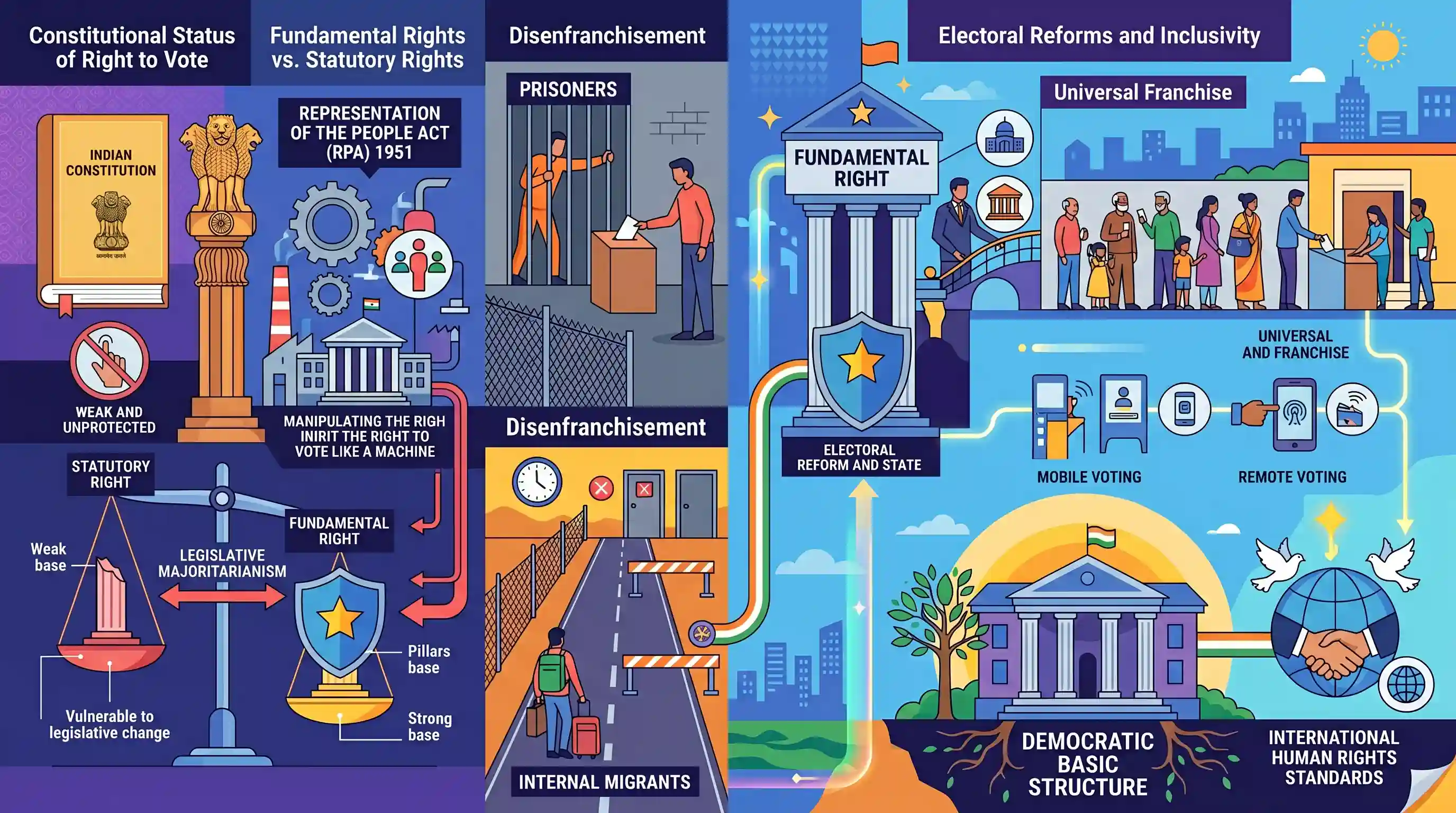
This article analyzes the legal and constitutional status of the right to vote in India, arguing that it should not remain a mere statutory right but must be recognized as a full-fledged Fundamental Right under Part III. Despite Article 326 of the Constitution establishing adult suffrage, the judiciary has historically vacillated, often categorizing it as a statutory right under the Representation of the People Act, 1951. This weak categorization exposes the right to legislative majoritarianism and results in systematic disenfranchisement of vulnerable groups, such as under-trial prisoners and internal migrants. Elevating voting to a Fundamental Right would impose a positive obligation on the state to proactively facilitate universal franchise, align Indian jurisprudence with international human rights standards, and secure the democratic basic structure.
Key Points
- The Legal Contradiction: While the Supreme Court in 'Jyoti Basu v. Debi Ghosal' (1982) and 'Kuldip Nayar v. Union of India' (2006) held the right to vote to be a pure statutory right, in 'PUCL v. Union of India' (2003), it recognized the act of voting as an expression of speech protected under Article 19(1)(a). This creates a legal paradox where the physical act of voting is a fundamental right, but the entitlement to do so is merely statutory.
- Constituent Assembly's Original Intent: The Sub-Committee on Fundamental Rights originally recommended placing universal adult suffrage in the list of Fundamental Rights under Part III. However, due to administrative and logistical constraints of conducting elections in a newly independent, highly illiterate nation, the Advisory Committee relocated it to Article 326 (Part XV), intending it to be a practical deferral rather than a dilution of its core democratic value.
- Risks of Statutory Status: Because statutory rights can be amended or restricted by a simple majority in Parliament, the right to vote remains vulnerable to majoritarian politics. A government with a brute majority could theoretically introduce qualification criteria (like tax brackets, property, or education) that disenfranchise specific sections of society, undermining the 'democratic' basic structure of the Constitution.
- Arbitrary Disenfranchisement of Prisoners: Section 62(5) of the Representation of the People Act, 1951, bars anyone in prison or police custody from voting. This leads to a severe anomaly where under-trials (who make up the majority of prisoners and are presumed innocent) are disenfranchised, while convicted criminals released on bail are allowed to vote. Elevating voting to a Fundamental Right would subject such restrictions to strict judicial scrutiny.
- Exclusion of Internal Migrants: Over 140 million domestic migrant workers are practically disenfranchised as they cannot travel back to their home constituencies to vote. Recognizing voting as a Fundamental Right would place a positive duty on the State and the Election Commission of India (ECI) to implement remote voting, postal ballots, or digital mechanisms to ensure their participation.
- Alignment with International Norms: Major international frameworks, including the Universal Declaration of Human Rights (UDHR) (Article 21) and the International Covenant on Civil and Political Rights (ICCPR) (Article 25), define the right to vote as a fundamental human right. India is a signatory to both, necessitating an upgrade in domestic legal status.
Important Terms
Representation of the People Act, 1951

A key parliamentary statute in India regulating the actual conduct of elections, detailing candidate qualifications and disqualifications, corrupt practices, electoral offences, and dispute resolution mechanisms.
UPSC context
GS Paper II (Polity); tests the statutory framework of democratic elections, disqualifications, and political accountability.
Representation of the People Act, 1950
A parliamentary legislation governing the pre-election framework, specifically regulating the allocation of legislative seats, delimitation of constituencies, voter qualifications, and the preparation of electoral rolls.
UPSC context
GS Paper II (Polity); tests knowledge of constituency delimitation, seat allocation, and pre-election administration.
Election Commission of India
An independent constitutional body established under Article 324, responsible for superintending, directing, and conducting free and fair elections to Parliament, State Legislatures, and top offices.
UPSC context
GS Paper II (Constitutional Bodies); tests electoral integrity, independent powers, and reform initiatives.
International Covenant on Civil and Political Rights (ICCPR)
A multilateral UN treaty committed to protecting global civil and political rights, including the right to life, freedom of expression, assembly, and political participation.
UPSC context
GS Paper II (International Relations); tests India's international treaty alignments and global human rights benchmarks.
Constituent Assembly
The sovereign body established in 1946 to draft the Indian Constitution, framing the nation's democratic values, fundamental rights, and electoral structures.
UPSC context
GS Paper II (Polity & History); tests historical constitutional debates on adult franchise and rights.
Prelims Trap
All persons deprived of physical liberty in India, whether convicted, under-trial, or under preventive detention, are equally barred from voting.
Section 62(5) of the RPA 1951 explicitly exempts persons under preventive detention, allowing them to vote via postal ballot, unlike under-trials or convicts in prison.
Static Concepts Connected
What is the constitutional basis of adult suffrage and its disqualifications under Article 326?
- Adult suffrage: Article 326 guarantees the right to vote for Lok Sabha and Assembly elections to every citizen of age.
- Age reduction: The 61st Amendment (1988) lowered the minimum voting age from 21 to 18 years.
- Constitutional bars: Disqualifications are restricted to non-residence, unsoundness of mind, crime, or corrupt/illegal practices under law.
How does Section 62(5) of the RPA 1951 distinguish voting rights in custody?
- General custody ban: It prohibits anyone confined in prison (convicts and under-trials alike) or police custody from voting.
- Bail anomaly: Convicts released on bail can vote, while under-trials (presumed innocent but in custody) cannot.
- Preventive detention exemption: It explicitly permits individuals under preventive detention to vote via postal ballots.
Cross-Topic Patterns
Electoral inclusion and internal migration trends
The intersection of Article 19(1)(d) (freedom of movement) and Article 326 reveals structural disenfranchisement of internal migrants, driving ECI's push for Remote Voting Machines.
Basic Structure and majoritarian legislative power
If the right to vote remains purely statutory, a simple parliamentary majority could alter franchise criteria, threatening the basic structure's core democratic pillar.

Expect a 2026 question testing Article 326 voting exclusions vs Section 62(5) RPA 1951 exceptions for preventive detention.
Linked PYQs · 3
Linked PYQs · 3
- 2017PrelimsGS1
Right to vote and to be elected in India is a
- 2024MainsGS2
Examine the need for electoral reforms as suggested by various committees with particular reference to "one nation one election" principle.
- 2020MainsGS2
There is a need for simplification of procedure for disqualification of persons found guilty of corrupt practices under the Representation of Peoples Act". Comment.
