French Snap Elections Result in Hung Parliament and Tactical Voting
Source:Indian Express ↗
Why It Matters
France is a critical strategic partner for India and a leading power in the European Union. Understanding its semi-presidential constitutional framework, unique two-round electoral system, and current political instability provides valuable comparative insights for UPSC aspirants, especially regarding constitutional design, electoral behavior, and global ideological shifts.
Summary
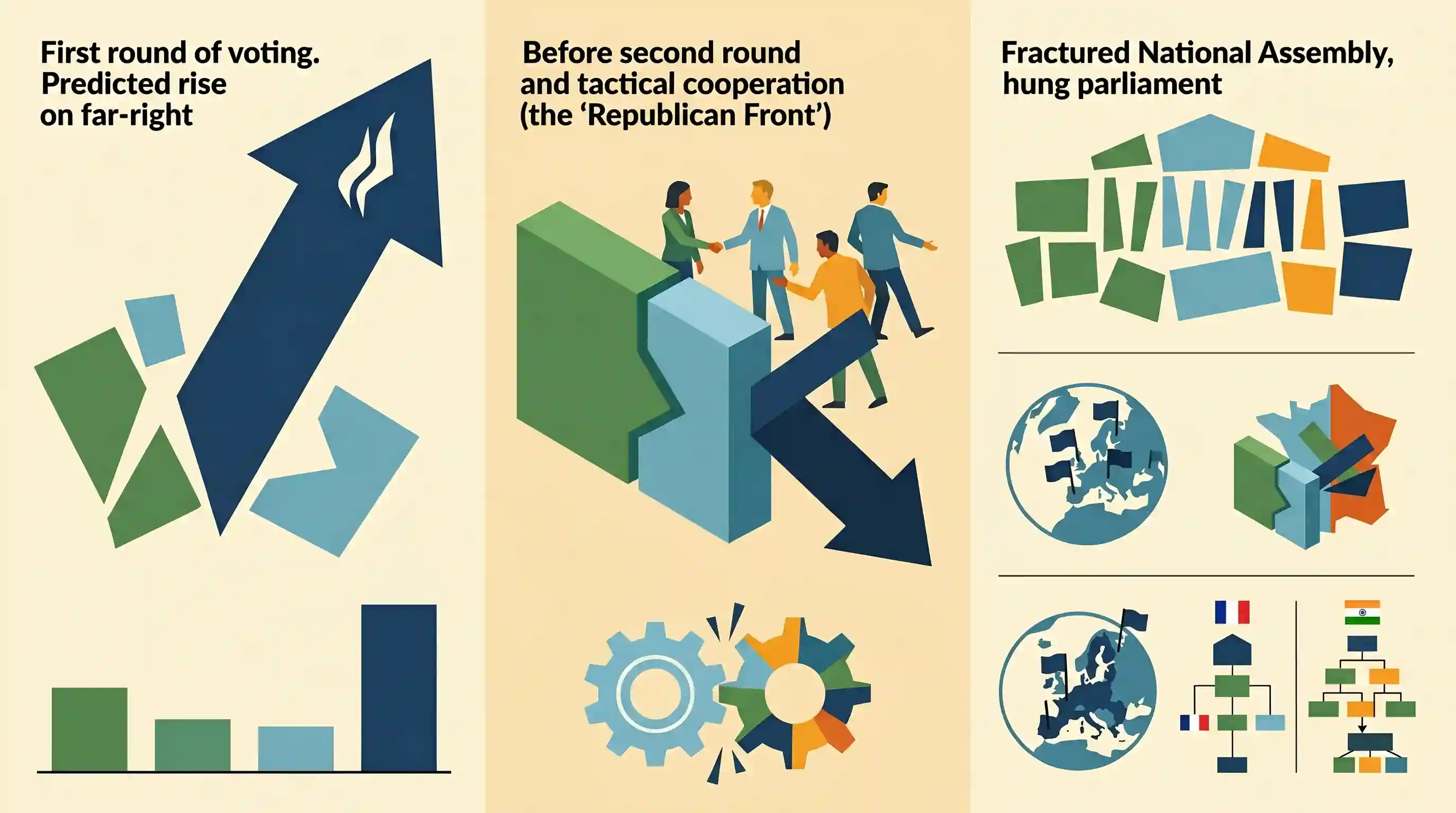
The article reflects on the dramatic turnaround during the French snap parliamentary elections, illustrating the adage that 'a week is a long time in politics'. In the first round of voting, the far-right National Rally (RN) seemed positioned for a historic victory. However, within a week, the second round delivered a surprising mandate: a hastily formed left-wing coalition, the New Popular Front (NFP), emerged as the largest bloc, followed by President Emmanuel Macron's centrist alliance, relegating the RN to third place. This outcome was primarily driven by the 'Republican Front'—a concerted effort involving tactical candidate withdrawals to prevent a far-right majority. The unprecedented result leaves France with a deeply fractured National Assembly and a hung parliament, posing significant challenges for government formation, potential political 'cohabitation', and the future stability of European politics amidst the rise of nationalism.
Key Points
- President Emmanuel Macron called snap legislative elections following his party's poor performance in the European Parliament elections, creating significant political uncertainty.
- The French two-round electoral system allowed for the revival of the 'Republican Front', a tactical voting strategy where left and centrist candidates withdrew to consolidate the anti-far-right vote.
- Despite leading in the first round, the far-right National Rally (RN) was pushed to third place in the final runoff, with the left-wing New Popular Front emerging as the largest bloc.
- The election resulted in a hung parliament, raising the prospect of 'cohabitation'—a scenario where the President and the Prime Minister belong to opposing political blocs.
- The dramatic shift between the two voting rounds exemplifies the phrase 'a week is a long time in politics' and highlights the ongoing struggle against right-wing sovereign nationalism in Europe.
Important Terms
National Assembly (France)

The 577-member lower house of the French Parliament. It can dismiss the government via a no-confidence motion, making it the primary site of legislative power and political contestation.
UPSC context
GS Paper II (Comparison of Constitutional Schemes): Contrasting India's parliamentary executive with France's semi-presidential model and legislative-executive relations.
Cohabitation
A situation in semi-presidential systems where the President and Prime Minister belong to opposing political camps, forcing a power-sharing arrangement between the Head of State and Government.
UPSC context
GS Paper II (Polity): Understanding divided government and executive dualism, crucial for comparing different democratic frameworks.
New Popular Front (NFP)
A broad left-wing electoral alliance formed in 2024 (including Socialists, Greens, and the hard-left France Unbowed) to prevent a far-right majority in the French legislature.
UPSC context
GS Paper II (Electoral Politics): Studying the role of "ideological vs. tactical" coalitions in multi-party systems and their governance challenges.
National Rally (RN)
A right-wing populist and nationalist party in France. Formerly the National Front, it advocates for "national preference," strict anti-immigration measures, and significant EU-level reforms.
UPSC context
GS Paper II (International Relations): Analyzing the global rise of right-wing populism and its implications for international diplomacy and regional integration.
European Parliament
The directly elected legislative assembly of the European Union. Its 2024 election results, marked by a far-right surge, served as the catalyst for the French snap elections.
UPSC context
GS Paper II (International Institutions): Evaluating how supranational electoral outcomes influence national politics and sovereignty within the EU.
Republican Front (Front Républicain)
An electoral tactic where mainstream French parties unite or withdraw candidates in second-round runoffs to prevent the far-right from securing a parliamentary majority.
UPSC context
GS Paper II (Electoral Systems): Examining tactical voting and "cordon sanitaire" strategies in majoritarian systems compared to India's First-Past-The-Post.
Prelims Trap
"Like the Indian President, the French President dissolves the lower house solely on the binding advice of the Prime Minister."
Article 12 of the French Constitution gives the President discretionary power to dissolve the National Assembly, unlike the Indian President (Article 85).
Static Concepts Connected
What is 'Cohabitation' in the French semi-presidential system?
- Semi-Presidential: Combines a directly elected President with a Prime Minister who is responsible to the legislature.
- Cohabitation: Occurs when the President and the parliamentary majority belong to opposing political blocs, forcing them to govern together.
- Power division: In cohabitation, the President typically controls foreign policy and defense, while the PM manages domestic affairs.
How does the French Two-Round voting system work?
- Round One: A candidate wins outright if they secure an absolute majority (over 50%) and at least 25% of registered voters' support.
- Round Two: If no outright winner emerges, candidates securing at least 12.5% of registered votes advance to a run-off where the highest vote-getter wins.
- Contrast with India: Unlike India's FPTP, the two-round system allows parties to field multiple candidates initially, then tactically withdraw to pool votes in the second round.
Cross-Topic Patterns
Euroscepticism & the rightward shift
France's right-wing RN surge connects to a broader GS-2 IR theme of Euroscepticism, anti-immigration policies, and protectionism sweeping post-Cold War Europe (e.g., Italy, Brexit).
Coalition politics & tactical voting
The French 'Republican Front' mirrors Indian electoral dynamics where fragmented opposition parties forge tactical pre/post-poll alliances to consolidate votes against a dominant national force.

GS2 Mains 2026 is highly likely to feature a 'Comparison of Constitutions' question contrasting executive deadlock resolution in India vs. France.
Linked PYQs · 3
Linked PYQs · 3
- 2022MainsGS2
Critically examine the procedures through which the Presidents of India and France are elected.
- 2019MainsGS2
What can France learn from the Indian Constitution's approach to secularism?
- 2025MainsGS2
"With the waning of globalization, post-Cold War world is becoming a site of sovereign nationalism.” Elucidate.
