Global protectionism impact on macroeconomic stability and trade
Source:Indian Express ↗
Why It Matters
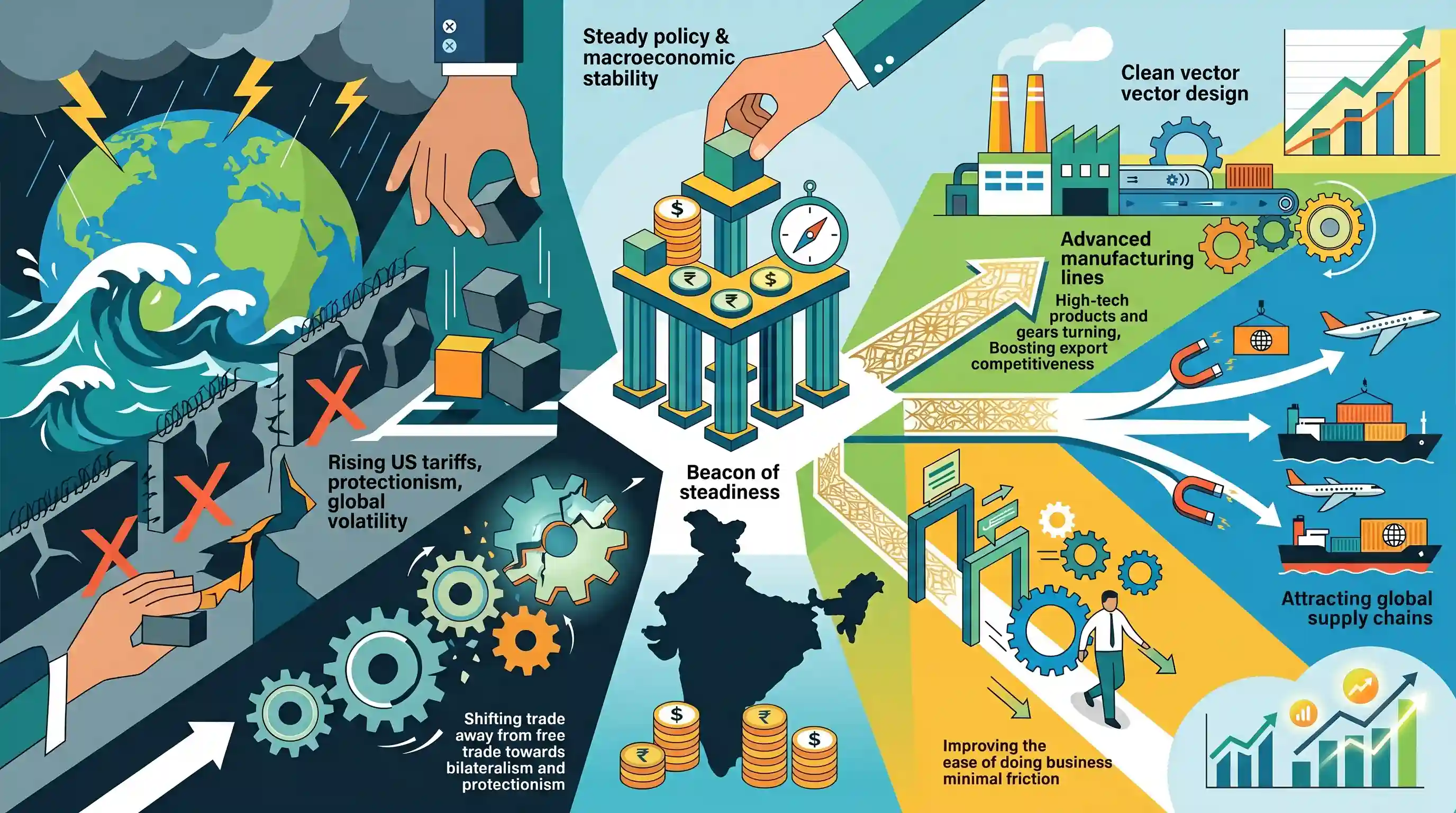
The piece directly addresses a core GS3 theme: how global shifts towards protectionism (e.g., US tariffs) and economic volatility impact India's macroeconomic stability and trade strategy. It provides key arguments on how India should respond through domestic reforms rather than retaliatory tariffs.
Summary
The article discusses the economic implications of rising US tariffs and global market volatility for India. It cautions against reactionary protectionism, arguing that India must instead maintain a steady policy approach focused on macroeconomic stability. As the world shifts away from free trade towards bilateralism and protectionism, the piece emphasizes the importance of structural reforms to boost export competitiveness. By enhancing its domestic manufacturing capabilities and improving the ease of doing business, India can better position itself to attract global supply chains and navigate the turbulent external economic environment without resorting to restrictive trade practices.
Key Points
- The global economic environment is experiencing heightened volatility due to geopolitical friction and a rise in protectionist policies, particularly through the imposition of US tariffs.
- A global shift away from free trade and multilateralism poses a challenge to emerging economies that rely on export-led growth, increasing the risks of supply chain disruptions and imported inflation.
- In response to these headwinds, India is advised to maintain a 'steady hand' by avoiding knee-jerk retaliatory tariffs, which could harm domestic manufacturers reliant on imported inputs.
- The focus must remain on ensuring robust macroeconomic stability through prudent fiscal and monetary management to absorb external shocks.
- India should capitalize on the 'China-Plus-One' strategy by deepening structural reforms, improving the ease of doing business, and enhancing export competitiveness rather than turning inward.
Important Terms
World Trade Organization (WTO)

The global international organization that sets rules for trade between nations, provides a forum for negotiations, and resolves trade disputes between its 164 member countries.
UPSC context
GS2 (International Institutions) & GS3 (Liberalization). Tests knowledge of multilateral trade regimes and India's interests in global trade.
Protectionism
Economic policy of shielding domestic industries from foreign competition through methods such as tariffs, import quotas, and government regulations to protect local jobs and businesses.
UPSC context
GS3 (Indian Economy). Relevant for questions on trade wars, de-globalization, and the impact of global volatility on India.
Macroeconomic Stability
A state where an economy has low inflation, stable exchange rates, manageable fiscal deficits, and sustainable growth, minimizing its vulnerability to external shocks.
UPSC context
GS3 (Indian Economy). Essential for discussing fiscal and monetary policy, inflation management, and resilience to global market fluctuations.
Tariffs
Taxes or duties imposed by a government on imported goods, increasing their cost to protect domestic industries or generate revenue.
UPSC context
GS3 (Economic Development). Central to trade policy analysis, bilateral trade agreements, and their impact on domestic manufacturing.
Global Value Chains (GVCs)
Production networks where different stages of manufacturing (design, assembly, marketing) are spread across multiple countries to capitalize on local efficiencies and comparative advantages.
UPSC context
GS3 (Industry/Exports). Tests India’s manufacturing competitiveness, the China+1 strategy, and participation in the global production landscape.
Structural Reforms
Long-term policy changes aimed at improving an economy's fundamental organization (e.g., labor laws, banking, or tax systems) to enhance productivity and efficiency.
UPSC context
GS3 (Growth and Development). Focuses on removing economic bottlenecks and improving the ease of doing business to drive growth.
Prelims Trap
"Imposing higher import tariffs inherently boosts domestic manufacturing and export competitiveness."
Higher tariffs on intermediate inputs increase the cost of production for domestic industries, ultimately reducing their global export competitiveness and fueling imported inflation.
Static Concepts Connected
What are the primary trade remedy measures permitted under the WTO?
- Anti-dumping duties: Levied when foreign companies sell goods below fair market value to protect domestic players.
- Countervailing duties: Applied to offset price-distorting subsidies provided by foreign governments to their exporters.
- Safeguard measures: Temporary restriction of imports to protect a specific domestic industry from an unforeseen import surge.
How does the Real Effective Exchange Rate (REER) relate to export competitiveness?
- NEER vs REER: NEER is the unadjusted weighted average rate; REER adjusts NEER for inflation differentials between trading partners.
- Export Competitiveness: An appreciating REER makes domestic goods more expensive abroad, mathematically reducing a nation's export competitiveness.
- Imported Inflation: While currency depreciation helps exports, it makes imported inputs costlier, harming import-dependent domestic manufacturing.
Cross-Topic Patterns
PLI schemes & Global Value Chains
Rising Western protectionism tests India's PLI schemes, as integrating into Global Value Chains requires cheap intermediate imports, not retaliatory tariff walls.
Forex reserves & Imported Inflation
Global trade volatility often triggers capital flight, forcing the RBI to use forex reserves to manage rupee depreciation and counter imported inflation.

Expect a 2026 GS3 Mains question linking US protectionism to India's 'China-Plus-One' strategy and the dilemma of tariffs vs GVC integration.
Linked PYQs · 2
Linked PYQs · 2
- 2025MainsGS3
What are the challenges before the Indian economy when the world is moving away from free trade and multilateralism to protectionism and bilateralism? How can these challenges be met?
- 2018MainsGS3
How would the recent phenomena of protectionism and currency manipulations in world trade affect macroeconomic stability of India?
