Defence Minister highlights cyber threats in era of grey zone warfare
Source:The Hindu ↗
Why It Matters
Provides an authoritative view on India's defence modernization, the conceptual shift towards multi-domain and grey-zone warfare, and highlights the specific technological threats (drones, AI, cyber) crucial for GS3 Internal Security and Science & Technology.
Summary
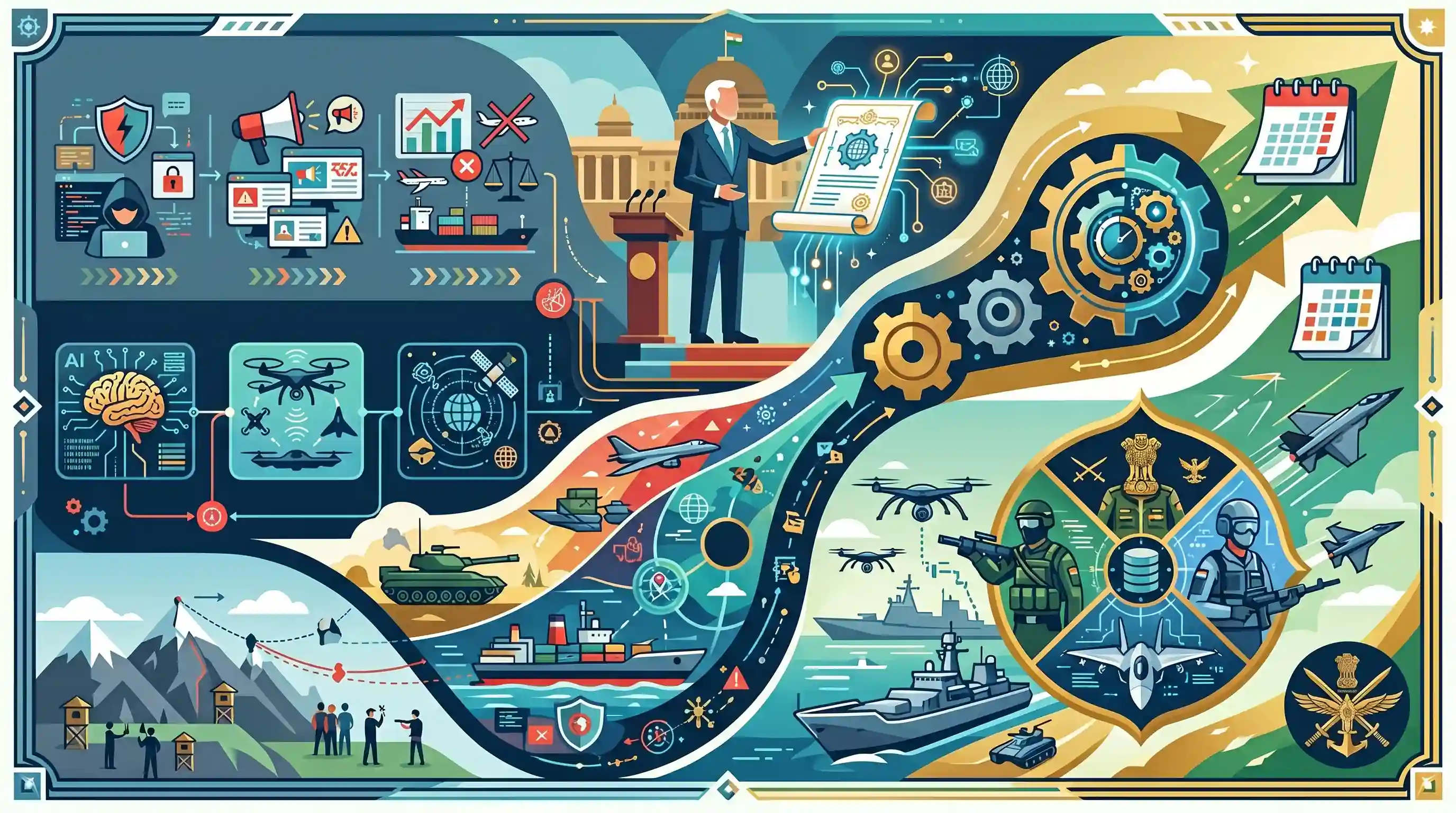
Addressing the Defence Services Staff College, Defence Minister Rajnath Singh highlighted the evolving nature of global conflict, marked by 'grey zone' warfare such as cyberattacks, disinformation, and the weaponisation of trade. He stressed that disruptive technologies—including AI, dronery, and space-based intelligence—are shifting warfare from traditional domains to multi-domain environments. To address these shifts and persistent border threats, the Ministry of Defence has declared 2025 the 'Year of Reforms,' aiming to modernize the Indian Armed Forces into a technologically-advanced, integrated combat force.
Key Points
- Defence Minister Rajnath Singh warned that the weaponisation of trade, finance, and monopolies in disruptive technologies are leading to a decline in global institutions.
- He highlighted the rise of 'grey zone' warfare, where cyberattacks, disinformation campaigns, and economic warfare are used to achieve politico-military aims without direct combat.
- Emerging technologies like AI, robotics, drones, and quantum blockchains are revolutionizing deterrence and shifting warfare to space and cyberspace.
- The proliferation of Low Earth Orbit (LEO) space capacities is transforming military intelligence through continuous surveillance and targeting.
- The Ministry of Defence has designated 2025 as the 'Year of Reforms' to transform the armed forces into a technologically-advanced, combat-ready force capable of multi-domain integrated operations.
- Officers were urged to become critical thinkers to navigate the challenges of proxy wars, terrorism on India's borders, and a rapidly changing geopolitical landscape.
Important Terms
Grey Zone Warfare

Conflict operating in the ambiguous space between peace and war, using unconventional tactics like cyberattacks and disinformation to achieve strategic goals without triggering a full-scale military response.
UPSC context
GS Paper III (Internal Security); relevant for understanding unconventional threats from state and non-state actors and challenges to traditional deterrence.
Year of Reforms (2025)
A strategic initiative by India's Ministry of Defence to accelerate military modernization, emphasizing jointness, emerging technologies (AI, robotics), and the establishment of Integrated Theatre Commands.
UPSC context
GS Paper III (Security); tests knowledge of contemporary defence policy, administrative restructuring, and indigenous technological integration in the armed forces.
Defence Services Staff College (DSSC)
A tri-services training institution in Wellington, Tamil Nadu, that prepares middle-level officers from the Army, Navy, Air Force, and Civil Services for high-level command and staff appointments.
UPSC context
GS Paper III (Security/Institutional Framework); significant for understanding India's military education and the promotion of 'jointmanship' among the services.
Multi-domain Operations (MDO)
A modern military strategy that integrates capabilities across land, sea, air, cyber, and space domains to create a synergistic effect and respond to complex, technology-driven threats.
UPSC context
GS Paper III (Science & Tech/Security); tests understanding of the evolving nature of warfare and the transition from platform-centric to network-centric operations.
Integrated Theatre Commands
A proposed organizational structure where all assets of the Army, Navy, and Air Force in a specific geographical region are placed under a single unified commander.
UPSC context
GS Paper III (Internal Security); a critical reform topic regarding higher defence management and the role of the Chief of Defence Staff (CDS).
Prelims Trap
"Grey zone warfare refers exclusively to non-state actors using cyberattacks and proxies against sovereign states."
Grey zone tactics are extensively employed by STATE actors (like China or Russia) to achieve geopolitical objectives while remaining just below the threshold of a declared, conventional armed conflict.
Static Concepts Connected
What are the defining characteristics of 'Grey Zone' warfare?
- Below threshold: Operations deliberately stay below the level of conventional armed conflict to avoid triggering massive military retaliation.
- Strategic ambiguity: Tactics are designed to obscure the identity or intentions of the attacker, blurring the lines between peace and war.
- Multi-domain approach: Simultaneously utilizes cyberattacks, economic coercion, disinformation campaigns, and proxy militias rather than direct kinetic force.
Why are Low Earth Orbit (LEO) satellites increasingly critical for modern military intelligence?
- Low latency: Proximity to Earth (altitude of 160-2000 km) ensures minimal signal delay, crucial for real-time targeting and drone operations.
- High resolution: Closer orbits enable superior optical and synthetic aperture radar (SAR) imaging for detailed, continuous tactical surveillance.
- Constellation resilience: Deploying large swarms (constellations) of cheaper LEO satellites ensures systemic survival even if individual nodes are attacked by adversaries.
Cross-Topic Patterns
Trade weaponisation & global institutions
Linking GS3 Security with GS2 IR, using economic coercion, financial bans, and tech export controls represents grey zone tactics that bypass traditional conflict and accelerate the decline of multilateral institutions like the WTO.
Dual-use LEO constellations
The overlap of civilian telecom satellite networks and military surveillance in LEO links GS3 Space Technology to emerging security debates regarding international space law and outer space weaponisation.

Expect a 2026 GS3 Mains question linking India's 'Year of Reforms 2025' and Theatre Commands to multi-domain 'grey zone' warfare threats.
Linked PYQs · 4
Linked PYQs · 4
- 2021MainsGS3
Keeping in view India's internal security, analyse the impact of cross-border cyber attacks. Also discuss defensive measures against these sophisticated attacks.
- 2023MainsGS3
The use of unmanned aerial vehicles (UAVs) by our adversaries across the borders to ferry arms/ammunitions, drugs, etc., is a serious threat to the internal security. Comment on the measures being taken to tackle this threat.
- 2017MainsGS3
Discuss the potential threats of Cyber attack and the security framework to prevent it.
- 2020MainsGS3
Discuss different types of cyber crimes and measures required to be taken to fight the menace.
