M23 Militia Expands Control in Eastern Democratic Republic of Congo
Source:The Hindu ↗
Why It Matters
The conflict in eastern DRC is a recurring theme in UPSC Prelims (Places in News like Kivu and Ituri) and highlights global resource security issues (DRC produces over 70% of the world's cobalt, crucial for EV batteries).
Summary
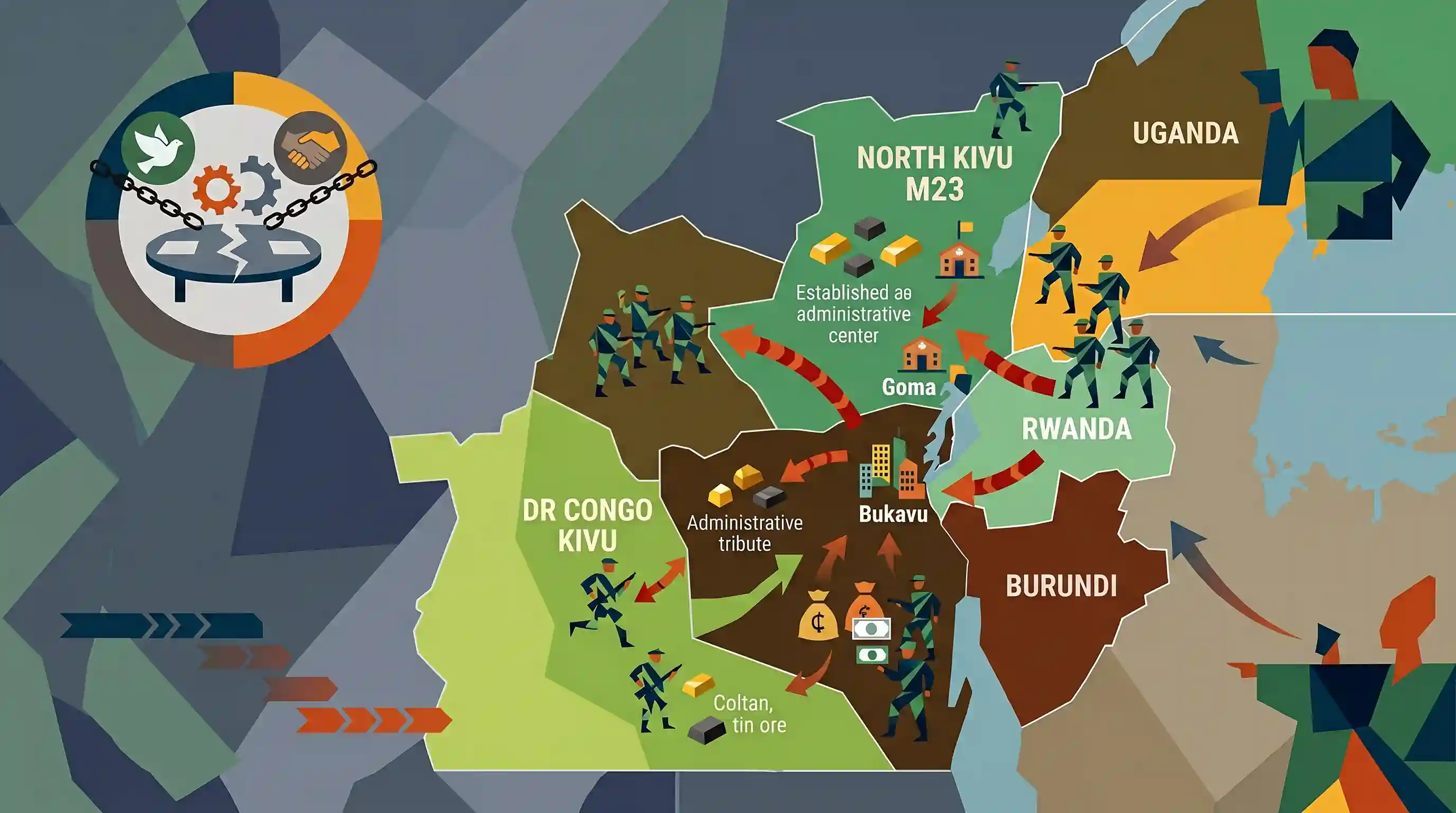
The M23 militia, allegedly backed by Rwanda, has captured vast swathes of eastern DR Congo, including the North and South Kivu provinces. As regional diplomacy—notably the Luanda peace process—stalls, M23 is establishing parallel administrative and tax structures in resource-rich areas near Goma and Bukavu. The conflict highlights the persistent instability and resource-driven geopolitical tensions in Central Africa.
Key Points
- The M23 militia has seized significant territory in the eastern Democratic Republic of Congo, specifically in the North and South Kivu provinces.
- M23 is allegedly backed by neighboring Rwanda, though Kigali denies these claims, complicating regional diplomatic efforts.
- Diplomatic initiatives, such as the Luanda peace process brokered by Angola, have stalled, allowing the militia to entrench its control.
- M23 is establishing a parallel state in the resource-rich region by appointing local leaders, collecting taxes, and setting up its own justice and security mechanisms.
- The conflict threatens to encircle major cities like Goma and Bukavu, exacerbating the humanitarian crisis in the mineral-rich eastern DRC.
Important Terms
M23 (March 23 Movement)

A Rwandan-backed rebel militia in eastern DR Congo, primarily ethnic Tutsi; it seeks territorial control and claims to protect minorities against Hutu-led groups like the FDLR.
UPSC context
GS Paper-II (International Relations); tests understanding of non-state actors in regional conflicts and their impact on global security.
Luanda Process
An African Union-backed peace initiative mediated by Angola aimed at de-escalating tensions between DR Congo and Rwanda and normalising regional diplomatic relations.
UPSC context
GS Paper-II (IR); highlights the role of regional mediation and diplomatic frameworks in resolving international crises.
North and South Kivu
Strategic, mineral-rich provinces in eastern DR Congo bordering Rwanda; they are the epicentre of long-standing conflict, massive internal displacement, and resource-driven insurgencies.
UPSC context
GS Paper-I (Geography/Places in News); important for mapping conflict zones and understanding the 'resource curse' in Africa.
Conflict Minerals (3TGs)
Natural resources like Coltan, Cobalt, and Gold mined in eastern DRC; their illegal extraction and trade finance armed groups and perpetuate regional instability.
UPSC context
GS Paper-I (Resource Geography) & Paper-III (Security); links global electronics supply chains to regional security and ethical sourcing.
Goma
The strategic capital of North Kivu province and a key humanitarian hub; its proximity to Rwanda makes it a focal point of regional military and political power.
UPSC context
GS Paper-I (Geography); frequently appears in 'Places in News' due to its geopolitical, humanitarian, and economic significance.
FDLR (Democratic Forces for the Liberation of Rwanda)
A Hutu-led rebel group based in eastern DRC, formed by remnants of perpetrators of the 1994 Rwandan genocide; its presence is a major flashpoint for Rwandan intervention.
UPSC context
GS Paper-II (IR); critical for understanding the ethnic and historical roots of the Great Lakes region conflict.
Prelims Trap
M23 is an armed rebel militia fighting to overthrow the government in Rwanda.
The M23 operates in, and holds territory in, the eastern Democratic Republic of Congo (DRC). While allegedly backed by Rwanda, it is not fighting the Rwandan government.
Static Concepts Connected
What makes Cobalt a critical mineral and where is it geographically concentrated?
- Industrial usage: It is heavily utilized in lithium-ion batteries, making it essential for electric vehicles (EVs) and renewable energy storage systems.
- Geographic concentration: Extraction is highly monopolized by the Democratic Republic of Congo, which produces roughly 70-75% of the world's supply.
- Processing monopoly: While mined in the DRC, over 70% of global cobalt is refined and processed in China, creating geopolitical supply chain vulnerabilities.
Which countries and features comprise the African Great Lakes region?
- Surrounding nations: The core countries surrounding the lakes are DRC, Burundi, Rwanda, Uganda, Kenya, and Tanzania.
- Major Lakes: Major lakes include Lake Victoria, Tanganyika, Malawi, Turkana, Albert, Kivu, and Edward. Most are deep, rift valley lakes.
- Tectonic origin: The lakes were formed by the tectonic activity of the East African Rift system, where the African plate is splitting.
Cross-Topic Patterns
Kivu conflict & India's EV push
Instability in DRC directly threatens India's critical mineral security (e.g., KABIL's overseas acquisition mandate) and its transition to EVs, linking African localized conflicts to India's domestic climate targets.
African peace agreements in Prelims
UPSC tests regional agreements. The Luanda Process (DRC-Rwanda) sits alongside the Pretoria Agreement (Ethiopia-Tigray) and Jeddah talks (Sudan) as highly testable match-the-following pairs for International Relations.

A multi-statement 2026 Prelims question will likely combine DRC's Kivu region, the M23 militia, and global cobalt supply chain dominance.
Linked PYQs · 2
Linked PYQs · 2
- 2023PrelimsGS1
Consider the following pairs: Regions often mentioned in news Reason for being in news 1. North Kivu and Ituri : War between Armenia and Azerbaijan 2. Nagorno-Karabakh : Insurgency in Mozambique 3. Kherson and Zaporizhzhia : Dispute between Israel and Lebanon How many of the above pairs are correctly matched?
- 2023PrelimsGS1
About three-fourths of world's cobalt, a metal required for the manufacture of batteries for electric motor vehicles, is produced by
