Desert National Park Begins Release of Captive Bred GIBs
Source:tripurastarnews ↗
Why It Matters
Highly relevant for RPSC RAS Prelims regarding Rajasthan's state bird conservation, endangered species management, and key protected areas like Desert National Park.
Summary
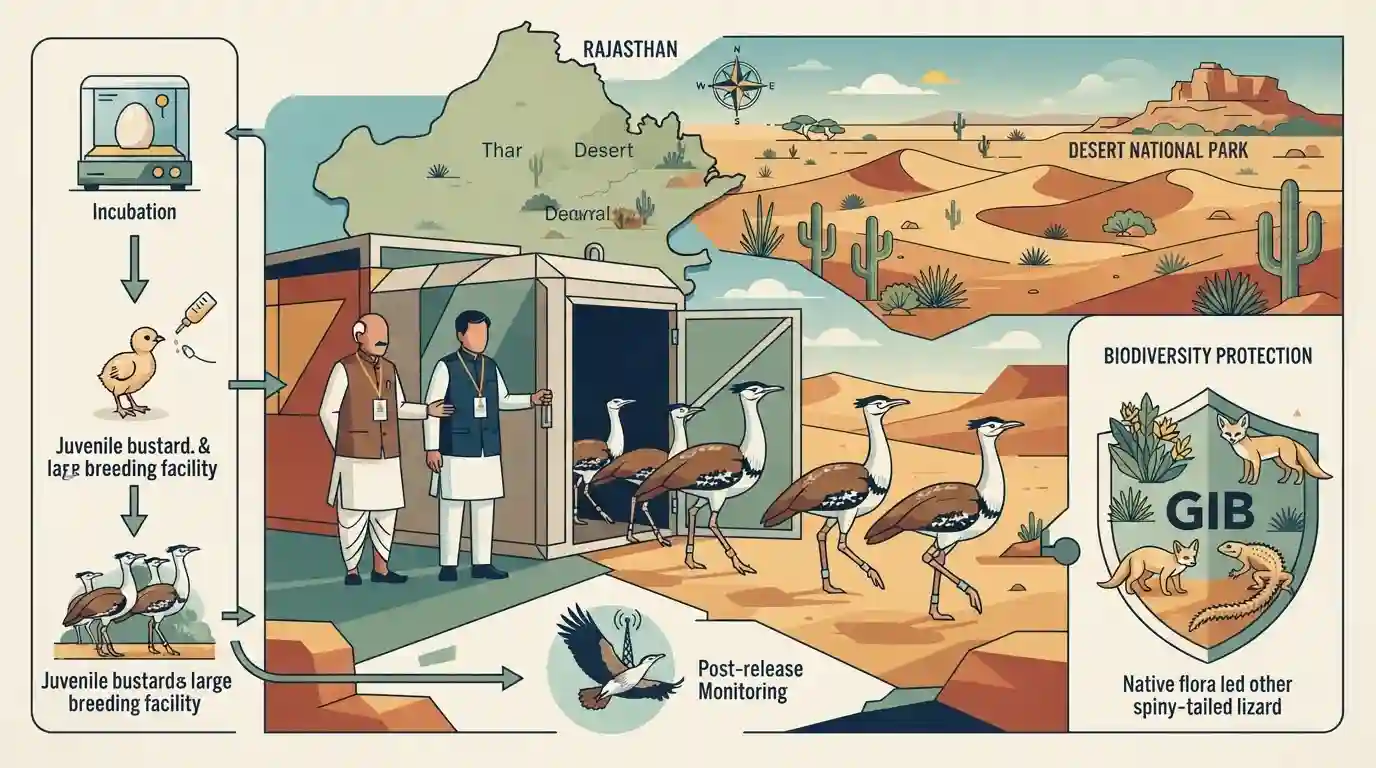
The Union Environment Minister and the Chief Minister of Rajasthan have initiated the release of captive-bred Great Indian Bustards into the wild at the Desert National Park, marking a crucial culmination of years of conservation and species recovery efforts for Rajasthan's critically endangered state bird.
Key Points
- Union Environment Minister and the Chief Minister of Rajasthan initiated the process of releasing captive-bred Great Indian Bustards (GIBs) into the wild at the Desert National Park.
- This marks a major milestone after years of dedicated captive breeding efforts to save the critically endangered State Bird of Rajasthan from the brink of extinction.
- Desert National Park, spread across Jaisalmer and Barmer districts, is the primary natural habitat and stronghold for the Great Indian Bustard in India.
Important Terms
Great Indian Bustard Species Recovery Programme

Rajasthan's state bird and a critically endangered species, subject to a dedicated species recovery and captive-breeding programme in the Thar Desert.
UPSC context
RPSC Paper 3 / Environment & Biodiversity: Crucial for questions on endangered species conservation and state wildlife projects in Rajasthan.
Desert National Park
A premier protected area located in Jaisalmer and Barmer districts, known for arid Thar Desert terrain and as the primary natural habitat and breeding ground for the Great Indian Bustard.
UPSC context
RPSC Rajasthan Geography & Environment: Tests knowledge of key protected wildlife areas, national parks, and endemic biodiversity in Rajasthan.
Prelims Trap
captive-bred Great Indian Bustards released into the wild
Aspirants often assume captive breeding means the GIB is no longer critically endangered, missing that wild release is merely the first phase of population stabilization.
Static Concepts Connected
What are the key ecological features and protected status of the Great Indian Bustard (GIB)?
- IUCN Status: IUCN Status: Listed as Critically Endangered, facing extremely high risk of extinction in the wild.
- State Bird: State Bird: Designated as the State Bird of Rajasthan, primarily inhabiting arid grasslands and scrublands.
- Legal Protection: Legal Protection: Included in Schedule I of the Wildlife (Protection) Act, 1972, and Appendix I of CITES.
What are the defining characteristics of Desert National Park in Rajasthan?
- Location: Location: Situated in the districts of Jaisalmer and Barmer, representing the Thar Desert ecosystem.
- Faunal Significance: Faunal Significance: Primary natural habitat and ultimate stronghold for the critically endangered Great Indian Bustard (Ardeotis nigriceps).
- Flora & Fossils: Flora and Fossils: Features fragile desert vegetation and houses famous National Fossil Park at Akal containing Jurassic-era wood fossils.
Cross-Topic Patterns
GIB conservation vs Renewable energy transmission lines
The GIB's plight in Desert National Park highlights the fatal collision risk of overhead transmission lines, linking wildlife conservation with renewable energy infrastructure policy in western Rajasthan.
Species recovery programmes under Wildlife Protection Act
Species Recovery Programmes operate under the Wildlife Protection Act, 1972, connecting state-level biodiversity actions with central statutory mandates and international CITES Appendix I listings.

Expect matching questions on Rajasthan state symbols, conservation status under IUCN, and specific districts of Desert National Park.
Linked PYQs · 2
Linked PYQs · 2
- 2025RPSC_PRELIMSGS1
In which district of Rajasthan is the ‘Khadin’ water conservation method prevalent?
- 2023RPSC_PRELIMSGS1
The National Tiger Conservation Authority has conferred the status of the fifth tiger sanctuary in Rajasthan, to which of the following sanctuaries?
