Captive Bred Great Indian Bustards Released at Desert National Park
Source:tripurastarnews ↗
Why It Matters
Crucial for RPSC RAS aspirants tracking wildlife conservation milestones, critically endangered species like the Great Indian Bustard (Godawan), and key protected areas in Rajasthan such as Desert National Park.
Summary
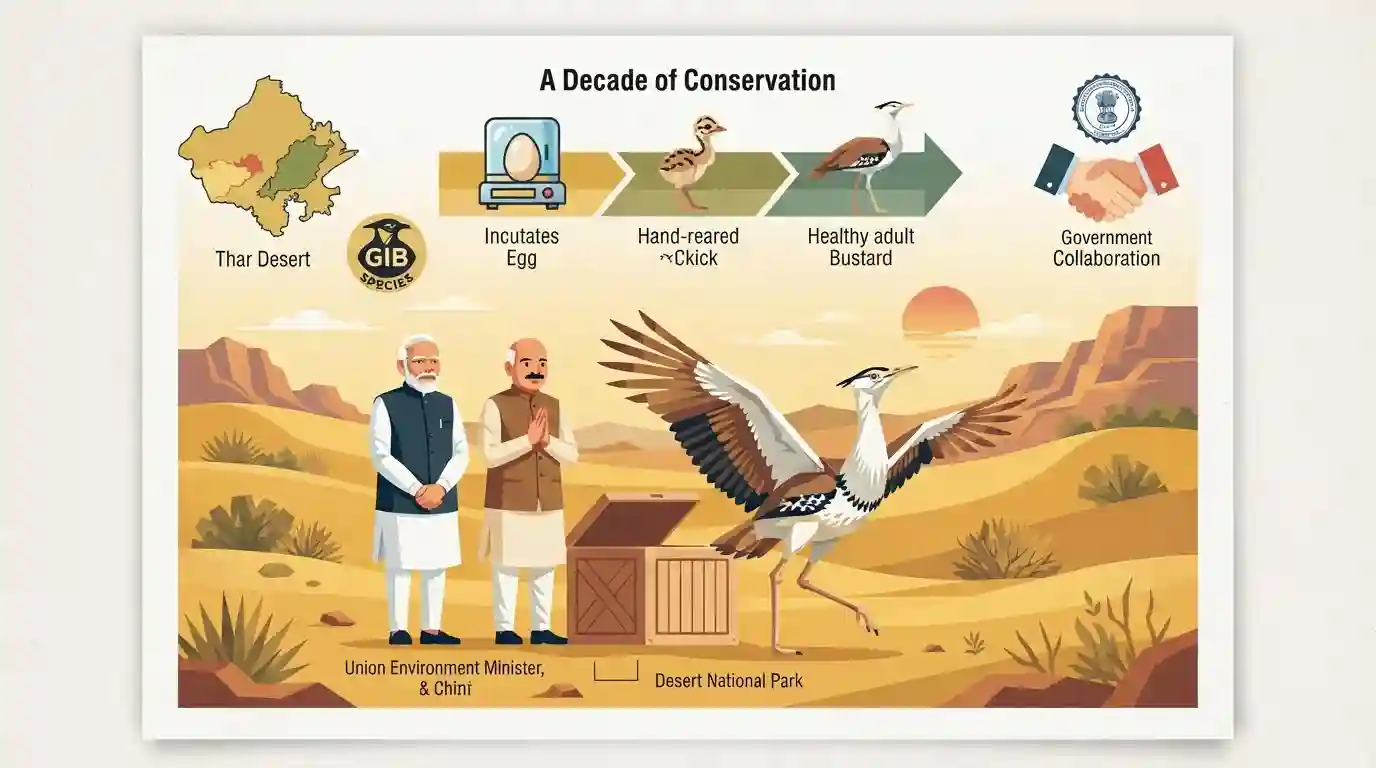
The Union Environment Minister and the Chief Minister of Rajasthan have initiated the release process of captive-bred Great Indian Bustards into the wild at the Desert National Park, marking a major milestone after a decade of dedicated conservation and breeding initiatives for the critically endangered state bird of Rajasthan.
Key Points
- Union Environment Minister and the Chief Minister of Rajasthan initiated the process for releasing captive-bred Great Indian Bustards (GIBs) into the wild at Desert National Park.
- This marks the culmination of a decade-long dedicated conservation and breeding effort for one of India's most critically endangered bird species.
- Desert National Park in Rajasthan serves as the primary natural habitat and stronghold for the Great Indian Bustard (Godawan), the state bird of Rajasthan.
Important Terms
Desert National Park

A premier national park located in Jaisalmer and Barmer districts of Rajasthan, famous as the primary natural habitat and breeding ground of the critically endangered Great Indian Bustard (Godawan).
UPSC context
RPSC Paper III (Geography and Environment of Rajasthan): Important national parks, wildlife sanctuaries, and protected areas in Rajasthan.
Ministry of Environment Forest and Climate Change
The central government ministry responsible for planning, promoting, and implementing environmental, forestry, and wildlife conservation policies and programs across India.
UPSC context
RPSC Paper I & III (Polity, Governance, and Environment): Central administrative bodies and national conservation frameworks.
Prelims Trap
Great Indian Bustards receive legal protection under Schedule IV of the Wildlife (Protection) Act, 1972 due to being avian species.
Aspirants often confuse Schedule I of the Wildlife Protection Act with IUCN categories; while GIB is Critically Endangered on IUCN, it enjoys Schedule I protection under the WPA, 1972.
Static Concepts Connected
What are the key ecological features and legal protections of the Great Indian Bustard (Godawan)?
- Conservation Status: IUCN Status is listed as Critically Endangered due to habitat loss and poaching.
- Legal Protection: Schedule I protection under the Wildlife (Protection) Act, 1972, granting it the highest level of legal protection in India.
- Endemic Habitat: State bird of Rajasthan, primarily found in the Thar Desert with Desert National Park as its major stronghold.
Cross-Topic Patterns
GIB Conservation vs Renewable Energy Transmission Corridors
The Supreme Court's intervention on overhead power lines passing through GIB habitats links wildlife conservation with energy transmission and infrastructure challenges in arid Rajasthan.
Ex-Situ Breeding vs In-Situ Rewilding Success
Captive breeding programs for flagship species like the GIB and Cheetah test the efficacy of ex-situ conservation coupled with in-situ reintroduction strategies.

Expect a matching or statement-based question on Desert National Park, IUCN status of GIB, and its legal status under WPA 1972.
Linked PYQs · 2
Linked PYQs · 2
- 2023RPSC_PRELIMSGS1
The National Tiger Conservation Authority has conferred the status of the fifth tiger sanctuary in Rajasthan, to which of the following sanctuaries?
- 2025RPSC_PRELIMSGS1
Choose the incorrect statement with respect to the Rajasthan Forestry and Biodiversity Project (Phase-2).
