Popular Culture and State Nationalism in China and India
Source:Indian Express ↗
Why It Matters
This article is highly relevant for GS2 (Governance/IR) and GS4 (Ethics) as it unpacks how mass media and popular culture are deployed to shape political imagination, manufacture consent, and navigate the ethical ambiguities of state power and nationalism.
Summary
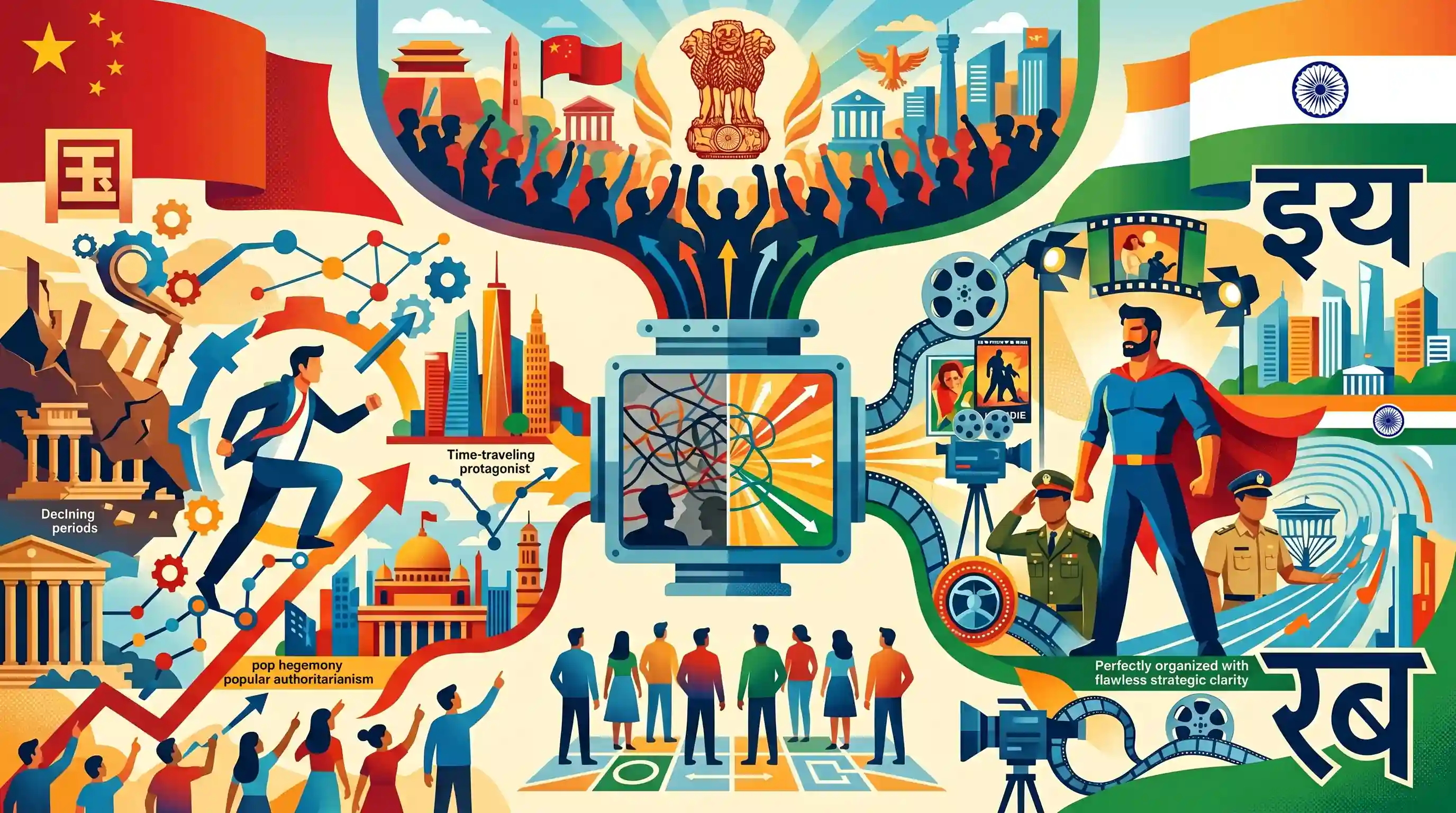
The article explores the intersection of popular culture and state-sponsored nationalism by comparing Chinese online alternate history fiction with Indian cinema, specifically citing the blockbuster *Dhurandhar*. Through Rongbin Han's concept of 'popular authoritarianism', it illustrates how Chinese web novels foster a 'pop hegemony' by depicting time-traveling protagonists who 'repair' historical national decline. Meanwhile, Indian pop culture often crafts an 'alternate present' where state institutions operate with flawless resolve and strategic clarity. Both narratives share a fundamental mechanism: they replace the moral ambiguities and political complexities of real-world geopolitics with absolute narrative certainty, transforming structural realities into simplistic, nationalist storytelling that aligns public imagination with state objectives.
Key Points
- In China, online alternate history (alt-history) fiction fosters 'pop hegemony' by allowing protagonists to travel back in time to fix historical national declines, constructing an illusion of imminent national revival.
- Scholar Rongbin Han refers to this dynamic as 'popular authoritarianism', where digital pop culture aligns with state-sponsored nationalism to manufacture consent for authoritarian rule.
- Similarly, Indian popular culture, exemplified by the blockbuster 'Dhurandhar', creates an 'alternate present' where state institutions and intelligence agencies operate with absolute clarity, stripped of real-world political hesitation.
- Both Chinese alt-history and Indian cinematic alternate presents function by replacing moral ambiguity with narrative certainty, thereby justifying geopolitical maneuvers as absolute necessities for national objectives.
- These cultural phenomena demonstrate how popular media—across both authoritarian and democratic regimes—simplifies complex structural and ethical realities into emotionally resonant nationalist storytelling.
Prelims Trap
"Popular authoritarianism means the strict state suppression of digital popular culture to enforce compliance."
False. It refers to the alignment of digitally empowered popular culture WITH state nationalism to manufacture public consent, not top-down suppression.
Static Concepts Connected
How do Soft Power, Sharp Power, and Smart Power differ in International Relations?
- Soft Power: Coined by Joseph Nye; the ability to attract and co-opt through culture, political values, and foreign policies rather than coercion.
- Sharp Power: Authoritarian influence that pierces political and information environments, manipulating narratives and suppressing dissent abroad.
- Smart Power: A strategic combination of hard power (military/economic coercion) and soft power to effectively achieve state objectives.
What is 'Manufacturing Consent' in the context of mass media and ethics?
- Core Premise: Introduced by Herman and Chomsky, it describes how mass media shapes public perception to build unquestioning support for state policies.
- Mechanism: It replaces moral ambiguity and complex structural realities with simplistic, emotionally resonant narratives that align with institutional objectives.
- Ethical Deficit: It undermines objective truth and independent public reasoning by functioning as subtle propaganda rather than critical storytelling.
Cross-Topic Patterns
Cinema as an instrument of Statecraft
Using films to project an 'alternate present' links GS-IV media ethics (propaganda vs truth) with GS-II cultural diplomacy, echoing historical Cold War-era psychological operations.
Digital narratives and Cognitive Warfare
China's digital 'pop hegemony' via web novels connects to GS-III internal security, demonstrating how domestic narrative control often serves as a testing ground for external cognitive domain operations.

Expect a GS-IV Mains question in 2026 on the ethical boundary between legitimate cultural soft power and jingoistic "manufacturing consent".
Linked PYQs · 2
Linked PYQs · 2
- 2025MainsGS2
"With the waning of globalization, post-Cold War world is becoming a site of sovereign nationalism.” Elucidate.
- 2020MainsGS4
‘The will to power exists, but it can be tamed and be guided by rationality and principles of moral duty.’ Examine this statement in the context of international relations.
