Farakka Treaty Review and Impact on Ganga Siltation in Bihar
Source:theprint ↗
Why It Matters
River management, siltation, and floods are highly relevant topics for BPSC Prelims and Mains (Geography and Disaster Management). Understanding transboundary water agreements (Farakka Treaty) and their regional impacts is crucial for aspirants.
Summary
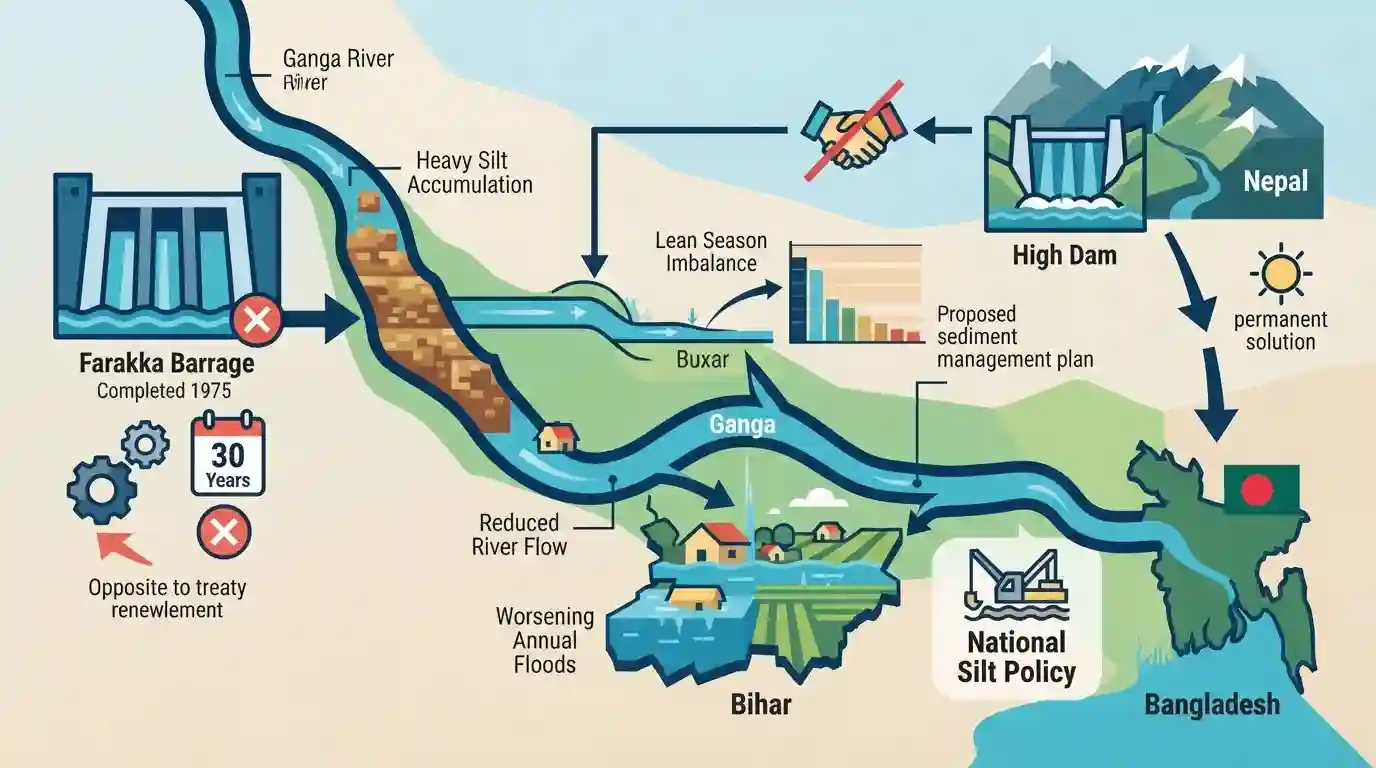
JD-U working president Sanjay Jha has advocated against renewing the 30-year Farakka water-sharing treaty with Bangladesh, asserting it has severely disadvantaged Bihar. The Farakka Barrage, completed in 1975, and the 1996 treaty have been criticized for leading to heavy silt accumulation in the Ganga, reducing the river's flow and worsening annual floods in Bihar. Additionally, the treaty creates an imbalance during the lean season, as Bihar receives minimal water at Buxar but is mandated to ensure a much larger flow at Farakka. Jha emphasized the necessity of a National Silt Policy and reiterated that a high dam in Nepal remains the sole permanent solution to North Bihar's chronic flooding.
Key Points
- JD-U leaders have urged the central government not to renew the 30-year Farakka Treaty with Bangladesh, originally signed in 1996.
- The Farakka Barrage and the treaty are blamed for causing massive silt accumulation in the Ganga river, which exacerbates recurrent flooding in Bihar.
- During lean seasons, Bihar struggles with inadequate water inflow at Buxar (400 cusecs) but is required to maintain a high volume (1,500 cusecs) at Farakka.
- There is a renewed demand for a National Silt Policy to address the desiltation of the Ganga.
- The construction of a high dam in Nepal is highlighted as the only permanent solution to mitigate Bihar's flood crisis.
Important Terms
Farakka Treaty

A 1996 30-year agreement between India and Bangladesh on sharing Ganges River water. Bihar attributes its severe annual flooding and heavy silt accumulation in the Ganga to the associated Farakka Barrage.
UPSC context
Tested in GS Papers 1 & 2 (IR and Geography of Bihar), focusing on river disputes and flood impacts.
National Silt Policy
A proposed national framework advocated by Bihar to manage and clear heavy sediment accumulation in rivers like the Ganga. It aims to ensure uninterrupted river flow and mitigate chronic annual floods.
UPSC context
Highly relevant for GS Paper 2 (Geography and Disaster Management), assessing strategies for North Bihar's chronic floods.
Janata Dal (United)
A prominent regional political party dominant in Bihar, formed in 1999 and led by Chief Minister Nitish Kumar. It plays a central role in the state's governance and coalition dynamics.
UPSC context
Important for GS Paper 2 (Polity), covering Bihar's political landscape, electoral dynamics, and regional party influence.
Prelims Trap
"The Farakka Treaty is a bilateral flood-control agreement between India and Bangladesh."
The 1996 Farakka Treaty strictly regulates the sharing of Ganga waters during the lean season (Jan-May). It is not a flood management agreement.
Static Concepts Connected
What is the geographic profile of the Ganga river's flow through Bihar?
- Entry Point: Enters Bihar at Chausa in Buxar district and acts as the state's main west-to-east drainage axis.
- Northern Tributaries: Includes Ghaghra, Gandak, Bagmati, Kosi, and Mahananda, which bring massive sediment loads from the Himalayas.
- Southern Tributaries: Includes Karamnasa, Son, Punpun, and Kiul, which are primarily rain-fed peninsular rivers.
What are the key water-sharing treaties India has with its eastern and northern neighbors?
- Farakka Treaty (Bangladesh): The 1996 agreement sharing the Ganga waters at Farakka, scheduled to expire in 2026.
- Nepal Pacts: Includes the Mahakali Treaty (1996), Kosi Agreement (1954), and Gandak Agreement (1959).
Cross-Topic Patterns
Federalism vs. Foreign Policy in Water Pacts
Bihar's opposition to the Farakka Treaty highlights the friction between the Centre's bilateral foreign policy obligations and state governments bearing the brunt of ecological and water-sharing imbalances.
River Morphology & Flood Disasters
The demand for a 'National Silt Policy' shifts the BPSC geography and disaster management narrative from traditional embankment construction to addressing riverbed aggradation and sediment management.

Expect a multi-statement question combining Farakka's lean-season sharing mandate, Ganga's siltation in Bihar, and Nepal high-dam demands.
Linked PYQs · 4
Linked PYQs · 4
- 2024-IBPSC_PRELIMSGS1
Which river is known as the ‘Sorrow of Bihar’?
- 2024-EBPSC_PRELIMSGS1
Which of the following drainage systems drains the lands of Bihar?
- 2022BPSC_PRELIMSGS1
The confluence of the rivers Son and Ganga is located in which district of Bihar?
- 2019BPSC_PRELIMSGS1
Among the following tributaries, which one is the part of Ganga river basin?
