Bihar Minority Residential Schools Expansion and Teacher Recruitment
Source:The Hindu ↗
Why It Matters
BPSC Preliminary and Mains examinations frequently feature questions regarding Bihar's state-specific welfare schemes, educational reforms, and minority upliftment initiatives. Understanding the specifics of the Minority Residential School Scheme and Mukhya Mantri Udyami Yojana provides crucial content for social justice and governance topics.
Summary
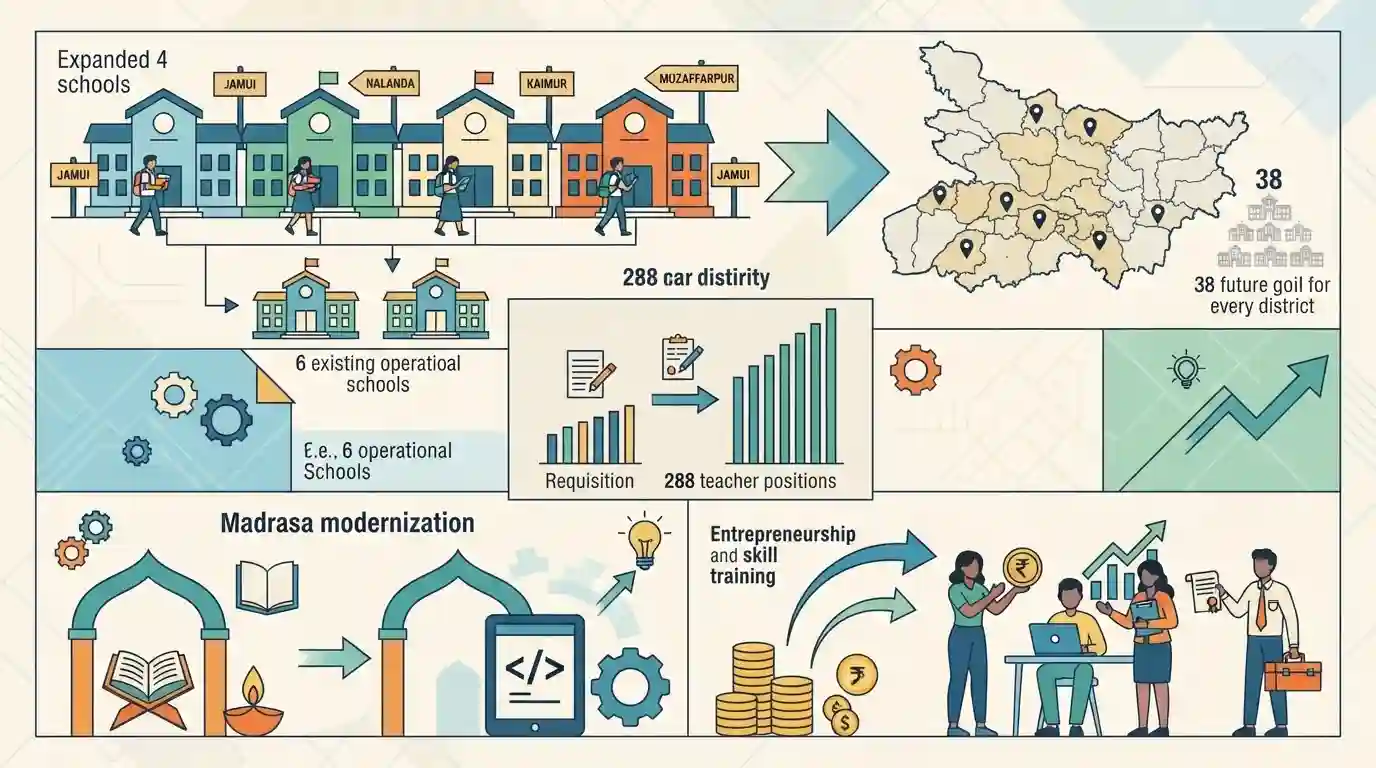
The Bihar government is expanding its educational outreach by launching academic sessions in four new minority residential schools across Jamui, Nalanda, Kaimur, and Muzaffarpur from August. Part of the 'Bihar State Minority Residential School Scheme' introduced in 2018-19, this brings the state's total operational minority residential schools to six. The state aims to construct such schools across all 38 districts, each hosting 560 students. To combat staff shortages, a requisition for 288 teachers has been sent to the BPSC. Further modernization efforts include introducing smart classes and skill development programs in madrasas through institutional tie-ups. The government also emphasized its ongoing financial backing for minority youth through the Mukhya Mantri Udyami Yojana.
Key Points
- The Bihar government is starting academic activities in four new minority residential schools in Jamui, Nalanda, Kaimur, and Muzaffarpur from August.
- With Darbhanga and Kishanganj already functioning, the state now has six operational minority residential schools out of a planned 38 under the 2018-19 scheme.
- Each of these schools is designed to accommodate 560 students, providing modern amenities and residential facilities.
- The Minority Welfare Department has requested the BPSC to conduct recruitment for 288 teaching posts to ensure adequate staffing.
- Smart classes and skill development programs are being introduced in state madrasas in partnership with NSIC and state education boards.
- The state government continues to provide financial support to minority youth through the Mukhya Mantri Udyami Yojana launched in 2023.
Important Terms
Bihar State Minority Residential School Scheme

A Bihar government initiative launched in 2018-19 to establish at least one free residential school in every district for meritorious minority students (Class 9-12), providing boarding, lodging, and high-quality education.
UPSC context
Important for GS Paper 2 (Welfare Schemes). Illustrates state-level interventions for the educational empowerment of minorities.
Mukhya Mantri Udyami Yojana
A Bihar government scheme promoting entrepreneurship among youth, women, and marginalized sections (including minorities) by providing financial assistance, subsidies, and loans up to Rs 10 lakh to set up micro-enterprises.
UPSC context
Relevant to GS Papers 2 & 3. Tests state-driven employment generation, inclusive growth, and financial empowerment of vulnerable communities.
National Small Industries Corporation (NSIC)
A Mini Ratna PSU under the Ministry of MSME established in 1955. It supports MSME growth and is currently partnering with the Bihar government to impart skill development training to madrasa students.
UPSC context
Relevant for GS Paper 3 (Skill Development). Demonstrates institutional synergy between federal MSME bodies and state-level minority education efforts.
Bihar Public Service Commission (BPSC)
A constitutional body (under Article 315) responsible for civil service and departmental recruitment in Bihar, recently tasked with conducting examinations to hire teachers for the state's minority residential schools.
UPSC context
Relevant for GS Paper 2 (Constitutional Bodies). Highlights the institutional recruitment machinery facilitating state welfare and educational programs.
Bihar State Madrasa Education Board
The statutory board regulating Islamic educational institutions in Bihar. It is actively collaborating with the state government to integrate mainstream subjects, smart classes, and skill training into traditional madrasa curricula.
UPSC context
Connects to GS Paper 2 (Education and Minority Affairs). Showcases policy shifts towards modernizing traditional education systems for better employability.
Prelims Trap
Minority educational institutions are completely immune from state regulation regarding teacher recruitment and minimum academic standards.
The Supreme Court has repeatedly held that the state can prescribe reasonable regulations for academic standards, teacher qualifications, and welfare without violating Article 30.
Static Concepts Connected
What is the constitutional scope of Article 30 regarding minority educational institutions?
- Establish and Administer: Clause (1) gives religious and linguistic minorities the fundamental right to establish and manage educational institutions of their choice.
- Non-discrimination in Aid: Clause (2) prevents the state from discriminating against minority-managed institutions when granting financial aid.
- State Regulation: The Supreme Court allows reasonable state regulations on academic standards, teacher qualifications, and sanitary conditions to ensure quality.
How is minority status determined for educational rights in India?
- No Constitutional Definition: The Constitution mentions religious and linguistic minorities but does not explicitly define the term "minority" itself.
- State-wise Determination: In the T.M.A. Pai Foundation case, the Supreme Court ruled that minorities must be identified state-wise, not nationally.
- Statutory Recognition: Under the National Commission for Minorities Act, six religious communities are notified as minorities at the national level.
Cross-Topic Patterns
Minority Rights vs Administrative Regulation
Explores the legal friction between fundamental rights of minority institutions and state regulatory bodies (like BPSC) enforcing standardized teacher qualification norms.
Madrasa Modernization and Skill India
Bridges welfare-driven religious education with national economic policies by utilizing institutions like NSIC to integrate skill development into traditional minority curriculums.

UPSC may test Article 30 limits in 2026, focusing on state powers to regulate teacher standards in minority-aided schools.
Linked PYQs · 3
Linked PYQs · 3
- 2025BPSC_PRELIMSGS1
What is the primary objective of Bihar’s Mission Daksh?
- 2018BPSC_PRELIMSGS1
Which of the following is not true about Bihar's Mukhyamantri Kanya Utthan Yojana?
- 2020BPSC_PRELIMSGS1
Bihar Government launched a new scheme 'Satat Jivikoparjan Yojana' in August 2018. The objective of this scheme is
