Bangladesh historical legacies and political crises impact India ties
Source:Indian Express ↗
Why It Matters
Understanding the internal political dynamics of India's neighboring countries is crucial for UPSC aspirants, as instability in Bangladesh directly impacts India's border security, economic connectivity, and the broader 'Neighbourhood First' diplomatic strategy.
Summary
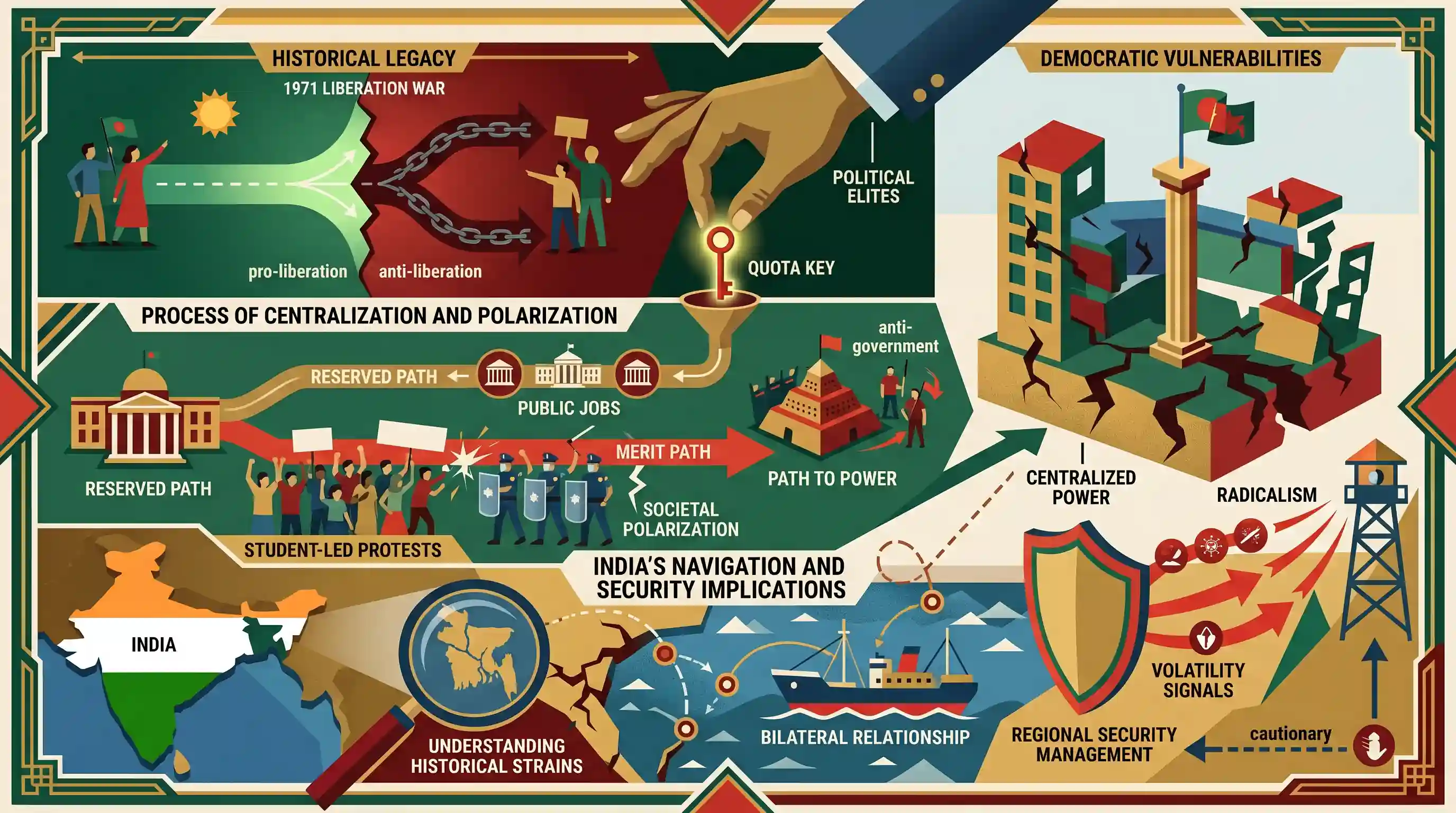
The article analyzes how Bangladesh's contemporary political crises are inextricably linked to its historical legacy, particularly the deeply entrenched narratives stemming from the 1971 Liberation War. It highlights how the controversial quota system for descendants of freedom fighters—which recently triggered massive student-led anti-government protests—exemplifies the ongoing societal polarization. By continuously leveraging the historical dichotomy between 'pro-liberation' and 'anti-liberation' factions, political elites have marginalized opposition and centralized power, leading to systemic democratic vulnerabilities. For India, understanding these historical strains is vital to navigating the bilateral relationship and managing the regional security implications of Bangladesh's internal volatility.
Key Points
- Bangladesh's contemporary political landscape remains deeply polarized by historical narratives and unresolved grievances dating back to the 1971 Liberation War.
- The recent widespread protests were initially ignited by a controversial quota system favoring descendants of 1971 freedom fighters, highlighting the enduring friction over historical legacy.
- Political factions in Bangladesh have historically utilized the dichotomy of 'pro-liberation' versus 'anti-liberation' forces as a tool to delegitimize opposition and consolidate power.
- The resulting internal instability poses significant diplomatic and security challenges for India, impacting its Neighbourhood First policy and regional stability.
Important Terms
Neighbourhood First Policy

India's core diplomatic strategy prioritizing stable, cooperative relations with its immediate neighbors through enhanced connectivity and economic integration to ensure regional security and prosperity.
UPSC context
GS Paper 2 (International Relations); critical for understanding India's regional foreign policy and its strategic engagement in South Asia.
Awami League
A major secular-nationalist party in Bangladesh that led the 1971 Liberation War; it held power from 2009 until being ousted during the 2024 student-led uprising.
UPSC context
GS Paper 2; tests knowledge of political stability and the democratic framework of a key Indian neighbor.
Bangladesh Nationalist Party (BNP)
A center-right political party founded in 1978 by Ziaur Rahman, advocating for 'Bangladeshi Nationalism' as an alternative to the secularist ideology of the Awami League.
UPSC context
GS Paper 2; vital for analyzing the domestic political landscape and ideological schisms in India's eastern neighborhood.
Jamaat-e-Islami (Bangladesh)
The largest Islamist party in Bangladesh; it historically opposed the 1971 independence and is central to the 'anti-liberation' narrative in the country's political discourse.
UPSC context
GS Paper 2; important for assessing the role of religious-political actors in regional stability and internal security.
Freedom Fighter Quota
A controversial reservation system for descendants of 1971 war veterans in civil service jobs; its 2024 reinstatement triggered the mass protests that ousted the government.
UPSC context
GS Paper 2; exemplifies how historical legacies and identity politics can trigger contemporary social unrest and political volatility.
Razakar
A derogatory term for collaborators who supported the Pakistani military during the 1971 war; its use against 2024 protesters inflamed long-standing historical grievances.
UPSC context
GS Paper 1 (Post-independence history) and GS 2; tests understanding of historical narratives that shape modern geopolitical tensions.
Prelims Trap
India shares its longest international land boundary with China, followed by Pakistan and Bangladesh.
India actually shares its longest land border (4,096.7 km) with Bangladesh, not China. This geographically complex, porous border is central to regional security issues.
Static Concepts Connected
What are the key geographical features of the India-Bangladesh border?
- Longest Boundary: India shares its longest international land boundary (4,096.7 km) with Bangladesh.
- Bordering States: Five Indian states share this border: West Bengal, Assam, Meghalaya, Tripura, and Mizoram.
- Riverine Nature: A significant portion is riverine and un-demarcated, making it highly porous and prone to illegal migration and smuggling.
What are the core tenets of India's 'Neighbourhood First' policy?
- Connectivity Focus: Building physical, digital, and energy infrastructure to boost regional trade and integration.
- Non-reciprocity: Drawing from the Gujral Doctrine, India aims to accommodate neighbors' concerns without demanding strict reciprocal concessions.
- Mutual Security: Ensuring that neighboring territories are not used by hostile elements for anti-India activities or terror staging.
Cross-Topic Patterns
Bangladesh Crisis & Border Management
Internal political chaos in Dhaka directly exacerbates challenges like illegal migration, human trafficking, and cattle smuggling across the porous border, linking IR directly to GS-3 Internal Security.
Domestic Volatility & Chinese Strategic Vacuum
Anti-India sentiments fueled by domestic political dichotomies create a strategic vacuum in Bangladesh, which China routinely exploits to advance its Belt and Road Initiative and regional strategic encirclement.

Expect a GS2 Mains question linking Bangladesh's internal instability to India's border security and the efficacy of Act East policy.
Linked PYQs · 1
Linked PYQs · 1
- 2013MainsGS1
Critically examine the compulsions which prompted India to play a decisive role in the emergence of Bangladesh.
