Political Instability in Bangladesh and Implications for India
Source:Indian Express ↗
Why It Matters
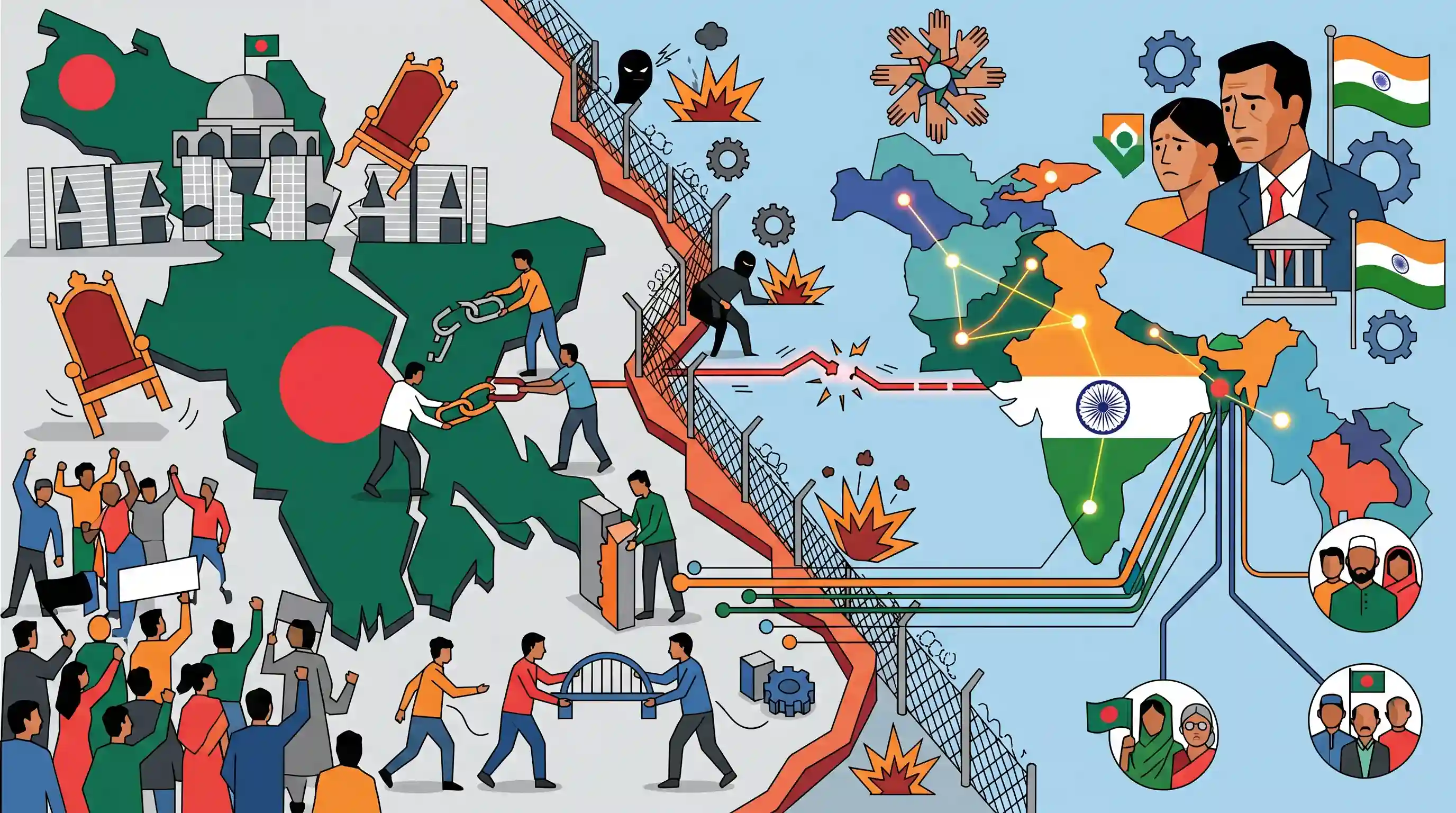
The political stability of Bangladesh is crucial for India's internal security (particularly in the Northeast) and its broader regional connectivity goals. The ongoing crisis necessitates a strategic reassessment of India's diplomatic engagement in its immediate neighbourhood.
Summary
The article analyzes the continuing political turmoil in Bangladesh, describing the post-uprising instability as a 'verdict foretold' stemming from structural democratic deficits. It highlights the immense pressure on the interim administration to restore order and bridge deep societal divides following the ouster of Sheikh Hasina. The ensuing crisis presents significant diplomatic and security challenges for India. The turmoil threatens border stability, raises the spectre of transborder extremism, and tests the resilience of India's Neighbourhood First policy, requiring New Delhi to adopt a pragmatic, multi-stakeholder diplomatic approach in Dhaka.
Key Points
- Reflects on the ongoing political turmoil in Bangladesh, framing the current instability as a predictable outcome of deep-rooted systemic issues and democratic backsliding.
- Discusses the formidable challenges before the interim administration, including managing societal polarization, reviving the economy, and maintaining law and order.
- Assesses the strategic fallout for India, highlighting concerns over cross-border security, potential surges in illegal migration, and disruptions to bilateral connectivity projects.
- Suggests that India must pragmatically recalibrate its foreign policy approach towards Dhaka by engaging with new political actors while safeguarding its own border security and regional interests.
Important Terms
Neighbourhood First Policy

India’s strategic foreign policy prioritizing immediate neighbors. It aims to foster regional stability, economic connectivity, and mutual trust through consultative and often non-reciprocal engagement.
UPSC context
GS Paper II (International Relations). Tests understanding of India’s regional security framework and challenges posed by political volatility in the neighborhood.
Awami League
A major secular-aligned political party in Bangladesh formerly led by Sheikh Hasina. It presided over 15 years of governance and close ties with India before its 2024 collapse.
UPSC context
GS Paper II (International Relations). Essential for analyzing the evolution of bilateral ties and the impact of regime changes on Indian interests.
Bangladesh Nationalist Party (BNP)
A center-right political party that returned to power in 2026. Historically more skeptical of Indian influence, it prioritizes national sovereignty and has traditionally allied with Islamist factions.
UPSC context
GS Paper II (International Relations). Critical for evaluating the future of connectivity and security cooperation under shifting political leadership in Dhaka.
Jamaat-e-Islami
Bangladesh's largest Islamist party. It saw a significant resurgence after the 2024 uprising, regaining legal status and political influence, which poses challenges for regional security and religious pluralism.
UPSC context
GS Paper II/III (IR/Security). Relevant for studying the impact of religious radicalization on border stability and minority safety in South Asia.
Interim Government (Bangladesh)
The transitional administration led by Nobel laureate Muhammad Yunus (2024–2026). It was established following Sheikh Hasina’s ouster to implement democratic reforms and stabilize the country before elections.
UPSC context
GS Paper II (IR/Governance). Relevant for analyzing crisis management, the "doctrine of necessity," and India’s diplomatic adaptation during regime transitions.
Prelims Trap
Assam, Meghalaya, Tripura, Mizoram, and Manipur share an international land border with Bangladesh.
Manipur does NOT share a border with Bangladesh (it borders Myanmar). The five Indian states bordering Bangladesh are West Bengal, Assam, Meghalaya, Tripura, and Mizoram.
Static Concepts Connected
Which Indian states border Bangladesh and what are the geographic challenges?
- Longest border: India shares a 4,096.7 km border with Bangladesh, making it India's longest international land boundary.
- Five States: West Bengal, Assam, Meghalaya, Tripura, and Mizoram.
- Geographic hurdles: High porosity due to densely populated areas, riverine delta systems, un-demarcated stretches, and shifting river islands (char lands).
What are the major strategic connectivity initiatives linking India and Bangladesh?
- Maitree Setu: A 1.9 km bridge over the Feni river, connecting Sabroom in Tripura to Chittagong port in Bangladesh.
- PIWTT: The Protocol on Inland Water Transit and Trade allows Indian vessels to transit through Bangladesh's inland waterways.
- Akhaura-Agartala Rail: A crucial dual-gauge rail link that connects Tripura directly to the Bangladesh railway network, boosting North-East trade.
Cross-Topic Patterns
Act East and North-East Internal Security
Instability in Dhaka directly threatens GS-3 internal security (resurgence of North-East insurgent groups) and GS-2 Act East connectivity projects linking India's landlocked North-East to the Bay of Bengal.
China's maritime expansion in Bay of Bengal
A strategic and political vacuum in Dhaka risks greater Chinese influence over key infrastructure like Mongla port and the Teesta river project, complicating India's maritime security.

Expect a 2026 Mains question on recalibrating India's 'Neighbourhood First' policy amidst democratic backsliding and regime changes.
Linked PYQs · 2
Linked PYQs · 2
- 2020MainsGS3
Analyze internal security threats and transborder crimes along Myanmar, Bangladesh and Pakistan borders including Line of Control (LoC). Also discuss the role played by various security forces in this regard.
- 2022MainsGS2
India is an age-old friend of Sri Lanka.’ Discuss India's role in the recent crisis in Sri Lanka in the light of the preceding statement.
