Asian summits and major power dynamics shaping India foreign policy
Source:Indian Express ↗
Why It Matters
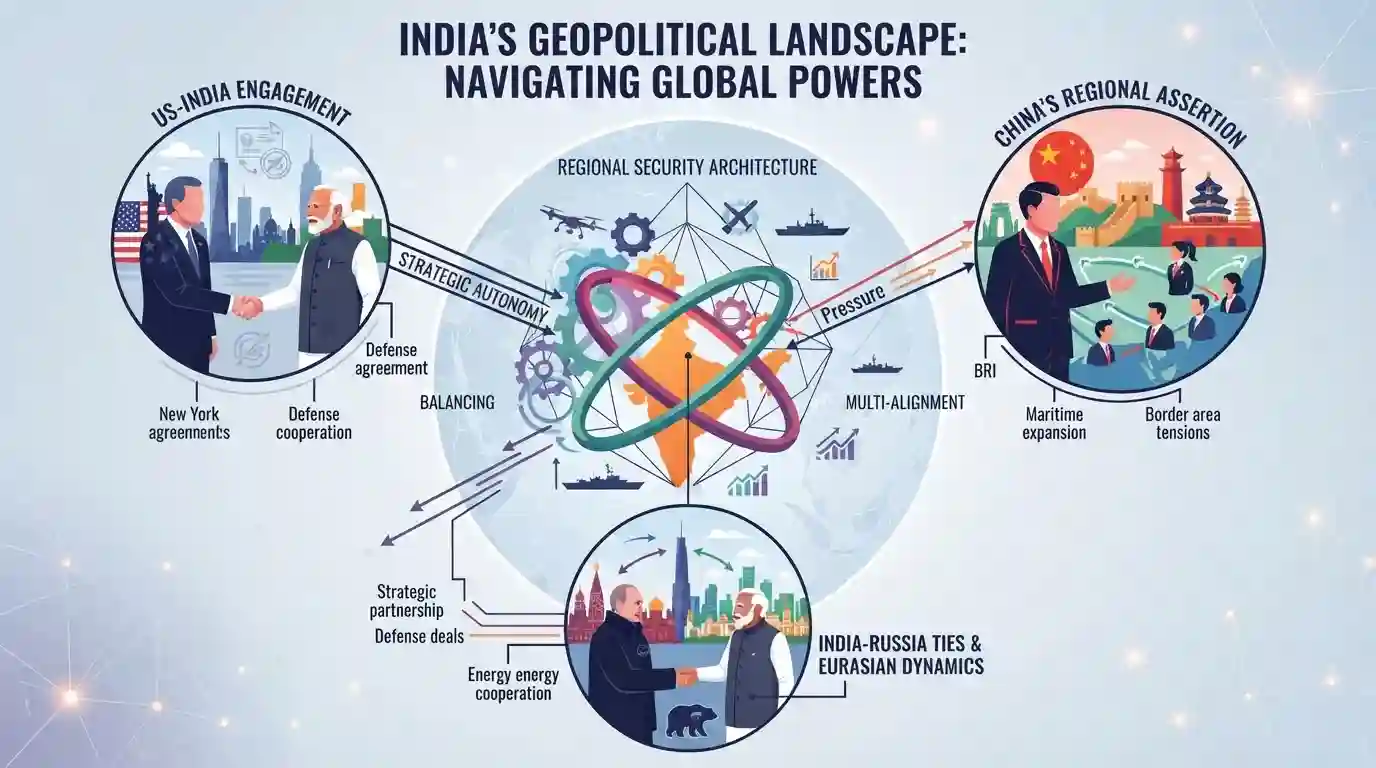
Understanding the evolving geopolitical dynamics among major global powers in Asia is crucial for analyzing India's strategic autonomy, foreign policy alignments, and regional security stakes.
Summary
The article discusses how recent high-level diplomatic summits and interactions among global powers like Trump, Xi, and Putin in Asia frame strategic implications and stakes for India's foreign policy and regional security architecture.
Key Points
- Geopolitical summits in Asia involving global leaders like Trump, Xi, and Putin shape strategic alignments and India's foreign policy stakes.
- India must navigate complex multilateral dynamics involving major powers while maintaining its strategic autonomy.
- Regional groupings like ASEAN and minilaterals like the Quad play a critical role in framing security and economic architecture in the Indo-Pacific.
Important Terms
Quad

A strategic security dialogue between India, the United States, Japan, and Australia aimed at ensuring a free, open, and inclusive Indo-Pacific region through maritime cooperation, infrastructure, and technology initiatives.
UPSC context
UPSC Prelims/Mains GS Paper II: Important international institutions, groupings, and India's foreign policy in the Indo-Pacific.
ASEAN
A geopolitical association of ten Southeast Asian nations promoting regional economic integration, security dialogue, and sociocultural cooperation, with India engaging it centrally via its Act East Policy.
UPSC context
UPSC Mains GS Paper II: Bilateral, regional and global groupings and agreements involving India and/or affecting India's interests.
BRICS
An intergovernmental organization of major emerging economies—including Brazil, Russia, India, China, South Africa, and recent expanding members—functioning as a platform for alternative global governance and South-South cooperation.
UPSC context
UPSC Prelims/Mains GS Paper II: Important international groupings affecting India's strategic autonomy and economic interests.
Static Concepts Connected
What are the core principles and evolution of India's Strategic Autonomy in foreign policy?
- Historical Roots: Rooted in the Non-Aligned Movement (NAM) era, emphasizing independent decision-making free from bloc politics.
- Modern Multi-alignment: Evolved into 'multi-alignment', engaging concurrently with competing power centres like the US, Russia, and regional groupings like BRICS and Quad.
- Pragmatic Focus: Prioritizes national interest over permanent military alliances, maintaining operational flexibility in the Indo-Pacific.
Cross-Topic Patterns
Multi-alignment vs Military Alliances in Indo-Pacific
India's participation in both western-leaning minilaterals (Quad) and non-Western forums (BRICS/SCO) tests the operational limits of multi-alignment and strategic autonomy.

Strategic autonomy + minilateralism (Quad/SCO/BRICS) likely to feature in IR questions on balancing rival global power axes.
Linked PYQs · 3
Linked PYQs · 3
- 2020MainsGS2
Quadrilateral Security Dialogue (Quad)' is transforming itself into a trade bloc from a military alliance, in present times - Discuss.
- 2021MainsGS2
The newly tri-nation partnership AUKUS is aimed at countering China's ambitions in the Indo-Pacific region. Is it going to supersede the existing partnerships in the region? Discuss the strength and impact of AUKUS in the present scenario.
- 2020MainsGS2
What is the significance of Indo-US defence deals over Indo-Russian defence deals? Discuss with reference to stability in the Indo-Pacific region.
