Energy Sovereignty and Critical Minerals Supply Chain Dynamics
Source:The Hindu ↗
Why It Matters
The concept of 'energy sovereignty' integrates foreign policy with sustainable development. It is crucial for UPSC aspirants to understand how geopolitical volatility necessitates a shift toward renewable energy and the securing of critical mineral supply chains, directly relevant to both GS2 (IR) and GS3 (Energy & Economy).
Summary
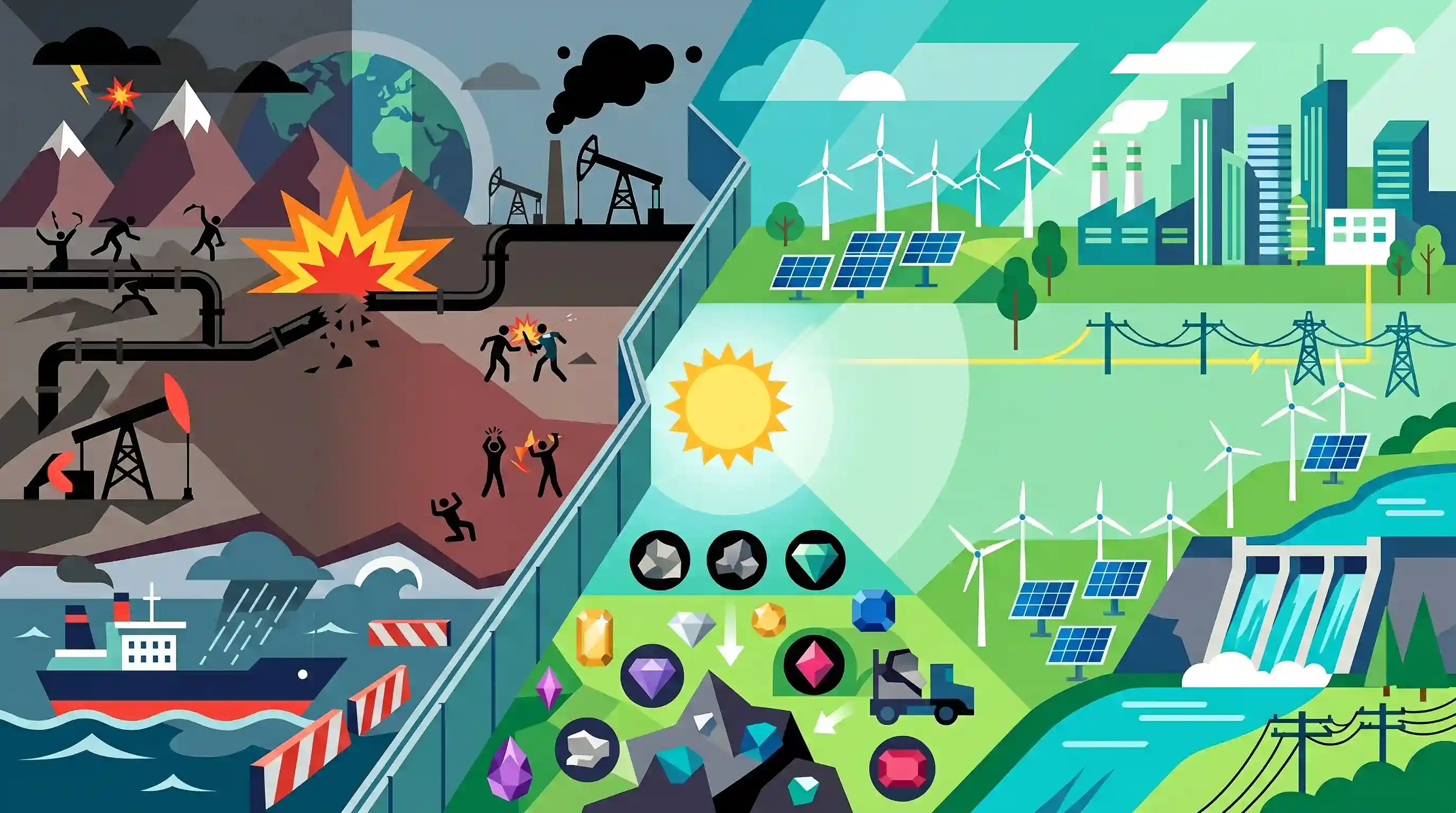
The article highlights the shift in global geopolitics where "energy sovereignty" is replacing traditional oil resources as the primary driver of national security. Amidst rising geopolitical tensions, global conflicts, and supply chain disruptions, over-reliance on imported fossil fuels exposes nations to severe vulnerabilities. Transitioning to renewable energy, securing critical mineral supply chains, and building self-reliant domestic energy infrastructure are framed as essential strategies for achieving true energy sovereignty, particularly for growing economies like India.
Key Points
- Energy sovereignty is replacing traditional oil reserves as a central pillar of national security and economic stability amidst global instability.
- Over-reliance on imported fossil fuels exposes nations to severe vulnerabilities during geopolitical conflicts and supply chain disruptions.
- The global transition to renewable energy requires securing new supply chains, particularly for critical minerals like lithium and rare earths, which are sparking new geopolitical competitions.
- For India, achieving energy sovereignty involves accelerating its green energy transition, boosting domestic manufacturing of clean technologies, and diversifying international energy partnerships.
Important Terms
National Green Hydrogen Mission

India’s flagship initiative (2023) to create a domestic ecosystem for producing and exporting hydrogen via renewable energy, targeting 5 MMT annual capacity by 2030.
UPSC context
GS-III (Energy, Infrastructure); tests understanding of energy self-reliance and India's strategy to reduce fossil fuel imports.
International Solar Alliance (ISA)
An India-France led global alliance headquartered in Gurugram, aiming to mobilize $1 trillion for solar energy deployment and provide clean energy access to 1 billion people.
UPSC context
GS-II (International Relations) and GS-III (Environment); evaluates India's leadership in global climate diplomacy and renewable transitions.
Paris Agreement
A 2015 legally binding treaty under the UNFCCC aiming to limit global temperature rise to 1.5°C through self-determined national climate targets (NDCs).
UPSC context
GS-III (Environment); central to questions on global climate governance and India's international environmental commitments.
OPEC
A permanent intergovernmental organization of oil-producing nations that manages global supply to stabilize prices; its decisions directly impact India’s energy security and inflation.
UPSC context
GS-II (IR) and GS-III (Economy); tests knowledge of global resource geopolitics and its impact on India's fiscal stability.
Prelims Trap
"The Minerals Security Partnership is a UN-led initiative aimed at equitable mineral distribution."
The MSP is a US-led multilateral alliance formed in 2022 (which India joined in 2023) to secure critical mineral supply chains, not a UN body.
Static Concepts Connected
What is the Minerals Security Partnership (MSP)?
- Origin: A US-led multilateral alliance of 14 partner countries and the European Union, formed in 2022.
- Objective: To catalyze public and private investment in sustainable critical mineral supply chains globally, reducing dependence on China.
- India's Status: India joined the partnership in 2023, enhancing its diplomatic leverage to secure essential transition metals like lithium, cobalt, and nickel.
What makes Critical Minerals strategically essential for national security?
- Definition: Elements crucial for modern clean technology and defense, characterized by high supply chain risks and a lack of viable substitutes.
- Key Examples: Lithium, cobalt, nickel, graphite, and Rare Earth Elements (REEs).
- Geopolitical Risk: High geographical concentration in extraction (e.g., DRC for cobalt) and processing (China for REEs) creates severe global supply vulnerabilities.
Cross-Topic Patterns
Clean tech meets PLI schemes
India's quest for energy sovereignty bridges geopolitics with internal economic policy, utilizing PLI schemes for Solar PVs and Advanced Chemistry Cells to avoid replacing oil imports with clean-tech imports.
Shifting geographic energy alliances
Energy diplomacy is structurally pivoting from the Middle East (hydrocarbons) to mineral-rich regions (South America, Australia) and strategic technology coalitions like the Quad and the Minerals Security Partnership.

Expect a composite 2026 Prelims question linking critical mineral supply chains, MSP membership, and India's clean tech PLI schemes.
Linked PYQs · 3
Linked PYQs · 3
- 2025MainsGS2
"Energy security constitutes the dominant kingpin of India's foreign policy, and is linked with India's overarching influence in Middle Eastern countries.” How would you integrate energy security with India's foreign policy trajectories in the coming years?
- 2022MainsGS2
‘Clean energy is the order of the day.’ Describe briefly India's changing policy towards climate change in various international fora in the context of geopolitics.
- 2022MainsGS3
Do you think India will meet 50 percent of its energy needs from renewable energy by 2030 ? Justify your answer. How will the shift of subsidies from fossil fuels to renewables help achieve the above objective ? Explain.
