India EU Free Trade Agreement Acceleration Amid Global Uncertainty
Source:Indian Express ↗
Why It Matters
The India-EU BTIA is a longstanding and critical component of India's foreign economic policy. Understanding the geopolitical imperatives for accelerating this agreement helps address GS2 questions on bilateral groupings and GS3 questions on trade and protectionism.
Summary
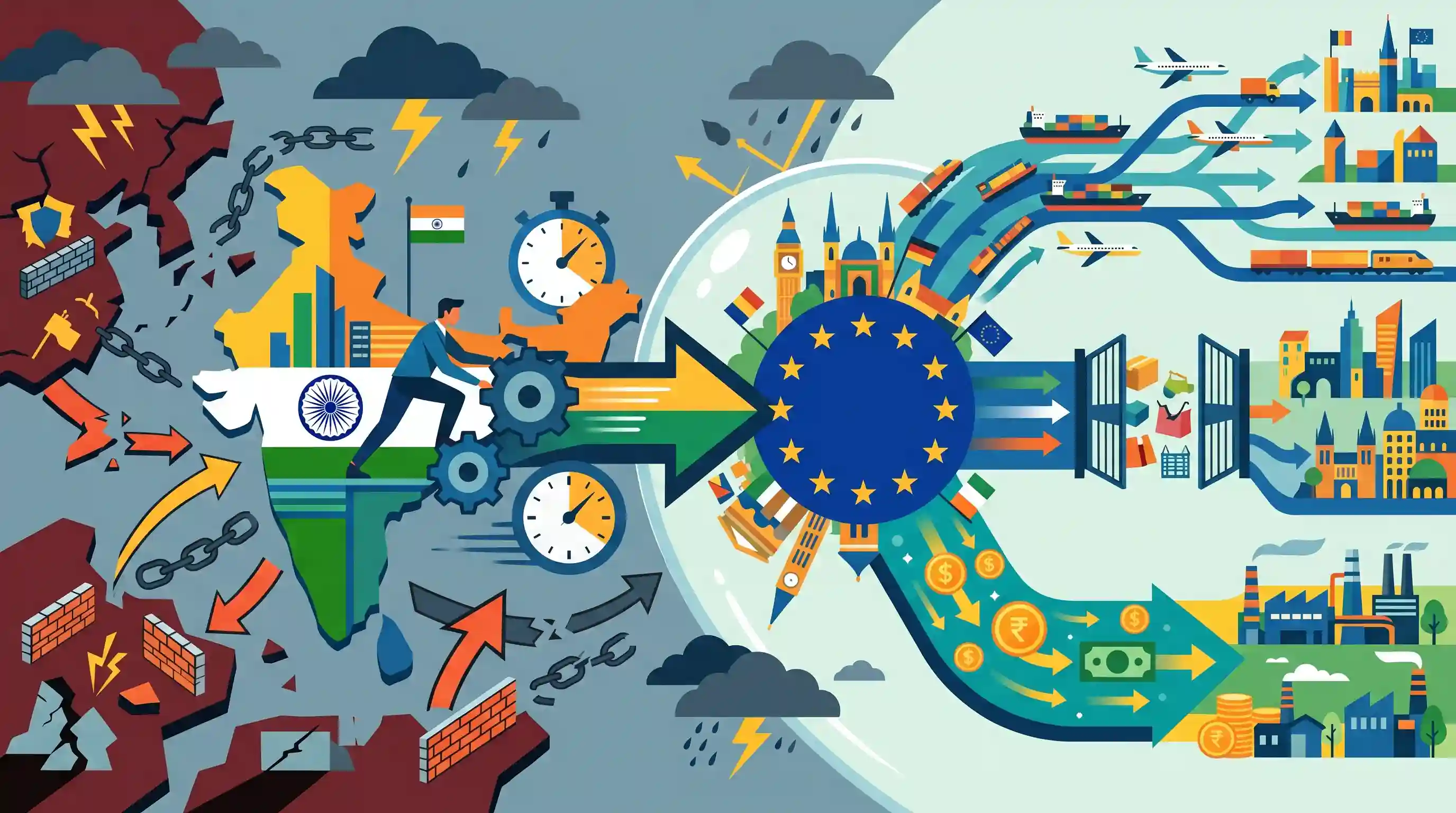
In the context of global unpredictability driven by geopolitical conflicts and rising protectionism, India must prioritize and accelerate the conclusion of its Free Trade Agreement (FTA) with the European Union. Fast-tracking the Broad-based Trade and Investment Agreement (BTIA) is essential for India to diversify its supply chains, enhance market access, and secure stable investment flows. Building a robust economic partnership with the EU serves as a strategic hedge against international trade disruptions and shifting global alignments.
Key Points
- Amidst global geopolitical uncertainties and rising protectionism, India needs to secure reliable trade partnerships to ensure economic stability.
- Accelerating the India-EU Free Trade Agreement (Broad-based Trade and Investment Agreement) is crucial for expanding market access and securing supply chains.
- A comprehensive FTA with the European Union would facilitate technology transfer, boost investments, and help India integrate into global value chains.
- Diversifying trade relations mitigates risks associated with over-reliance on specific global players in a highly unpredictable international environment.
Important Terms
Broad-based Trade and Investment Agreement (BTIA)

The formal name for the proposed Free Trade Agreement between India and the European Union, aiming to reduce trade barriers across goods, services, and investment sectors.
UPSC context
GS Paper-II/III; tests knowledge of bilateral trade hurdles and India's economic integration with the EU.
Free Trade Agreement (FTA)
A formal pact between nations to reduce or eliminate trade barriers like tariffs and quotas to increase the cross-border exchange of goods and services.
UPSC context
GS Paper-III (Economy); essential for understanding trade policy, export competitiveness, and global economic integration.
European Union (EU)
A supranational political and economic union of 27 member states in Europe, operating as a single market and acting as a major strategic partner for India.
UPSC context
GS Paper-II (International Relations); tests understanding of regional groupings and India's multi-aligned foreign policy.
Protectionism
Economic policies like tariffs or quotas designed to shield domestic industries from foreign competition, often cited as a hurdle in India-EU negotiations.
UPSC context
GS Paper-III (Economy); relevant for debates on globalization versus self-reliance (Atmanirbhar Bharat).
Strategic Partnership
A formal diplomatic framework (established between India and EU in 2004) covering cooperation in security, technology, climate change, and global governance.
UPSC context
GS Paper-II (International Relations); focuses on bilateral institutional mechanisms and shared democratic values.
Supply Chain Diversification
A strategy to reduce economic dependency on a single source (like China) by spreading manufacturing and sourcing across multiple countries to ensure resilience.
UPSC context
GS Paper-III (Economy); crucial for understanding the "China Plus One" strategy and global value chains.
Prelims Trap
India and the EU recently signed the Broad-based Trade and Investment Agreement (BTIA).
BTIA is still under negotiation (since 2007). Furthermore, in 2022, talks were officially split into three separate agreements: a core FTA, an Investment Protection Agreement, and a Geographical Indications pact.
Static Concepts Connected
What are the 4 modes of services trade under WTO GATS?
- Mode 1 (Cross-border): Services crossing borders without people moving (e.g., telemedicine, software services).
- Mode 2 (Consumption abroad): Consumers travel to the supplying country (e.g., medical tourism, international students).
- Mode 3 (Commercial presence): A service provider establishes a branch or subsidiary in another country (e.g., foreign banks).
- Mode 4 (Natural persons): Temporary movement of skilled professionals to another country (e.g., Indian IT workers in Europe). A major BTIA sticking point.
How does India's 2015 Model BIT affect the EU Investment Protection Agreement?
- Exhaustion of local remedies: Requires foreign investors to use domestic courts for at least 5 years before seeking international arbitration.
- Enterprise-based investment: Narrows the definition compared to older asset-based definitions, excluding portfolio investments from protection.
- Negotiation friction: The EU prefers an Investment Court System (ICS) and finds India's Model BIT restrictive, heavily complicating the IPA track of the BTIA.
Cross-Topic Patterns
EU CBAM and FTA friction
The EU's carbon tax (CBAM) acts as a de facto non-tariff barrier on Indian steel and aluminum, forcing negotiators to address climate mandates within traditional trade talks.
Trade & Technology Council (TTC)
FTAs are moving beyond just goods and services; the India-EU TTC aligns with broader geopolitical tech alliances by focusing on semiconductor supply chains and AI governance.

Expect a multi-statement prelims question combining the 3-track BTIA split (FTA, IPA, GI), the Trade and Tech Council, and EU CBAM.
Linked PYQs · 2
Linked PYQs · 2
- 2025MainsGS3
What are the challenges before the Indian economy when the world is moving away from free trade and multilateralism to protectionism and bilateralism? How can these challenges be met?
- 2017PrelimsGS1
'Broad-based Trade and Investment Agreement (BTIA)' is sometimes seen in the news in the context of negotiations held between India and
