Soft Power Relevance Amid US Isolationism and Global Conflicts
Source:Indian Express ↗
Why It Matters
Understanding the shifting balance between hard and soft power is crucial for analyzing contemporary global geopolitics, the impact of waning globalization, and the strategic recalibrations required in India's foreign policy to navigate a multipolar, conflict-prone world.
Summary
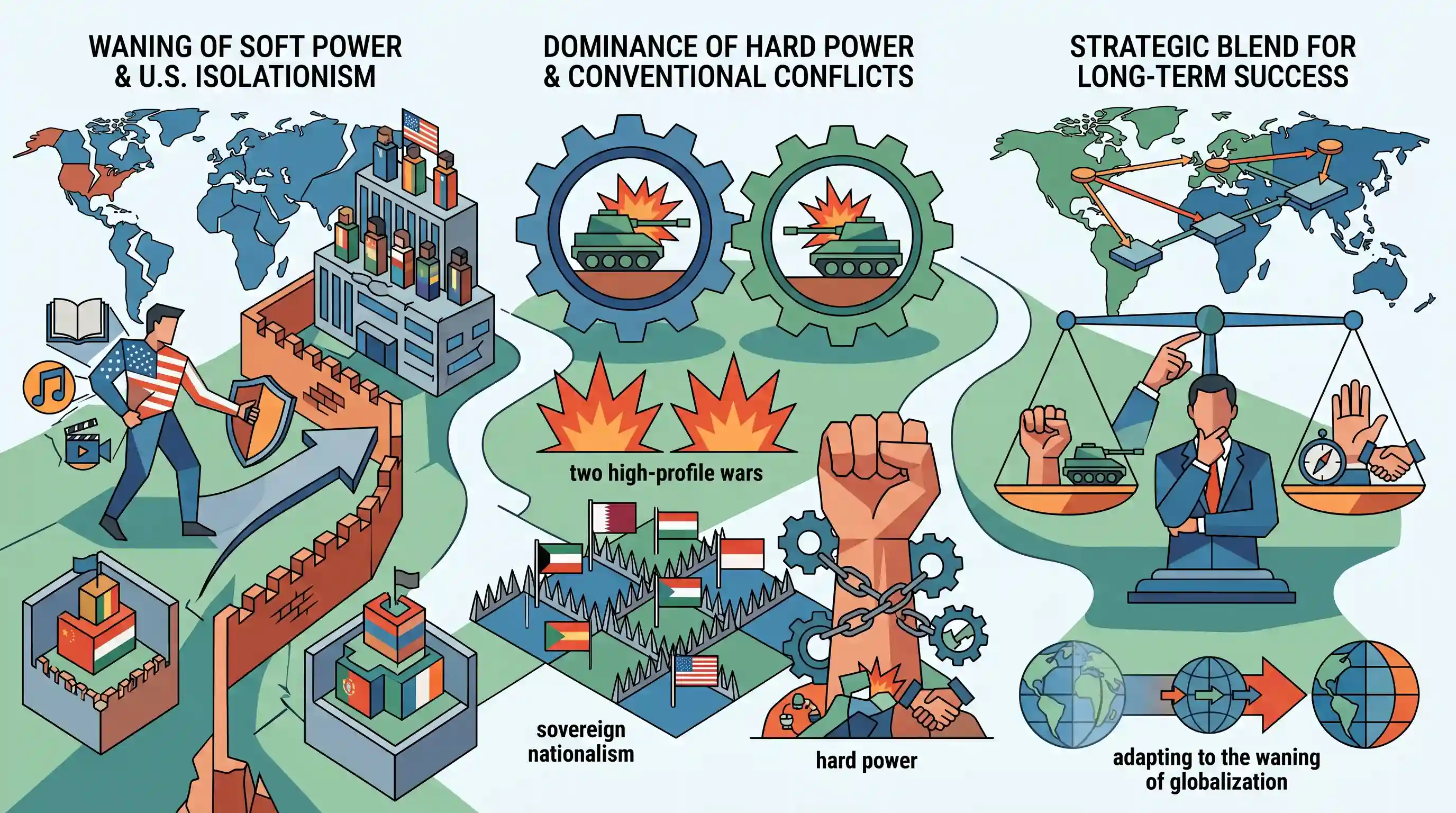
The article critically examines the continued relevance of 'soft power' in a contemporary world fraught with major conventional conflicts and a global shift towards sovereign nationalism. It highlights how the United States' isolationist tilt and the reality of two high-profile wars underscore the limitations of relying solely on cultural and ideological influence. The piece suggests that while hard power currently dominates the international arena, long-term diplomatic success still requires a strategic blend of both hard and soft power, adapting to the waning of globalization.
Key Points
- The relevance of 'soft power' is increasingly questioned in a geopolitical landscape dominated by conventional warfare and hard power realities.
- The resurgence of US isolationism under Donald Trump's 'America First' approach signifies a retreat from traditional liberal internationalism and normative global leadership.
- The waning of globalization has paved the way for sovereign nationalism, where states prioritize immediate security and economic interests over cultural and ideological influence.
- While soft power faces limitations in resolving acute conflicts, maintaining a balance between hard and soft power ('smart power') remains essential for long-term diplomatic strategy.
Prelims Trap
Smart power is an IR doctrine defined exclusively by the use of advanced technological and AI-driven military capabilities.
Smart power, conceptualized by Joseph Nye, is not about technology. It refers to the strategic combination of hard power (military/economic coercion) and soft power (cultural attraction) to achieve state goals.
Static Concepts Connected
What distinguishes Hard, Soft, and Smart Power in International Relations?
- Hard Power: Coercive approach relying on military force, strategic alliances, and economic sanctions to compel desired outcomes from other states.
- Soft Power: The ability to co-opt rather than coerce, relying on the intrinsic appeal of a nation's culture, political values, and diplomatic policies.
- Smart Power: A pragmatic, strategic blend of both hard and soft power, ensuring cultural appeal is backed by real economic and military leverage.
What is 'Sovereign Nationalism' and how does it challenge globalization?
- Sovereign Nationalism: A political ideology prioritizing absolute national sovereignty, border security, and domestic interests over global ideological convergence or multilateral commitments.
- Economic Protectionism: It manifests economically through tariffs, friend-shoring, and domestic industrial subsidies, actively challenging free-market globalization and established WTO norms.
- Normative Vacuum: As powerful nations retreat into isolationism, it undermines liberal international institutions, complicating global consensus on issues like climate change and trade.
Cross-Topic Patterns
India's shift to 'Smart Power' diplomacy
India increasingly couples its historical soft power (Yoga, diaspora, Vaccine Maitri) with hard power assertions (border infrastructure, defense indigenization), reflecting a pragmatic 'smart power' shift in a multipolar world.
Economic protectionism and Sovereign Nationalism
Sovereign nationalism directly feeds GS-3 economic themes like deglobalization, protectionist tariffs, and the push for self-reliance (Atmanirbhar Bharat) as nations prioritize security over efficient global supply chains.

Expect a 2026 Mains GS-2 question evaluating India's transition to 'Smart Power' diplomacy amidst the decline of liberal internationalism.
Linked PYQs · 2
Linked PYQs · 2
- 2015MainsGS2
Terrorist activities and mutual distrust have clouded India-Pakistan relations. To what extent the use of soft power like sports and cultural exchanges could help generate goodwill between the two countries? Discuss with suitable examples.
- 2025MainsGS2
"With the waning of globalization, post-Cold War world is becoming a site of sovereign nationalism.” Elucidate.
