Geopolitical Chokepoint Disruptions Impact Global Supply Chains
Source:Indian Express ↗
Why It Matters
It provides a highly illustrative, real-world example of how geopolitical choke points (like the Strait of Hormuz) and regional conflicts disrupt international trade, cascading down to everyday consumer products. This is highly useful for substantiating answers on globalization, supply chain resilience, and the economic impacts of war.
Summary
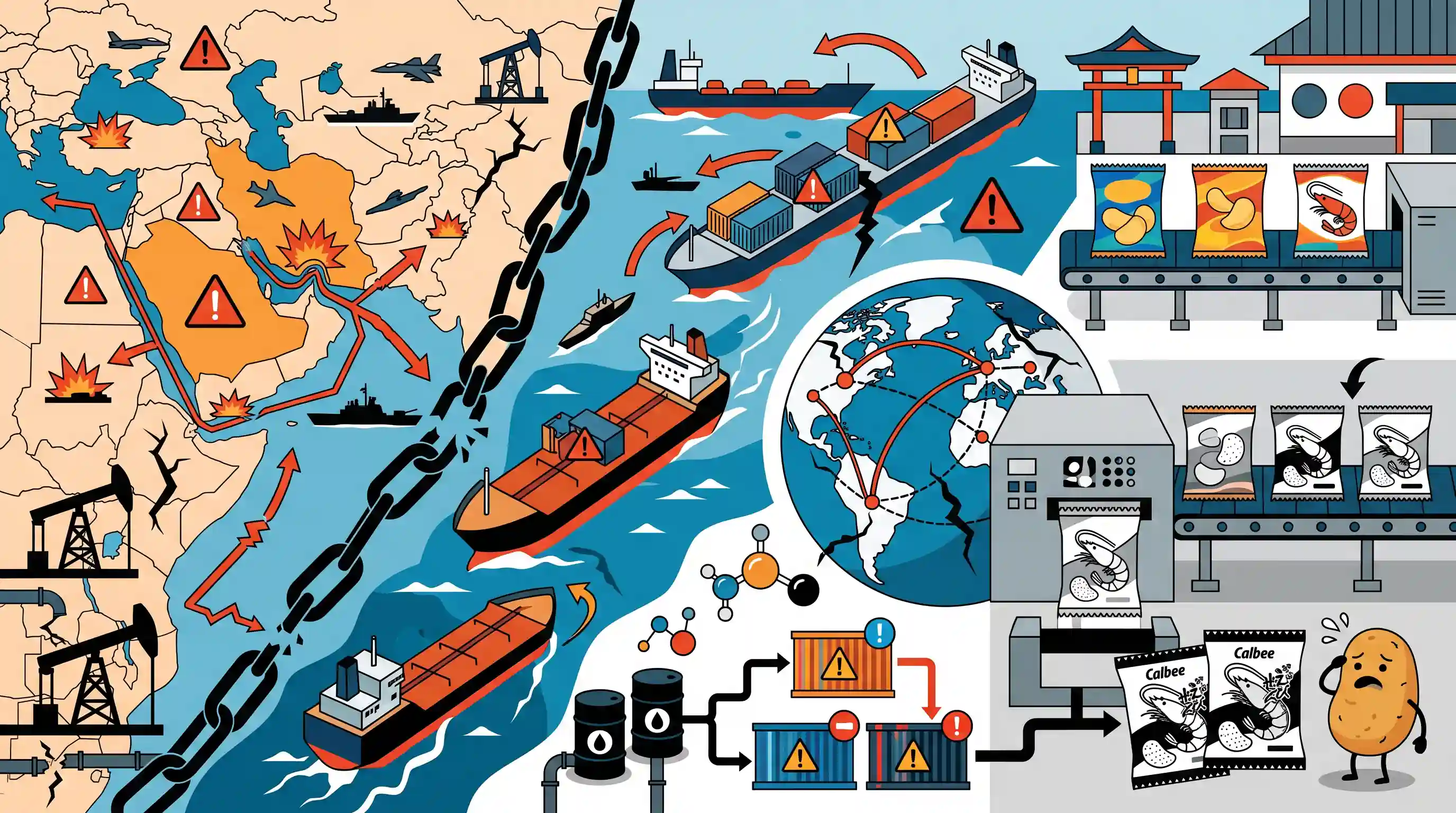
The article discusses how global conflicts and shipping disruptions, particularly around the Strait of Hormuz, have caused shortages in petroleum derivatives. This disruption has forced companies, such as the Japanese snack manufacturer Calbee, to adopt black-and-white packaging due to a lack of colored ink, serving as a stark reminder of the vulnerability of interconnected global supply chains to geopolitical tensions.
Key Points
- Japanese snack maker Calbee is transitioning to monochrome packaging for its potato chips due to a global shortage of colored printing ink.
- The ink scarcity is driven by a disruption in the supply of petroleum derivatives, caused by shipping challenges and conflicts near the critical Strait of Hormuz.
- Pigment categories crucial for colored inks, such as Phthalocyanine (blues and greens) and Azo (reds, oranges, yellows), require uninterrupted petroleum supplies.
- The situation illustrates the fragility and hyper-interconnectedness of global supply chains, where distant geopolitical instability directly impacts everyday consumer goods globally.
Important Terms
Strait of Hormuz

A strategic waterway between Iran and Oman connecting the Persian Gulf to the Gulf of Oman; the world's most critical oil chokepoint.
UPSC context
GS Paper I/II: Geography and International Relations. Essential for questions on global energy security and West Asian geopolitics.
Supply Chain Resilience
The ability of a supply chain to anticipate, absorb, and recover from disruptions, often through source diversification and strategic stockpiling.
UPSC context
GS Paper III: Indian Economy. Key to discussing India's self-reliance (Atmanirbharta) and trade diversification strategies.
Maritime Chokepoint
Narrow maritime passages that are vital for global trade but vulnerable to blockades, causing significant delays and price spikes if disrupted.
UPSC context
GS Paper I: World Geography. Tests knowledge of critical trade routes and their strategic vulnerability during conflicts.
Naphtha
A flammable liquid hydrocarbon mixture derived from petroleum distillation; a primary feedstock for producing plastics, chemicals, and printing inks.
UPSC context
GS Paper III: Infrastructure/Energy. Relevant for understanding industrial raw material dependencies and the petrochemical sector's link to global oil.
Energy Security
Ensuring uninterrupted availability of energy sources at an affordable price, mitigating risks like price volatility and supply route blockages.
UPSC context
GS Paper III: Energy and Security. Core concept for India’s external trade and strategic petroleum reserve policies.
Calbee
A major Japanese snack manufacturer whose shift to monochrome packaging serves as a case study of how geopolitics affects consumer goods.
UPSC context
Essay/GS Paper III: Case study for supply chain vulnerability and the real-world economic impacts of international conflict.
Prelims Trap
The Supply Chain Resilience Initiative (SCRI) is a Quad framework involving India, Japan, Australia, and the US.
SCRI is frequently confused with the Quad. It is a trilateral initiative by India, Japan, and Australia to reduce supply chain dependency on China. The US is not a member.
Static Concepts Connected
What are the key strategic maritime chokepoints in the Middle East?
- Strait of Hormuz: Connects the Persian Gulf to the Gulf of Oman and Arabian Sea. Bordered by Iran and Oman. Crucial for global petroleum transit.
- Bab-el-Mandeb: Connects the Red Sea to the Gulf of Aden and Arabian Sea. Bordered by Yemen, Djibouti, and Eritrea.
- Suez Canal: Artificial sea-level waterway in Egypt connecting the Mediterranean Sea to the Red Sea, separating Africa from Asia.
What is the Supply Chain Resilience Initiative (SCRI)?
- Core Members: India, Japan, and Australia. Launched in 2021 to counter over-dependence on China.
- Objective: To create a virtuous cycle of enhancing supply chain resilience with a view to eventually attaining strong, sustainable, and inclusive growth in the Indo-Pacific.
- Mechanism: Focuses on sharing best practices, investment promotion events, and buyer-seller matching platforms to diversify supply networks.
Cross-Topic Patterns
Geopolitics driving "Imported Inflation"
Disruptions in maritime chokepoints don't just spike energy costs; they trigger petrochemical shortages, cascading into FMCG supply shocks and driving "imported inflation" in import-dependent economies like India.
Strait of Hormuz to Indo-Pacific SCRI
The vulnerability of just-in-time manufacturing to Middle East instability underscores why Indo-Pacific nations (India, Japan, Australia) launched the SCRI to diversify manufacturing hubs away from single-point dependencies.

Mapping of Middle East chokepoints paired with SCRI/IPEF supply-chain pillars is highly probable as a multi-statement question in 2026.
Linked PYQs · 2
Linked PYQs · 2
- 2024MainsGS2
Discuss the geopolitical and geostrategic importance of Maldives for India with a focus on global trade and energy flows. Further also discuss how this relationship affects India's maritime security and regional stability amidst international competition ?
- 2024PrelimsGS1
Consider the following statements : Statement-I : Sumed pipeline is a strategic route for Persian Gulf oil and natural gas shipments to Europe. Statement-II : Sumed pipeline connects the Red Sea with the Mediterranean Sea. Which one of the following is correct in respect of the above statements?
