Government Releases Names of Personnel Killed in Operation Sindoor
Source:The Hindu ↗
Why It Matters
This officially acknowledges the casualties of India's proactive counter-terrorism strategy (surgical strikes) against cross-border terror launchpads. The involvement of an Agniveer in a high-risk trans-LoC operation also provides critical real-world context to the ongoing debate over the combat efficacy and welfare of recruits under the Agnipath scheme.
Summary
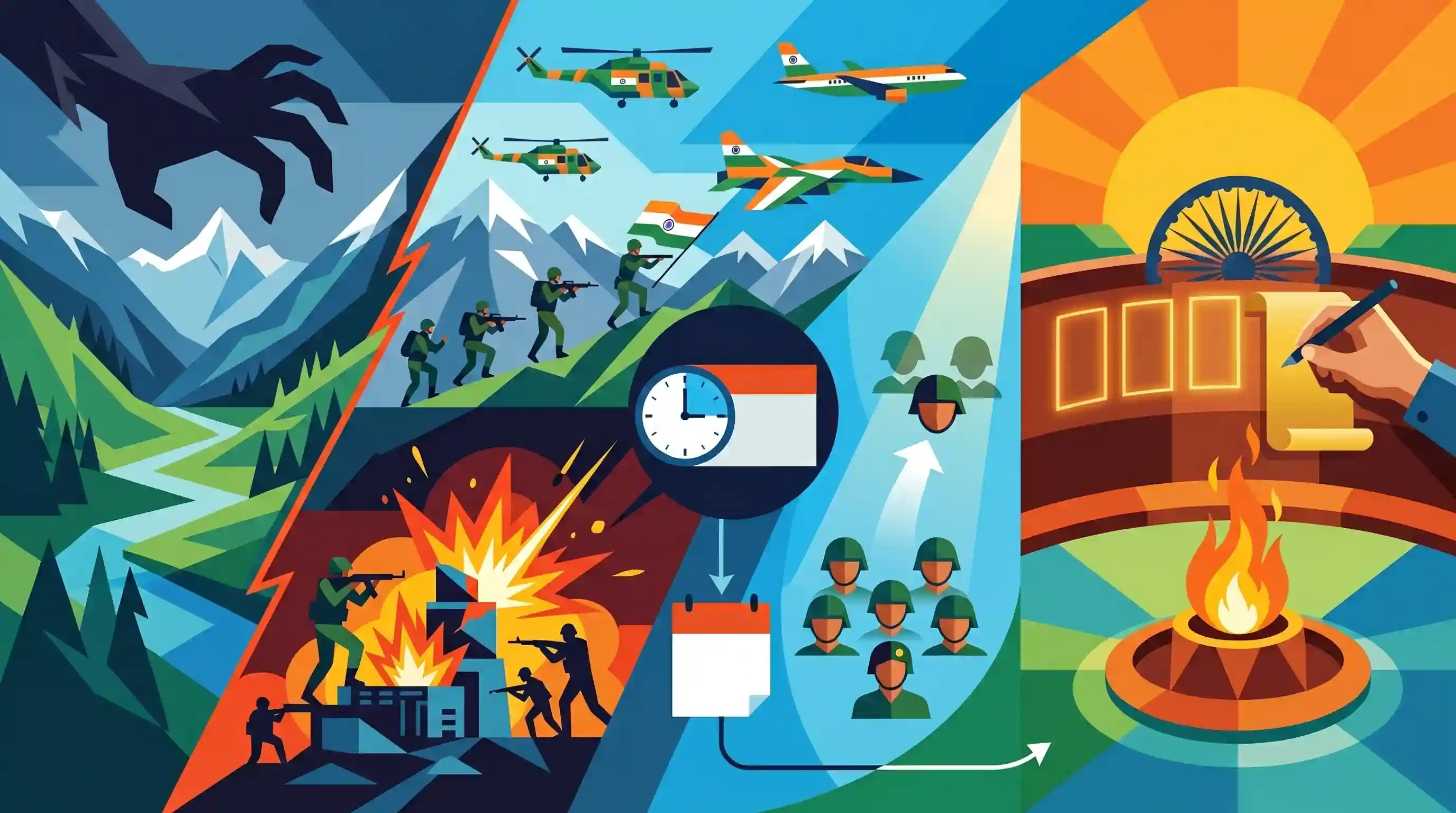
The Indian government has officially released the names of six armed forces personnel killed during 'Operation Sindoor', a cross-border retaliatory strike conducted in May 2025 against Jaish-e-Mohammed and Lashkar-e-Taiba launchpads in Pakistan and PoK. The operation was launched in response to the Pahalgam terror attack. Among the martyrs was an Agniveer, marking a significant instance of Agnipath recruits facing casualties in frontline, offensive combat. The names of the fallen personnel have now been inscribed on the Tyag Chakra (Circle of Sacrifice) at the National War Memorial in New Delhi to honor their supreme sacrifice.
Key Points
- The government officially released the names of six Indian armed forces personnel who were killed in action during 'Operation Sindoor'.
- Conducted in May 2025, Operation Sindoor was a targeted surgical strike across the LoC against JeM and LeT camps in retaliation for the Pahalgam terror attack.
- The casualties included an Agniveer, highlighting the active combat deployment of recruits under the Agnipath scheme in high-stakes operations.
- The names of the fallen soldiers have been inscribed on the Tyag Chakra at the National War Memorial and listed in the digital Roll of Honour.
Important Terms
Operation Sindoor

A 2025 cross-border retaliatory strike by Indian forces targeting Jaish-e-Mohammed and Lashkar-e-Taiba launchpads in Pakistan and PoK, launched following the deadly Pahalgam terror attack.
UPSC context
GS-III (Security/Internal Security); tests knowledge of strategic deterrence, retaliatory doctrine, and contemporary cross-border operations.
Agnipath scheme
A 2022 defense recruitment reform where youth (Agniveers) enlist for a four-year service term, with 25% potentially absorbed into permanent commission.
UPSC context
GS-II/III (Government Policies/Security); tests understanding of manpower reforms and their impact on defense preparedness and budgets.
Tyag Chakra
The 'Circle of Sacrifice' at the National War Memorial, featuring 16 concentric granite walls inscribed with the names of fallen personnel in golden letters.
UPSC context
GS-I/III (Culture/Security); tests awareness of national monuments and traditions of military honor and commemoration.
National War Memorial
A New Delhi-based monument inaugurated in 2019 to honor Indian Armed Forces personnel who died in armed conflicts and peacekeeping missions since Independence.
UPSC context
GS-I (Culture); significant for questions regarding national symbolism, modern history, and military heritage.
Lashkar-e-Taiba (LeT)
A Pakistan-based militant organization responsible for major terror incidents in India, including the 2008 Mumbai attacks and the 2025 Pahalgam incident.
UPSC context
GS-III (Internal Security); tests knowledge of non-state actors, cross-border terrorism, and external security threats.
Jaish-e-Mohammed (JeM)
A Deobandi militant group founded by Masood Azhar, known for high-profile suicide missions including the 2019 Pulwama and 2025 Delhi Red Fort attacks.
UPSC context
GS-III (Internal Security); focuses on terrorist infrastructure in neighboring countries and India's counter-terrorism response.
Prelims Trap
"Recruits under the Agnipath scheme are restricted to defensive roles and excluded from offensive cross-border operations."
Agniveers undergo standard combat training and are actively deployed in frontline, high-stakes, and cross-border offensive missions, as evidenced by Operation Sindoor.
Static Concepts Connected
What are the four concentric circles of the National War Memorial?
- Amar & Veerta Chakra: The innermost circles featuring the Eternal Flame (Immortality) and bronze murals depicting famous battles (Bravery).
- Tyag Chakra: Concentric walls modeled on the ancient 'Chakravyuh' formation, bearing independent granite tablets inscribed with the names of fallen soldiers.
- Rakshak Chakra: The outermost circle consisting of trees, symbolizing standing soldiers guarding the nation's territorial integrity.
What are the core mechanisms of the Indus Waters Treaty (1960)?
- River Allocation: India receives unrestricted use of Eastern rivers (Ravi, Beas, Sutlej). Pakistan receives Western rivers (Indus, Jhelum, Chenab).
- Run-of-the-River Rights: India is permitted limited agricultural use and the construction of run-of-the-river hydroelectric projects on the Western rivers.
- Dispute Resolution: A three-tiered mechanism: Permanent Indus Commission, followed by a Neutral Expert (World Bank), and a Court of Arbitration for unresolved disputes.
Cross-Topic Patterns
Hydropolitics as comprehensive deterrence
The linkage of military strikes (Op Sindoor) with the suspension of the Indus Waters Treaty marks a strategic shift towards multi-domain 'comprehensive deterrence', combining hard power with hydropolitics.
Agnipath scheme in active combat
The casualty validates that Agniveers are deployed in high-stakes, cross-border offensives. This bridges HR defense policy (Agnipath) with operational internal security realities.

Expect a 2026 prelims question mapping the National War Memorial 'Chakras' or a Mains prompt on hydropolitics as military deterrence.
Linked PYQs · 3
Linked PYQs · 3
- 2016MainsGS3
The terms 'Hot Pursuit' and 'Surgical Strikes' are often used in connection with armed action against terrorist attacks. Discuss the strategic impact of such actions.
- 2021MainsGS3
Keeping in view India's internal security, analyse the impact of cross-border cyber attacks. Also discuss defensive measures against these sophisticated attacks.
- 2020MainsGS3
Analyze internal security threats and transborder crimes along Myanmar, Bangladesh and Pakistan borders including Line of Control (LoC). Also discuss the role played by various security forces in this regard.
