Ancient Enamel Proteins Advance Paleoproteomics and Evolution
Source:The Hindu ↗
Why It Matters
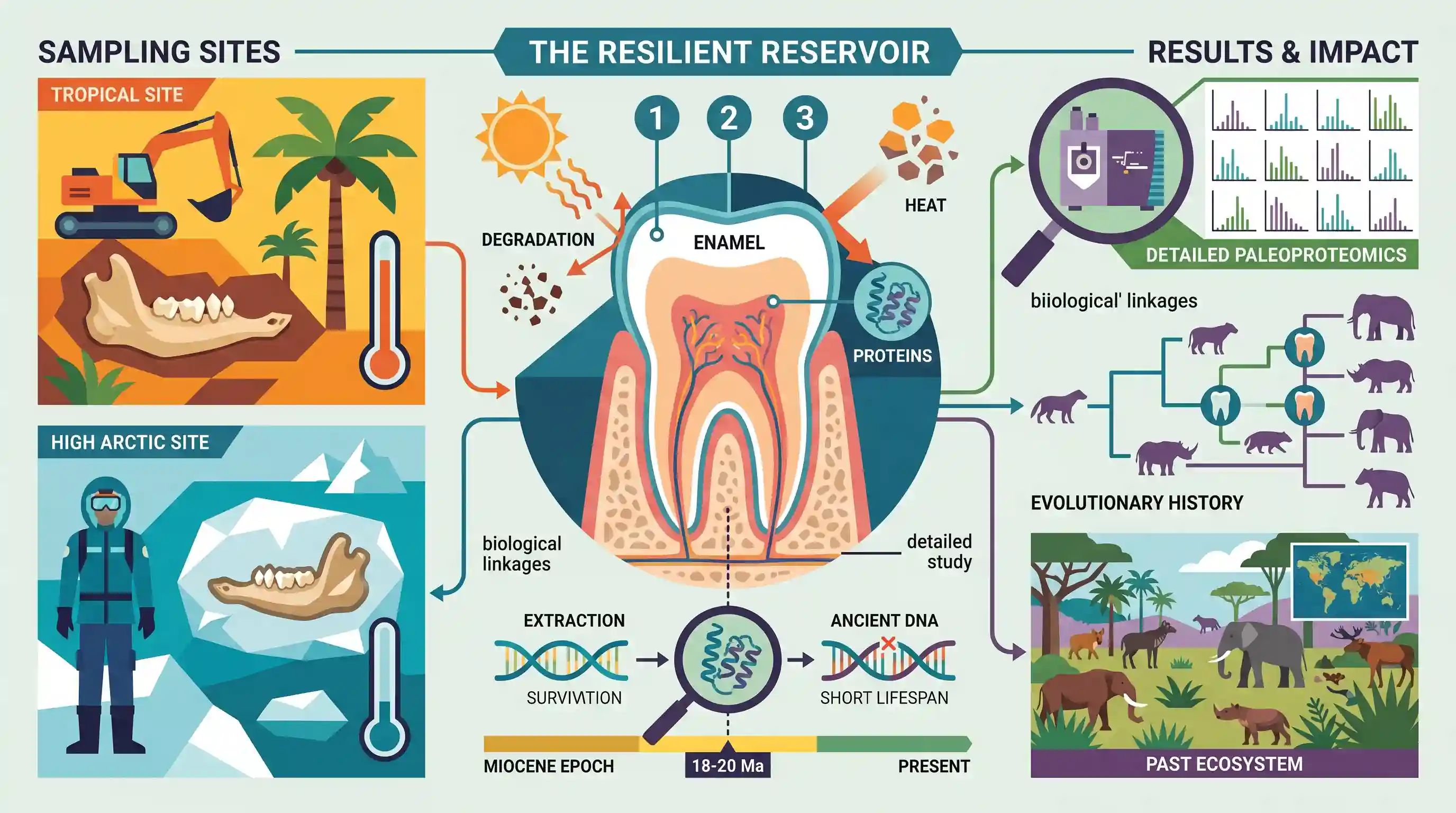
Demonstrates the immense potential of paleoproteomics in unlocking deep geological history. Being able to extract ancient proteins dating back millions of years allows scientists to map evolutionary linkages of extinct taxa, surpassing the chronological limits of ancient DNA preservation, which rarely survives past a few million years.
Summary
In a groundbreaking scientific achievement, researchers have successfully extracted enamel proteins dating back 18-20 million years from fossils located in both tropical and High Arctic sites. This major advancement in paleoproteomics enables the detailed study of the palaeobiology and evolutionary history of extinct species from the Miocene epoch. Extracting ancient biomolecules from tropical climates is exceptionally challenging due to the rapid degradation of organic material caused by heat. However, tooth enamel—the hardest tissue in vertebrate bodies—functions as a resilient reservoir that preserves these proteins across geological timescales, allowing scientists to reconstruct past ecosystems and biological linkages beyond the limits of ancient DNA.
Key Points
- Researchers successfully extracted ancient enamel proteins dating back 18 to 20 million years, marking a significant milestone in paleoproteomics.
- Tooth enamel serves as an exceptionally stable reservoir, protecting ancient proteins from degradation over immense geological timescales.
- The extraction of biomolecules from tropical sites is particularly groundbreaking, as high temperatures usually accelerate the breakdown of proteins and DNA.
- Studying these ancient proteins helps scientists unravel the palaeobiology, phylogenetic linkages, and evolutionary relationships of extinct taxa from the Miocene epoch.
- Data gathered from both the High Arctic and tropical fossils aids in the reconstruction of Earth's past climates and ancient ecosystems.
Prelims Trap
Ancient DNA is highly resilient and can survive for 20 million years in tropical fossils.
DNA degrades much faster than proteins, rarely surviving past 1 million years. Paleoproteomics succeeds here precisely because proteins in tooth enamel outlast DNA over geological timescales.
Static Concepts Connected
How do ancient DNA and Paleoproteomics differ in studying extinct species?
- Target molecules: Ancient DNA studies surviving genetic material (nucleic acids); paleoproteomics studies ancient amino acid sequences (proteins).
- Longevity: DNA rarely survives beyond 1-2 million years; proteins preserved in tooth enamel can survive for tens of millions of years.
- Preservation climate: Both degrade faster in hot, humid (tropical) climates compared to frozen environments like permafrost, making tropical extraction rare.
What are the key evolutionary and climatic features of the Miocene Epoch?
- Timeframe: Spans from roughly 23 million to 5.3 million years ago, falling under the Neogene Period.
- Flora shifts: Marked by the massive expansion of open vegetation systems (grasslands) at the expense of forests.
- Faunal evolution: Characterized by the widespread diversification of grazing mammals and early hominoids (apes).
Cross-Topic Patterns
Paleoproteomics & Human Evolution
Just as ancient proteins helped identify Denisovans (UPSC 2019), this breakthrough extends paleoproteomics to older epochs, linking biological evolution directly to paleoclimatology.
Geography of Fossil Preservation
Ties into physical geography concepts of chemical weathering; high heat and humidity usually destroy organic matter rapidly, making this tropical biomolecule extraction highly anomalous.

Expect a comparative S&T question contrasting ancient DNA with paleoproteomics (longevity, target molecules) linked to geological epochs.
Linked PYQs · 4
Linked PYQs · 4
- 2019PrelimsGS1
The word 'Denisovan' is sometimes mentioned in media in reference to
- 2023PrelimsGS1
'Microsatellite DNA' is used in the case of which one of the following?
- 2023PrelimsGS1
'Aerial metagenomics' best refers to which one of the following situations?
- 2021MainsGS3
What are the research and developmental achievements in applied biotechnology? How will these achievements help to uplift the poorer sections of the society?
