Great Indian Bustard Chicks Released into Rewilding Tunnel
Source:dailypioneer ↗
Why It Matters
The Great Indian Bustard (Godawan) is critically endangered and serves as the State Bird of Rajasthan. Conservation efforts like captive breeding and rewilding in the Desert National Park are highly relevant for RPSC exams, especially concerning the state's biodiversity, environmental initiatives, and state symbols.
Summary
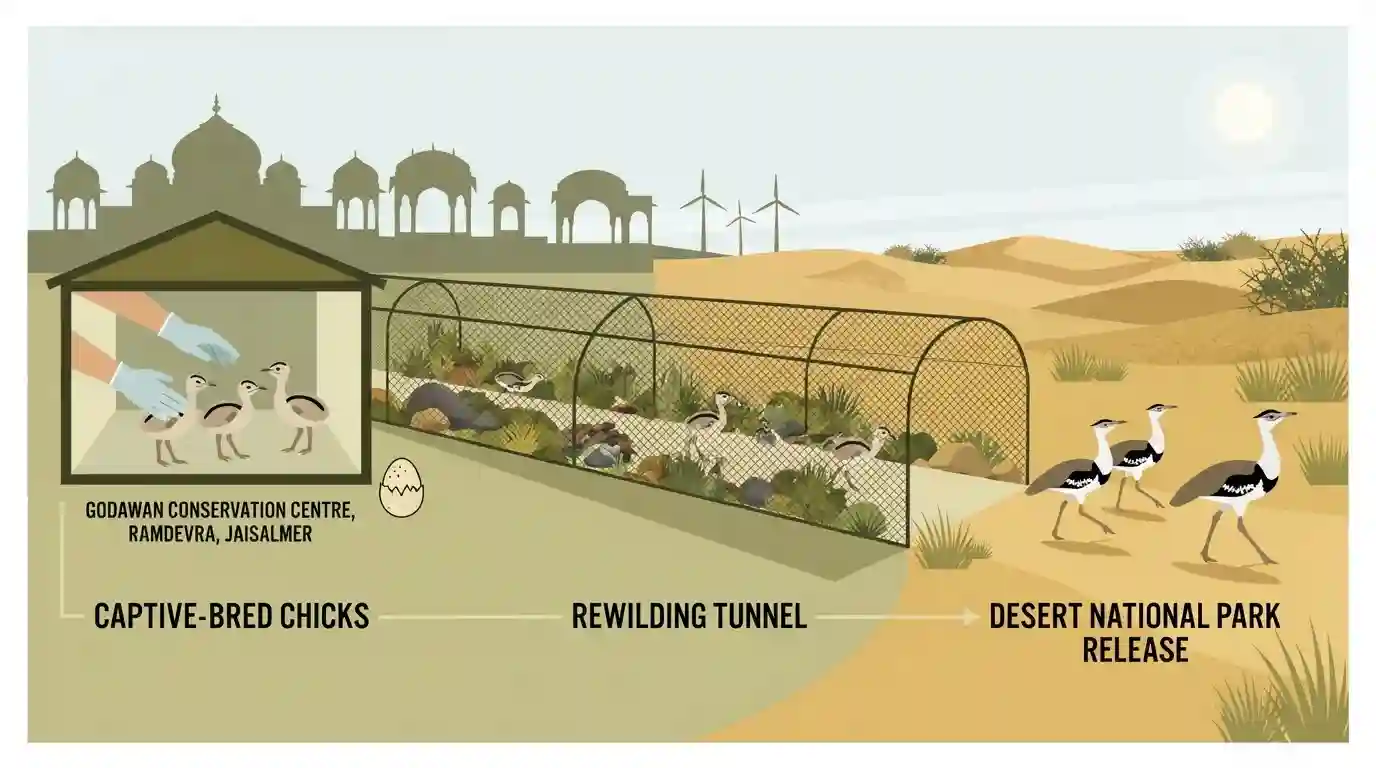
In a first-of-its-kind conservation effort for the critically endangered Great Indian Bustard (GIB), three captive-bred chicks have been released into a newly constructed rewilding tunnel at the Godawan Conservation Centre in Ramdevra, Jaisalmer. The initiative aims to acclimatize the chicks to a natural environment with minimal human interaction, fostering their wild instincts. Once successfully rewilded, the birds will be released into the Desert National Park to help boost the dwindling population of Rajasthan's State Bird.
Key Points
- Three captive-bred Great Indian Bustard (GIB) chicks were released into a specially designed rewilding tunnel at the Godawan Conservation Centre in Ramdevra, Jaisalmer.
- The rewilding tunnel is designed to minimize human contact, helping the chicks develop natural instincts required for survival in the wild.
- This initiative marks the first time such a rewilding process has been attempted for the Great Indian Bustard, an endangered species and the State Bird of Rajasthan.
- The ultimate goal is to prepare these birds for release into their natural habitat, specifically the Desert National Park in Rajasthan.
Important Terms
Great Indian Bustard (Godawan)

A critically endangered, heavy flying bird native to the Indian subcontinent's dry grasslands. It is Rajasthan's state bird, protected under Schedule I of the Wildlife (Protection) Act, and faces severe threats from power lines and habitat loss.
UPSC context
Crucial for GS Paper 3 (Biodiversity) and Prelims. Often tested on its Critically Endangered IUCN status and specific desert habitats.
Godawan Conservation Centre
A specialized breeding and rehabilitation facility in Jaisalmer, Rajasthan, dedicated to saving the Great Indian Bustard. It utilizes modern techniques like artificial insemination and rewilding enclosures to restore dwindling wild populations.
UPSC context
GS Paper 3 (Conservation). Relevant for evaluating ex-situ conservation strategies and state-led species recovery programs in India.
Rewilding
A conservation approach that transitions captive-bred animals back into their natural habitats. In this context, using specially designed tunnels to acclimatize chicks to desert conditions while eliminating human dependence.
UPSC context
GS Paper 3 (Environment). Important concept for questions on ecological restoration, species reintroduction, and wildlife rehabilitation methods.
Desert National Park
A major protected area spanning Jaisalmer and Barmer districts in Rajasthan. Characterized by sand dunes and extreme aridity, it is the primary natural stronghold for the critically endangered Great Indian Bustard.
UPSC context
GS Paper 1 & 3 (Geography, Environment). Frequently tested in Prelims mapping and protected area questions (e.g., UPSC 2020).
Prelims Trap
The Desert National Park is completely free of human settlements to minimize anthropogenic pressure on the Great Indian Bustard.
UPSC often tests this exception; Desert National Park uniquely includes several villages and permanent human settlements inside its boundaries.
Static Concepts Connected
What are the unique geographical and ecological features of Desert National Park (DNP)?
- Location: Spread across Jaisalmer and Barmer districts of Rajasthan within the Thar Desert ecosystem.
- Human Presence: Unlike most national parks, DNP contains multiple inhabited villages and human settlements inside its boundaries.
- Fauna: Acts as the primary natural habitat of the critically endangered Great Indian Bustard.
What is the constitutional significance of the M.K. Ranjitsinh v. Union of India case?
- Article 21 expansion: The Supreme Court recognized a fundamental 'right to be free from adverse effects of climate change' under Articles 21 and 14.
- Policy Balance: Created a balanced framework to protect GIBs from power lines while permitting underground solar energy transmission corridors.
Cross-Topic Patterns
Green energy vs. Wildlife conservation
The collision of GIBs with solar power lines in Rajasthan illustrates the direct policy conflict between expanding renewable energy grids and preserving endangered biodiversity.
Ex-situ to In-situ transitions
Using Ramdevra's rewilding tunnels to acclimatize captive-bred GIB chicks before release into DNP showcases the integration of ex-situ breeding with in-situ wild recovery.

The GIB power-line case and SC's reading of the 'right against climate change' into Article 21 is a high-probability 2026 GS-2/3 theme.
Linked PYQs · 3
Linked PYQs · 3
- 2021RPSC_PRELIMSGS1
The state flower of Rajasthan is
- 2023RPSC_PRELIMSGS1
The National Tiger Conservation Authority has conferred the status of the fifth tiger sanctuary in Rajasthan, to which of the following sanctuaries?
- 2025RPSC_PRELIMSGS1
Choose the incorrect statement with respect to the Rajasthan Forestry and Biodiversity Project (Phase-2).
