Scientific Discovery of New Color and Philosophical Perspectives
Source:Indian Express ↗
Why It Matters
The discovery acts as a perfect interdisciplinary case study, linking the hard science of human vision and genetic disorders (like colour blindness) to the philosophical necessity of empathy and breaking rigid binaries in essay writing and ethics.
Summary
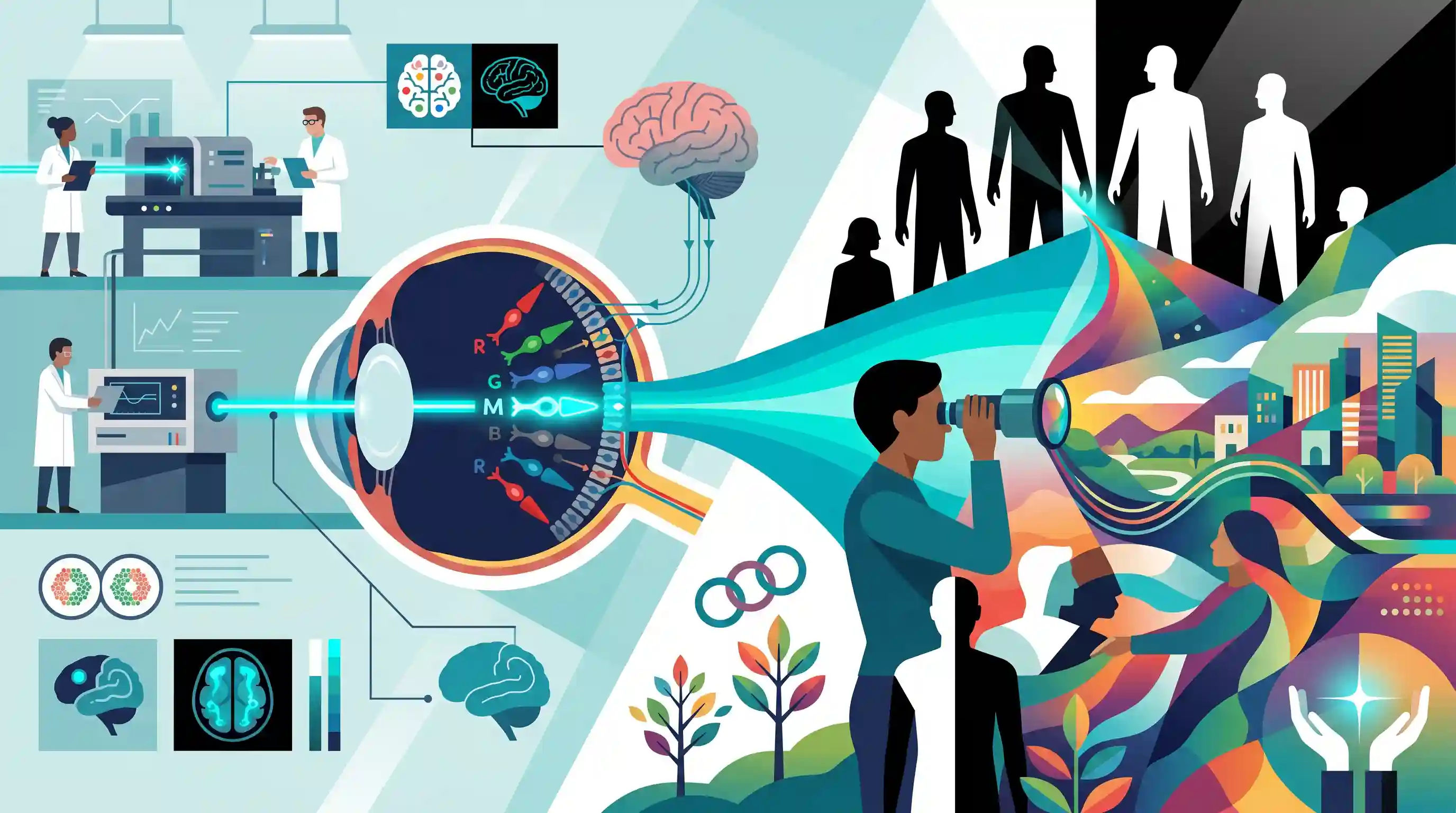
Researchers from UC Berkeley and the University of Washington have discovered "olo," an unprecedented, highly saturated blue-green colour. Utilizing a device called the Oz Vision System, scientists fired precise laser pulses to stimulate exclusively the medium (M) cone cells in the human eye—hence the binary '010' origin of the name. While this breakthrough offers significant scientific value for understanding colour blindness and brain-vision mechanics, the editorial highlights its profound philosophical metaphor. In an increasingly polarized world dominated by black-and-white binaries, the ability to perceive a completely new shade underscores the importance of nuance, breaking fixed dichotomies, and viewing reality through an empathetic, alternative lens.
Key Points
- Researchers have discovered a new, incredibly saturated blue-green colour named "olo" that cannot be seen under normal conditions.
- The colour was generated using the "Oz Vision System", which uses laser pulses to selectively stimulate only the M (medium) cone cells in the human retina.
- The name "olo" is derived from the binary code 010, representing the isolated activation of the M cone without triggering the L (long) or S (short) cones.
- Scientifically, this breakthrough enhances the understanding of human vision, brain visualisation, and genetic conditions like colour blindness.
- Philosophically, the discovery serves as a metaphor against rigid black-and-white binary thinking, advocating for nuance, ambiguity, and the empathy required to see the world from entirely new perspectives.
Important Terms
Cone Cells (M-cones)

Light-sensitive photoreceptor cells in the retina responsible for color vision. M-cones specifically detect medium-wavelength light, which the brain typically interprets as green.
UPSC context
GS Paper III (Science and Technology): Human Physiology and sensory perception; GS Paper I: Basic Biology.
Color Blindness
A visual impairment where an individual cannot distinguish certain colors, usually caused by the absence or defect of one or more types of cone cells.
UPSC context
GS Paper III (Health): Genetic disorders and medical advancements in restoring sensory functions.
Tetrachromacy
The rare ability to perceive a fourth dimension of color due to having four types of cone cells, significantly expanding the visible color gamut beyond the standard three.
UPSC context
GS Paper III (Science and Technology): Advanced biological concepts and potential human enhancement technologies.
Oz Vision System
A laser-based technology that uses high-precision pulses to stimulate individual retinal photoreceptors, bypassing natural light constraints to study brain-vision mechanics.
UPSC context
GS Paper III (Science and Technology): Precision medicine, laser technology, and innovations in diagnostic/experimental imaging.
Olo
An 'impossible' hyper-saturated blue-green color discovered in 2025; its name is derived from binary '010,' representing the exclusive stimulation of medium (M) cone cells.
UPSC context
GS Paper III: Scientific breakthroughs; GS Paper IV: Philosophical metaphors for nuance and alternative perspectives.
Polarization (Social/Philosophical)
The division of a population or discourse into two sharply contrasting and often hostile groups or sets of opinions, typically eliminating nuance.
UPSC context
GS Paper IV (Ethics) and Essay: Analyzing societal conflict, empathy, and the importance of 'middle-path' perspectives.
Prelims Trap
"The colour 'olo' is a newly discovered naturally occurring wavelength in the visible light spectrum."
Olo does not exist in the natural electromagnetic spectrum. It is an artificial neural perception created by using lasers to stimulate only the M-cone, bypassing the natural overlap of cone activation.
Static Concepts Connected
What is the difference between Rods and Cones in the human eye?
- Rod cells: Responsible for vision at low light levels (scotopic vision). They do not mediate colour and have low spatial acuity.
- Cone cells: Active at higher light levels (photopic vision). They are responsible for colour vision and high spatial acuity.
- Cone variations: Humans typically have three types based on wavelength sensitivity: Short (S/blue), Medium (M/green), and Long (L/red).
How does colour blindness affect eligibility for UPSC Civil Services?
- Genetic basis: It is typically an X-linked recessive genetic condition, making it significantly more common in males than in females.
- Technical Services: Candidates with colour blindness are deemed medically unfit for technical/field services like IPS, IFoS, and IRTS.
- Non-Technical Services: Colour-blind candidates remain fully eligible for non-technical administrative and diplomatic roles like IAS, Indian Foreign Service (IFS), and IRS.
Cross-Topic Patterns
Scientific discoveries as Essay metaphors
The discovery of 'olo' breaking visual binaries serves as a potent essay theme on avoiding black-and-white thinking and fostering empathy in an increasingly polarized, algorithmic society.
Genetics and public service eligibility
Colour blindness bridges human genetics with administrative rules, relevant to debates over medical standards, disability rights, and inclusivity in All India Services (IPS/IFoS).

Expect a General Science prelims question pairing the function of cone cells (S, M, L) with genetic conditions like colour blindness.
Linked PYQs · 3
Linked PYQs · 3
- 2009PrelimsGS1
In the context of genetic disorders, consider the following: A woman suffers from colour blindness while her husband does not suffer from it. They have a son and a daughter. In this context, which one of the following statements is most probably correct?
- 2023MainsEssay
Thinking is like a game, it does not begin unless there is an opposite team.
- 2025MainsEssay
3. Thought finds a world and creates one also.
