Independence Day Address Highlights Bengal Freedom Struggle Legacy
Source:The Hindu ↗
Why It Matters
The article touches upon several key figures and elements of the Indian freedom struggle centered in Bengal (like Bankim Chandra Chattopadhyay, Khudiram Bose, and Syama Prasad Mookerjee), which are frequently tested in the Indian National Movement section of WBCS Prelims.
Summary
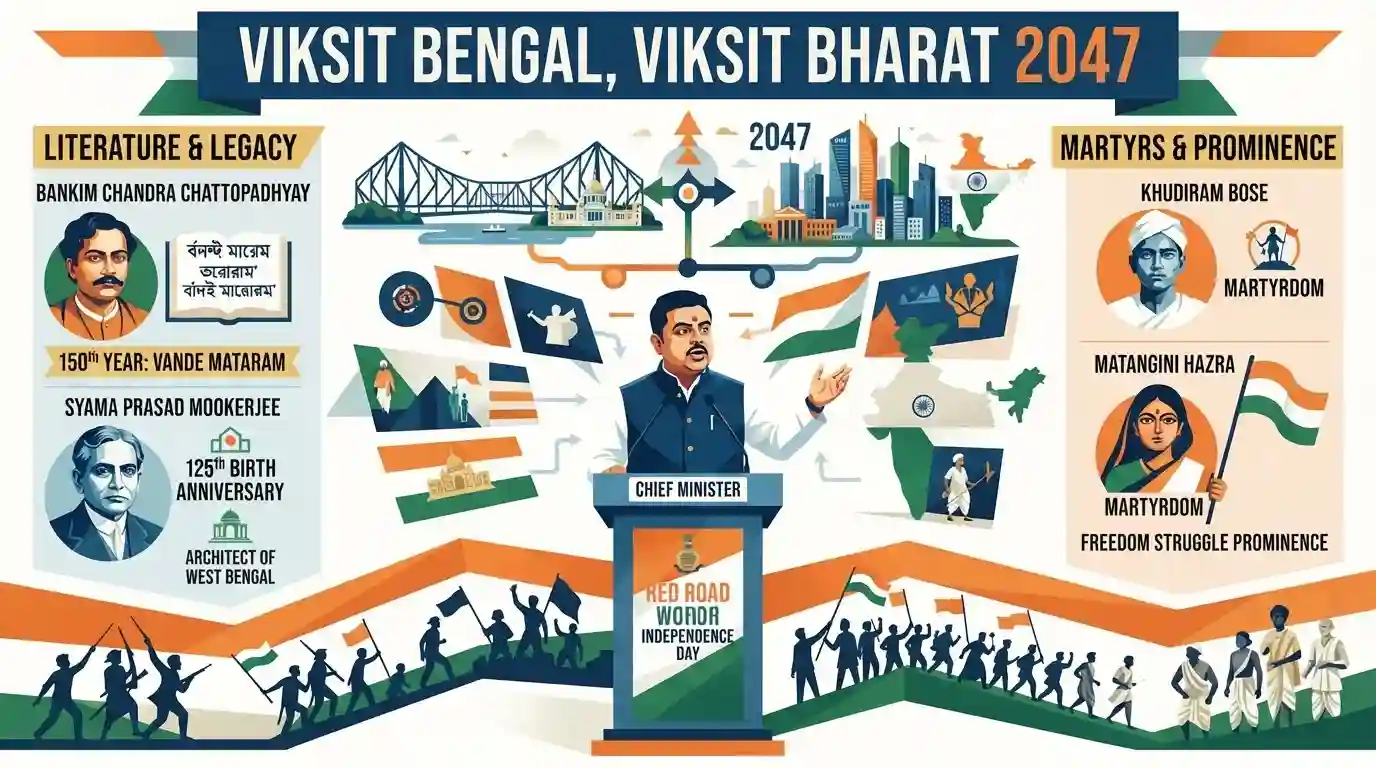
During his maiden Independence Day speech at Kolkata's Red Road, Chief Minister Suvendu Adhikari articulated a vision for 'Viksit Bengal' as a crucial component of achieving 'Viksit Bharat' by 2047. The celebration heavily honored Bengal's rich legacy in the freedom struggle, highlighting the 150th anniversary of Bankim Chandra Chattopadhyay's 'Vande Mataram' and the 125th birth anniversary of Syama Prasad Mookerjee, whom Adhikari termed the architect of West Bengal. The event also commemorated legendary martyrs like Khudiram Bose and Matangini Hazra, reaffirming the state's historical prominence.
Key Points
- Chief Minister Suvendu Adhikari delivered his maiden Independence Day address, promising to restore the old glory of West Bengal.
- He emphasized that Prime Minister Narendra Modi's vision of 'Viksit Bharat' (Developed India) by 2047 can only be realized through a prosperous 'Viksit Bengal'.
- The speech highlighted the historical contributions of prominent Bengali figures in the freedom struggle, including Bankim Chandra Chattopadhyay (composer of Vande Mataram, which is marking its 150th year), Rabindranath Tagore, Khudiram Bose, and Matangini Hazra.
- Special tribute was paid to Syama Prasad Mookerjee, described as the architect of West Bengal, featuring a tableau for his 125th birth anniversary.
Important Terms
Viksit Bharat 2047

The Government of India’s overarching vision to transform the country into a fully developed nation by the 100th anniversary of its independence in 2047, focusing on economic growth, sustainability, and inclusive development.
UPSC context
Important for Economy and Current Affairs papers. Candidates must know its key pillars and socio-economic targets.
Vande Mataram
India's National Song, written by Bankim Chandra Chattopadhyay in 1875 within his novel Anandamath. The government is celebrating its 150th anniversary across 2025-2026 to honor its historic role as a rallying cry during the freedom struggle.
UPSC context
Relevant for History (Indian National Movement) and Current Affairs, testing knowledge of cultural artifacts of independence.
Syama Prasad Mookerjee
An Indian politician, educationist, and Bharatiya Jana Sangh founder. Often called the 'architect of West Bengal,' he led the 1947 Bengali Hindu Homeland Movement to partition Bengal, ensuring a Hindu-majority state remained within the Indian Union.
UPSC context
Crucial for History and Polity papers regarding the Partition of India, Bengal politics, and post-independence political parties.
Khudiram Bose
A revolutionary from Bengal executed at age 18 on August 11, 1908, for his role in the Muzaffarpur conspiracy case. He is celebrated as one of the youngest and most iconic martyrs of India's independence movement.
UPSC context
A staple in the History syllabus (Indian National Movement), testing knowledge of early revolutionary nationalism.
Matangini Hazra
Affectionately known as 'Gandhi Buri,' she was a Gandhian freedom fighter from Bengal. She was martyred on September 29, 1942, while fearlessly leading a Quit India Movement procession in Tamluk, Midnapore with the tricolor in hand.
UPSC context
Frequently tested in History, highlighting women’s participation and regional (Bengal) contributions to the freedom struggle.
Prelims Trap
Rabindranath Tagore translated Vande Mataram into English for its first public performance at the 1896 Congress session.
Tagore set the tune and sang Vande Mataram at the 1896 Calcutta session, but the complete English translation was penned by Sri Aurobindo.
Static Concepts Connected
What is the historical significance of Bankim Chandra Chattopadhyay’s literary works?
- Anandamath (1882): Set against the 1770s Sannyasi Rebellion, this novel popularized 'Vande Mataram' as a nationalist rallying cry.
- Bangadarshana: A highly influential monthly literary magazine founded by Bankim in 1872 to nurture Bengali national consciousness.
What were the key political and academic contributions of Dr. Syama Prasad Mookerjee?
- Calcutta University: Served as the youngest Vice-Chancellor of Calcutta University from 1934 to 1938.
- First Cabinet: Served as independent India's first Minister for Industry and Supply; later resigned over the 1950 Liaquat-Nehru Pact.
- Jana Sangh Era: Founded the Bharatiya Jana Sangh in 1951, the ideological predecessor of the Bharatiya Janata Party.
Cross-Topic Patterns
Cultural Nationalism + INC Sessions
Connects literary resistance (like Anandamath) with specific INC sessions (1896 Calcutta Session), showing how cultural symbols catalyzed early political mobilization.
Militant Nationalism + Secret Societies
Ties revolutionary figures like Khudiram Bose to the organizational networks of Anushilan Samiti and Jugantar, highlighting Bengal's militant nationalism.

Anniversaries of Vande Mataram & S.P. Mookerjee make specific historical facts about Anandamath and early INC sessions high-yield for WBCS.
Linked PYQs · 2
Linked PYQs · 2
- 2008WBCS_PRELIMSGS1
Who wrote “Bande Mataram” ?
- 2007WBCS_PRELIMSGS1
Which two revolutionaries were involved in the Muzaffarpur Murder (1908)?
