IACS Science Institute Plans Second Campus in Baruipur for Anniversary
Source:timesofindia ↗
কেন এটি গুরুত্বপূর্ণ
The article highlights significant historical milestones related to India's scientific heritage, particularly the founding of IACS by Mahendra Lal Sircar and C. V. Raman's Nobel Prize-winning discovery. These form essential components of Modern History and General Science sections in the WBCS Preliminary syllabus.
সারসংক্ষেপ
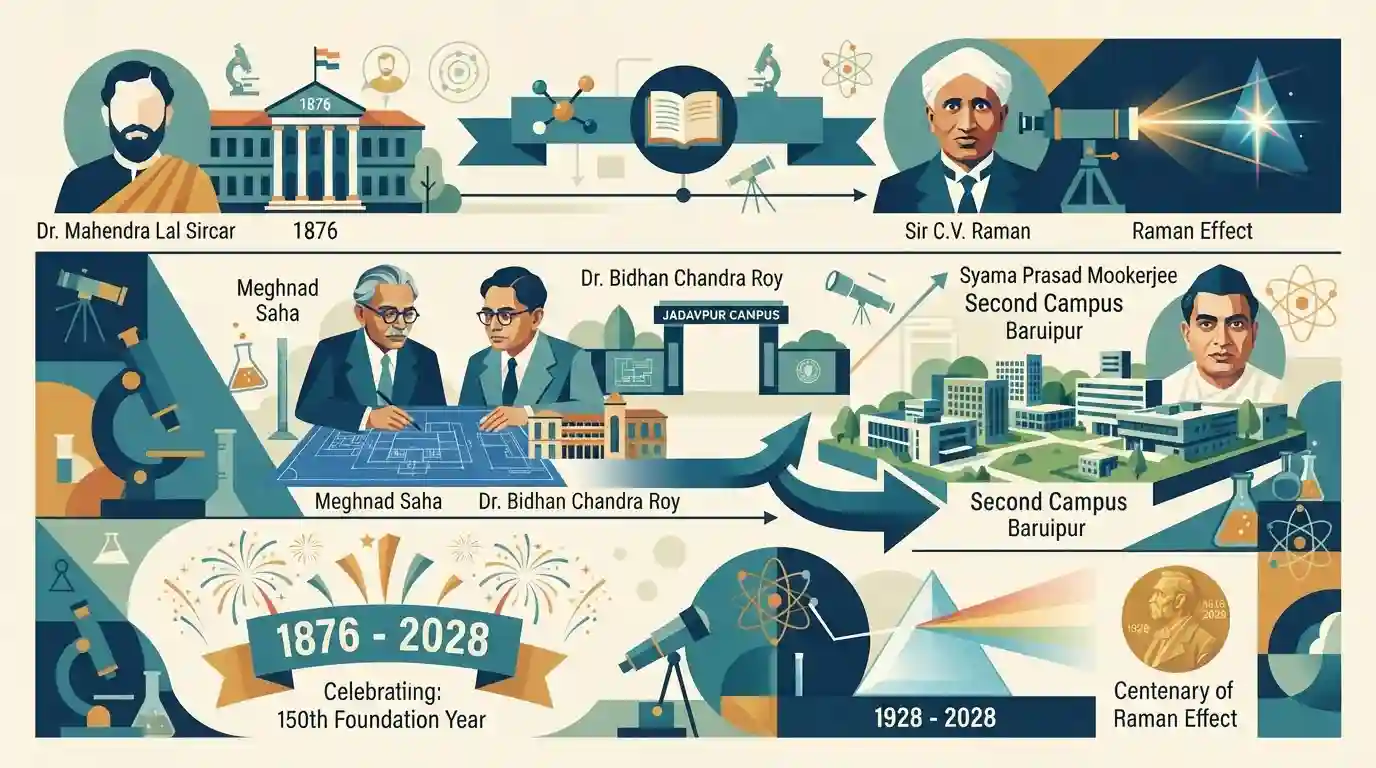
As it approaches its 150th anniversary, the Indian Association for the Cultivation of Science (IACS) in Kolkata has announced plans for a second campus in Baruipur, to be named after Syama Prasad Mookerjee. Founded in 1876 by Dr. Mahendra Lal Sircar, IACS holds the distinction of being the oldest science research institute in Asia. The institute boasts a rich historical legacy, notably being the place where Sir C. V. Raman discovered the Raman Effect, leading to his 1930 Nobel Prize in Physics. The current Jadavpur campus was developed by Meghnad Saha on land granted by Dr. Bidhan Chandra Roy. IACS plans to celebrate both its 150th foundation year and the centenary of the Raman Effect's discovery leading up to 2028.
মূল বিষয়
- The Indian Association for the Cultivation of Science (IACS), Asia's oldest science research institute, is planning a second campus at Baruipur to mark its 150th year.
- Founded in 1876 by Dr. Mahendra Lal Sircar, IACS is an autonomous institute under the Department of Science and Technology, Government of India.
- The new Baruipur campus will be named the Syama Prasad Mookerjee Advanced Research and Training (SMART) campus.
- IACS is historically significant as the site where Sir C. V. Raman discovered the Raman Effect, for which he was awarded the Nobel Prize in Physics in 1930.
- The present Jadavpur campus was established by eminent physicist Meghnad Saha on land provided by then Chief Minister Dr. Bidhan Chandra Roy.
গুরুত্বপূর্ণ শব্দ
Indian Association for the Cultivation of Science (IACS)

Established in 1876 in Kolkata, it is India’s oldest scientific research institution. Originally founded to promote indigenous science, it is now an autonomous deemed university funded by the Department of Science and Technology.
UPSC context
GS Paper I (Modern History) & GS Paper III (S&T); tests early national institutions and self-reliance in science.
Department of Science and Technology (DST)
A department under the Ministry of Science and Technology, established in 1971 to promote new scientific domains and act as a nodal agency for coordinating and funding scientific research in India.
UPSC context
GS Paper III (S&T Institutions); tests governance, funding, and policy frameworks driving the nation's scientific development.
Dr. Mahendra Lal Sircar
A 19th-century social reformer, homeopathic doctor, and the second MD from Calcutta Medical College. He founded the IACS in 1876, making him a pioneer of the modern science movement in colonial India.
UPSC context
GS Paper I (Modern History & Personalities); tests notable figures who spearheaded socio-cultural and scientific advancements.
Raman Effect
The inelastic scattering of light by molecules, resulting in changes in wavelength and energy of scattered photons. Discovered by C.V. Raman in 1928 at IACS, earning him the 1930 Nobel Prize.
UPSC context
GS Paper III (S&T/Developments); tests optical physics, spectroscopy applications, and landmark achievements of Indian scientists.
Syama Prasad Mookerjee
An eminent academician, barrister, and politician who served as the youngest Vice-Chancellor of Calcutta University, India's first Minister for Industry, and founded the Bharatiya Jana Sangh.
UPSC context
GS Paper I (Modern History/Post-Independence); tests political leadership and institutional contributions during the transition to independence.
প্রিলিমস ফাঁদ
IACS was founded under the direct patronage and financial sponsorship of the British colonial administration in 1876.
It was established entirely by Indian private initiative and public subscriptions led by Dr. Mahendra Lal Sircar to foster independent national scientific research.
সংযুক্ত স্থির ধারণা
What is the historical background and structure of India's National Calendar?
- Saha Committee: Chaired by physicist Meghnad Saha, the Calendar Reform Committee recommended standardizing India's diverse calendar systems in 1952.
- Saka Era: Adopted officially on March 22, 1957, with the Saka Era starting in 78 AD serving as the scientific base.
- Structure: Begins with the month of Chaitra; aligns with the tropical solar year with a standard length of 365 days.
আন্তঃবিষয় প্যাটার্ন
Swadeshi Science and National Education
IACS's founding reflects the late 19th-century Swadeshi impulse where Indian elites built indigenous scientific institutions to challenge colonial intellectual hegemony.
Scientists as Modern Nation Builders
Physicists like Meghnad Saha and doctors like B.C. Roy bridged the gap between pure science, early industrial planning, and post-independence constitutional statecraft.

IACS sesquicentennial likely to trigger a 2026 Prelims question mapping 19th-century scientific bodies to their Swadeshi-era founders.
সংযুক্ত PYQ · 1
সংযুক্ত PYQ · 1
- 2020WBCS_PRELIMSGS1
Sir C. V. Raman was awarded Nobel Prize for his work connected with which of the following phenomenon of radiation?
