Examination Leak Impunity Erodes Institutional Trust and Meritocracy
Source:Indian Express ↗
Why It Matters
The integrity of the examination system is a fundamental component of public trust and governance. For UPSC aspirants, this issue perfectly encapsulates the intersection of GS-2 (Governance, Accountability, Education) and GS-4 (Ethics, Probity, Corruption), illustrating how administrative failures and impunity compromise meritocracy and social mobility.
Summary
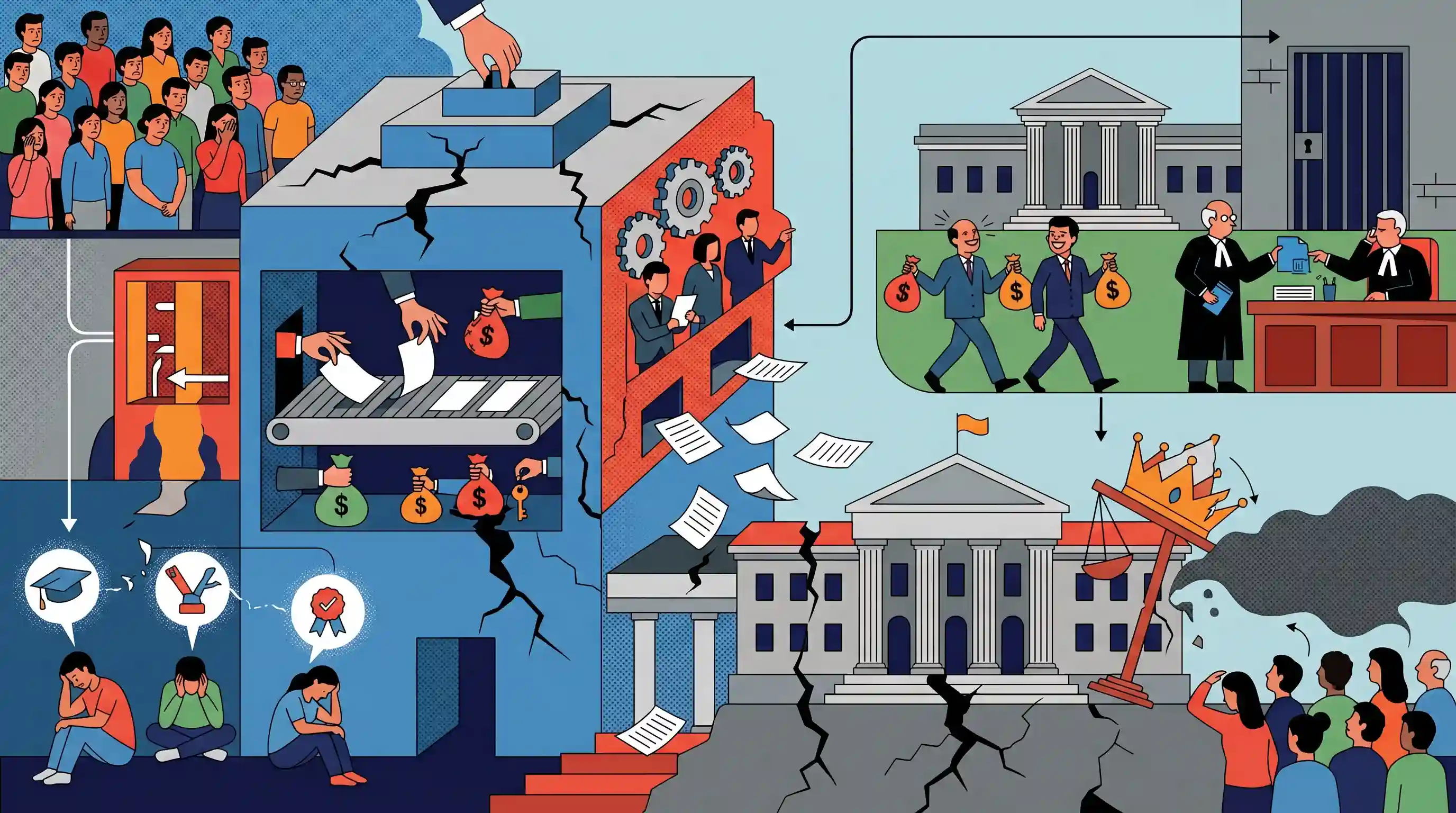
The editorial highlights the chronic failure of India's examination system, underscoring systemic vulnerabilities like paper leaks and organized cheating rackets. Despite affecting over 3.86 crore candidates over 23 years, the system suffers from an abysmal lack of accountability, evidenced by an exceptionally low conviction rate in leak cases. The outsourcing of exam logistics and the rise of private testing agencies have created structural loopholes. The persistent impunity for these crimes not only jeopardizes the futures of millions of youth but also undermines the core democratic principle of meritocracy, leading to a profound erosion of public trust in state institutions.
Key Points
- India's examination ecosystem suffers from chronic vulnerabilities, including recurring paper leaks and sophisticated cheating rackets across school, university, and recruitment exams.
- There is a staggering lack of accountability; between 2002 and 2025, convictions were achieved in only two out of 45 major paper leak cases, and only 55% of the 1,658 arrested individuals were charge-sheeted.
- Over 3.86 crore candidates across 15 states were impacted by canceled exams in the past 23 years, severely disrupting educational and career mobility.
- Systemic weaknesses stem from the outsourcing of exam logistics, the unchecked proliferation of private testing agencies, and the influence of powerful coaching networks.
- The persistent impunity undermines the democratic promise of meritocracy, deeply eroding public trust in institutional integrity and state capabilities.
Important Terms
National Testing Agency (NTA)

An autonomous agency under the Ministry of Education mandated to conduct standardized, transparent entrance examinations for higher educational institutions in India.
UPSC context
GS-2 (Statutory/Non-statutory bodies); critical for questions on administrative reforms in the education sector and institutional accountability.
Public Examinations (Prevention of Unfair Means) Act, 2024
A central law enacted to curb malpractices like paper leaks and organized cheating in public exams, prescribing stringent, non-bailable penalties and heavy fines.
UPSC context
GS-2 (Governance) & GS-4 (Ethics); essential for discussing legal deterrents against corruption and protecting candidate merit.
Meritocracy
A social and political system where advancement is based solely on individual talent, ability, and effort rather than status or wealth.
UPSC context
GS-2 (Constitutional Bodies); relates to the UPSC’s mandate under Articles 315-323 as the 'guardian of meritocracy' in India.
Probity in Governance
The quality of having strong moral principles; in governance, it implies the positive presence of ethical conduct, honesty, and uprightness in public affairs.
UPSC context
GS-4 (Ethics); a core syllabus topic testing the application of ethical standards in administrative processes and public service.
Institutional Integrity
The adherence of an organization to its mission and ethical codes, ensuring its procedures are transparent, robust, and resistant to corruption.
UPSC context
GS-4 (Ethics); key for case studies on systemic failures, public trust, and the difference between compliance and ethical robustness.
Accountability
The requirement for public officials and agencies to be answerable for their decisions and to face consequences for failures or misconduct.
UPSC context
GS-2 (Governance); central to themes of transparency, the social contract, and the reform of state institutions to prevent impunity.
Prelims Trap
The Public Examination Act 2024 establishes a uniform anti-cheating framework for all state and central recruitment exams.
The Act applies specifically to Central exams (UPSC, SSC, NTA, etc.). State-level public exams fall outside its purview unless states explicitly adopt it.
Static Concepts Connected
What are the features of the Public Examination (Prevention of Unfair Means) Act, 2024?
- Scope of application: Applies exclusively to central recruitment and entrance bodies, including UPSC, SSC, RRB, IBPS, and the National Testing Agency (NTA).
- Nature of offences: All offences under the Act are classified as cognizable, non-bailable, and non-compoundable, ensuring strict police action.
- Severe penalties: Organised syndicates and service providers involved in paper leaks face 5 to 10 years in prison and a minimum fine of Rs 1 crore.
What is the administrative mandate and legal structure of the National Testing Agency (NTA)?
- Legal status: It is an autonomous and self-sustained premier testing organization registered under the Societies Registration Act, 1860.
- Core mandate: Established by the Ministry of Education to conduct transparent, international-standard entrance exams for admission to higher educational institutions.
Cross-Topic Patterns
Exam leaks & demographic dividend
Frequent exam cancellations delay youth entry into the workforce, risking the demographic dividend by fueling structural unemployment, skill stagnation, and growing civil unrest.
Ethics of outsourcing public duty
Delegating exam logistics to private testing agencies creates an accountability deficit, raising GS-4 questions on who bears ultimate moral and legal responsibility for systemic governance failures.

The 2024 Public Examination Act's exact scope (Central vs. State) and penal provisions will likely form a Prelims multi-statement question.
Linked PYQs · 5
Linked PYQs · 5
- 2023MainsGS4
Corruption is the manifestation of the failure of core values in the society." In your opinion, what measures can be adopted to uplift the core values in the society ?
- 2024MainsGS2
e-governance is not just about the routine application of digital technology in service delivery process. It is as much about multifarious interactions for ensuring transparency and accountability. In this context evaluate the role of the 'Interactive Service Model' of e-governance.
- 2020MainsGS2
Institutional quality is a crucial driver of economic performance". In this context suggest reforms in Civil Service for strengthening democracy.
- 2019MainsGS4
"Non-performance of duty by a public servant is a form of corruption". Do you agree with this view? Justify your answer.
- 2017MainsGS4
Examine the relevance of the following in the context of civil service: Transparency, Accountability, Fairness and justice, Courage of conviction, Spirit of service.
