Improving Nutrient Use Efficiency and Reforming Fertilizer Subsidies
Source:The Hindu ↗
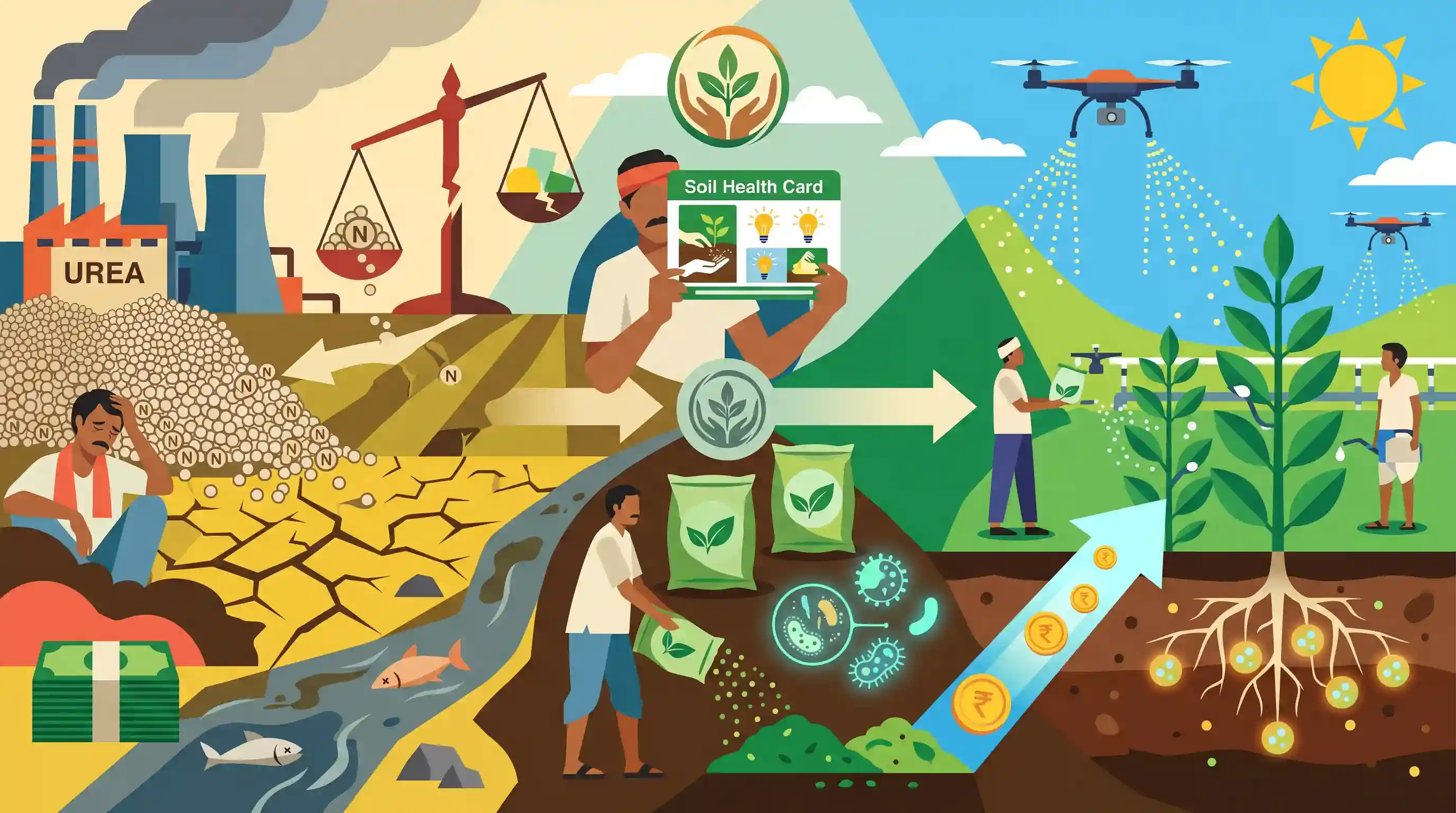
Why It Matters
Rationalizing fertilizer use is crucial for managing India's fiscal deficit, mitigating environmental degradation, and securing long-term agricultural productivity in the face of climate change. It directly overlaps with the GS3 syllabus concerning farm subsidies and sustainable agriculture.
Summary
Improving the efficiency of fertilizer use in India is a critical imperative for achieving sustainable agriculture, restoring soil health, and reducing the government's fiscal burden. For decades, skewed subsidy policies have incentivized the over-application of urea (nitrogen), leading to an imbalanced NPK ratio, degraded soil fertility, and environmental pollution. To combat this, the government has introduced measures such as Neem Coated Urea, the Soil Health Card Scheme, and the PM PRANAM scheme to promote balanced fertilization and alternative nutrients. Going forward, enhancing Nutrient Use Efficiency (NUE) through technological innovations like nano-fertilizers, and implementing structural economic reforms—such as extending the Nutrient Based Subsidy (NBS) to urea and shifting to a Direct Benefit Transfer (DBT) system—are vital steps to ensure long-term agricultural resilience.
Key Points
- India faces a massive fertilizer subsidy burden and heavy import dependence, necessitating urgent reforms in how nutrients are priced and utilized.
- The heavily subsidized price of urea has led to its excessive and imbalanced application, skewing the ideal NPK ratio and degrading soil health over time.
- Initiatives like PM PRANAM aim to incentivize States to reduce chemical fertilizer use by promoting alternative, organic, and bio-fertilizers.
- Technological interventions like Nano Urea and Nano DAP offer higher Nutrient Use Efficiency (NUE), minimizing environmental runoff and logistical costs.
- Long-term efficiency requires structural policy shifts, including bringing urea under the Nutrient Based Subsidy (NBS) regime and transitioning to Direct Benefit Transfer (DBT) directly into farmers' accounts.
Important Terms
Nutrient Based Subsidy (NBS)

A policy where the government fixes a per-kilogram subsidy for nutrients (Nitrogen, Phosphorus, Potash, Sulphur) in non-urea fertilizers. It aims to promote balanced fertilization and reduce soil degradation.
UPSC context
GS Paper III (Agriculture/Subsidies). Tests knowledge of fiscal reforms in agriculture and the logic of balanced soil health.
PM PRANAM
A scheme launched in 2023 to incentivize States/UTs to promote alternative, non-chemical fertilizers. It grants states 50% of the subsidy savings achieved through reduced chemical fertilizer consumption.
UPSC context
GS Paper III (Environment/Agriculture). Relevant for questions on sustainable farming, green growth, and fiscal deficit management.
Soil Health Card Scheme
A 2015 flagship initiative providing farmers with soil nutrient status across 12 parameters every 2-3 years. It includes specific crop-wise recommendations for fertilizers and soil amendments to optimize yields.
UPSC context
GS Paper III (Agriculture). Focuses on scientific farming, resource efficiency, and soil conservation policies.
Direct Benefit Transfer (DBT)
In the fertilizer sector, a mechanism where the government pays subsidies to manufacturers only after a sale is authenticated via Aadhaar-linked Point of Sale (PoS) devices at retail outlets.
UPSC context
GS Paper II & III (Governance/Economy). Critical for discussing transparency, leakages, and targeting of welfare benefits.
Nutrient Use Efficiency (NUE)
A measure of how effectively plants absorb and utilize nutrients from fertilizers to produce yield. Improving NUE is vital for reducing costs, waste, and environmental pollution.
UPSC context
GS Paper III (Technology/Agriculture). Tests understanding of sustainable productivity and the impact of skewed NPK ratios.
Nano-fertilizers
Highly efficient fertilizers engineered at the nanoscale (e.g., Nano Urea) to increase nutrient absorption by plants. They aim to replace bulky conventional fertilizers and minimize nutrient leaching.
UPSC context
GS Paper III (S&T in Agriculture). Relevant for emerging technologies that enhance productivity and environmental sustainability.
Prelims Trap
"All major chemical fertilizers, including Urea, are covered under the Nutrient Based Subsidy (NBS) regime."
Urea is the only major fertilizer excluded from NBS. It remains under a strict statutory Maximum Retail Price (MRP), making it artificially cheap and driving its over-application.
Static Concepts Connected
What is the Nutrient Based Subsidy (NBS) regime?
- Nutrient-linked rates: Subsidies are fixed annually based on the weight of macro/micro nutrients (N, P, K, S) rather than the end product type.
- Urea exclusion: Urea is explicitly excluded from NBS, keeping its price artificially low and heavily distorting the ideal 4:2:1 NPK ratio in Indian soils.
Why did the government mandate Neem Coated Urea?
- Slows nitrification: Neem oil acts as a nitrification inhibitor, slowing nitrogen release to match plant uptake and reducing leaching into groundwater.
- Stops industrial diversion: The coating makes urea unfit for industrial uses (e.g., plywood, explosives), curbing black market smuggling and diversion.
Cross-Topic Patterns
Fertilizer Subsidies & Revenue Deficit
Heavy reliance on imported urea and DAP inflates India's revenue deficit. Transitioning to Direct Benefit Transfers (DBT) directly ties agricultural policy to macroeconomic stabilization.
Nano Urea & Eutrophication
Conventional urea runoff causes algal blooms and hypoxic dead zones. Nano-urea's foliar application prevents this ecological damage, directly linking agricultural practices to aquatic ecology.
PM PRANAM & Fiscal Federalism
By sharing 50% of fertilizer subsidy savings back with the states as grants, PM PRANAM creates a cooperative federalism model for agricultural reform.

Expect a Prelims 2026 multi-statement question linking Nano-Urea's high NUE, PM-PRANAM's fiscal mechanics, and agricultural eutrophication.
Linked PYQs · 5
Linked PYQs · 5
- 2020PrelimsGS1
With reference to chemical fertilizers in India, consider the following statements : 1. At present, the retail price of chemical fertilizers is market-driven and not administered by the Government. 2. Ammonia, which is an input of urea, is produced from natural gas. 3. Sulphur, which is a raw material for phosphoric acid fertilizer, is a by-product of oil refineries. Which of the statements given above is/are correct?
- 2016PrelimsGS1
Why does the Government of India promote the use of 'Neem-coated Urea' in agriculture?
- 2017PrelimsGS1
Consider the following statements: The nation-wide 'Soil Health Card Scheme' aims at 1. expanding the cultivable area under irrigation. 2. enabling the banks to assess the quantum of loans to be granted to farmers on the basis of soil quality. 3. checking the overuse of fertilizers in farmlands. Which of the above statements is/are correct?
- 2023MainsGS3
What are the direct and indirect subsidies provided to farm sector in India? Discuss the issues raised by the World Trade Organization (WTO) in relation to agricultural subsidies.
- 2017MainsGS3
How do subsidies affect the cropping pattern, crop diversity and economy of farmers? What is the significance of crop insurance, minimum support price and food processing for small and marginal farmers?
