Defence Secretary outlines pragmatic limits of import substitution
Source:The Hindu ↗
Why It Matters
The nuances of self-reliance in defence are highly relevant for UPSC Mains, particularly regarding the realistic limits of import substitution and the strategic importance of building full-spectrum ecosystems (including MROs) through private sector JVs and FDI.
Summary
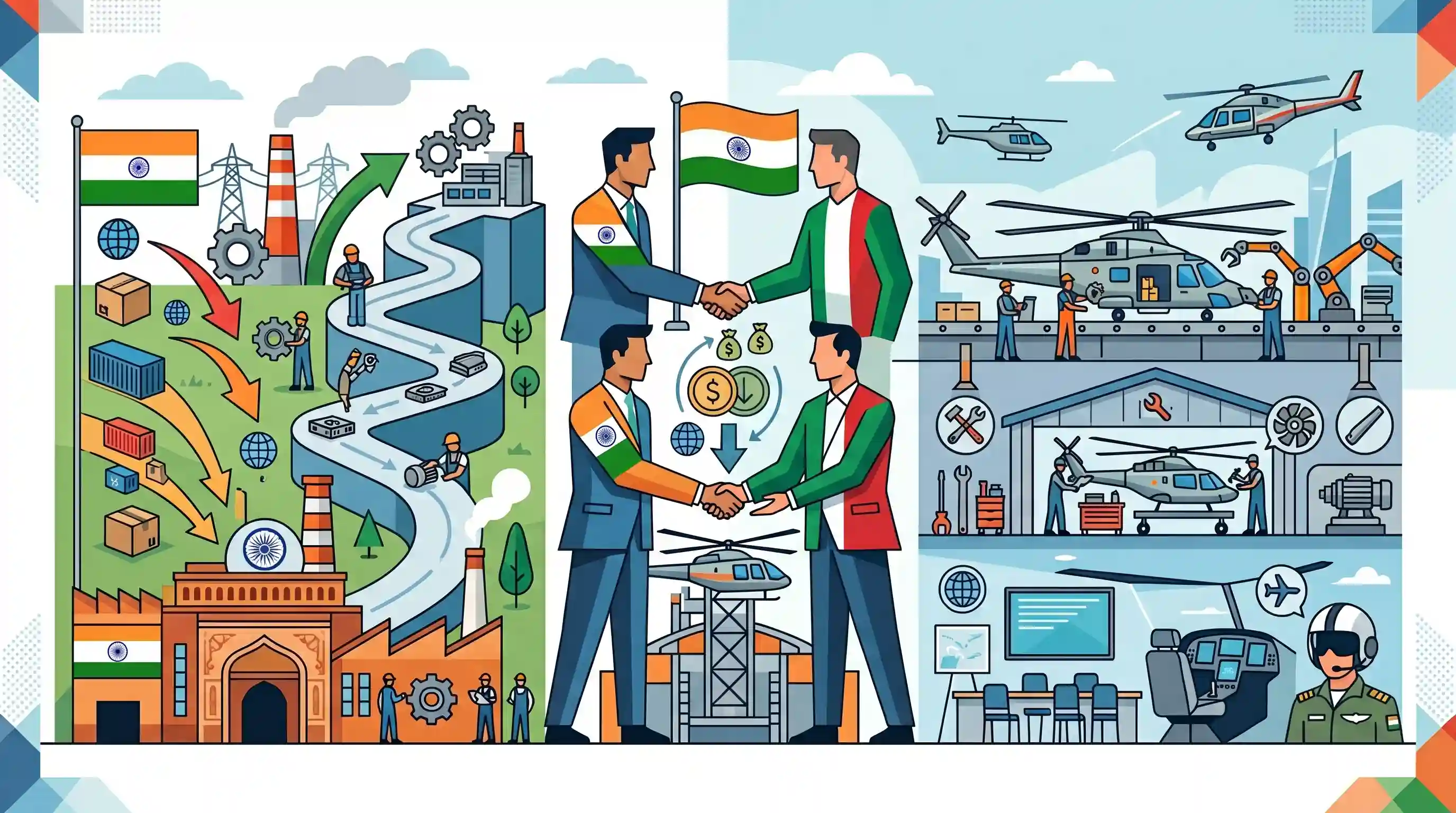
Defence Secretary Rajesh Kumar Singh noted that while the 'Make in India' initiative aims to drastically reduce the defence sector's import dependence, achieving absolute autarky is impractical. The focus remains on moving up the manufacturing value chain and expanding domestic capabilities over time. Concurrently, a significant milestone in private defence manufacturing was reached as Adani Defence & Aerospace signed an MoU with Italy's Leonardo. This partnership will establish a comprehensive helicopter manufacturing ecosystem in India, encompassing not just production, but also crucial Maintenance, Repair, and Overhaul (MRO) operations and pilot training facilities.
Key Points
- Defence Secretary Rajesh Kumar Singh stated that achieving 100% autarky in defence manufacturing is neither practical nor necessary, though 'Make in India' aims to progressively minimize import dependence.
- The primary objective is to expand the scope of domestic manufacturing, move up the value chain, and substantially reduce foreign imports over time.
- Adani Defence & Aerospace signed an MoU with Italian aerospace firm Leonardo to build an integrated helicopter manufacturing ecosystem in India for the rotary-wing segment.
- The strategic partnership extends beyond mere production to establishing robust Maintenance, Repair, and Overhaul (MRO) capabilities and pilot training facilities within the country.
Important Terms
Make in India

Launched in 2014, it aims to transform India into a global manufacturing hub by encouraging domestic production and foreign investment across 25 sectors, including defense.
UPSC context
GS Paper 3: Indian Economy; tests understanding of industrial policy, manufacturing growth targets, and FDI liberalization.
Aatmanirbhar Bharat
A vision of a 'Self-Reliant India' emphasizing economic resilience, local supply chains, and strategic independence in critical sectors like defense through domestic manufacturing and R&D.
UPSC context
GS Paper 3: Security and Economy; tests conceptual understanding of strategic autonomy and economic sovereignty.
Indigenisation of Technology
The process of developing and manufacturing defense equipment locally, aimed at reducing import dependence and enhancing national security through technological self-reliance.
UPSC context
GS Paper 3: Security and Science & Technology; tests the ability to evaluate self-reliance in strategic sectors.
Maintenance, Repair, and Overhaul (MRO)
Specialized services ensuring the airworthiness and operational readiness of aerospace assets, encompassing inspections, repairs, and complete overhauls of aircraft components and engines.
UPSC context
GS Paper 3: Economy and Infrastructure; tests understanding of the aerospace industrial ecosystem and high-tech service sectors.
Private Sector Participation in Defence
The strategic shift allowing non-government entities to manufacture military hardware, often through joint ventures, to boost innovation, investment, and technological depth in the defense sector.
UPSC context
GS Paper 3: Security; relates to the Strategic Partnership Model and the corporatization of defense manufacturing.
Prelims Trap
'Make in India' in the defence sector aims to achieve absolute autarky by completely eliminating foreign imports.
The government explicitly acknowledges that 100% autarky is impractical in globalized aerospace. The actual goal is strategic self-reliance and ascending the manufacturing value chain.
Static Concepts Connected
How is FDI regulated in India's defence manufacturing sector?
- Automatic Route: Allowed up to 74% for companies seeking new industrial licenses, reducing bureaucratic hurdles for foreign OEMs.
- Government Route: Allowed beyond 74% if the investment results in access to modern, state-of-the-art technology for domestic firms.
- Security Clearance: All foreign investments in the defence sector remain subject to scrutiny by the Ministry of Home Affairs.
What is the Strategic Partnership (SP) Model under DAP 2020?
- Core Objective: Aims to establish long-term partnerships between Indian private sector companies and global Original Equipment Manufacturers (OEMs).
- Key Segments: Primarily targets four segments: fighter aircraft, helicopters, submarines, and armored fighting vehicles/main battle tanks.
- Technology Transfer: Mandates deep transfer of technology (ToT) to build domestic manufacturing infrastructure, moving beyond mere licensed assembly.
Cross-Topic Patterns
MRO Hubs + Skill India
Establishing a domestic Maintenance, Repair, and Overhaul (MRO) ecosystem requires certified aviation engineers, making defence self-reliance intrinsically dependent on the success of national skilling missions.
Value Chains vs Import Substitution
The official rejection of 'autarky' mirrors recent Economic Survey themes: India seeks strategic integration into global supply chains rather than retreating into closed-door import substitution.

Expect a GS-3 Mains question evaluating 'Atmanirbhar Bharat' in defence, contrasting practical MRO/tech-transfer goals against absolute autarky.
Linked PYQs · 2
Linked PYQs · 2
- 2014MainsGS3
Foreign Direct Investment (FDI) in the defence sector is now set to be liberalized. What influence this is expected to have on Indian defence and economy in the short and long run?
- 2015MainsGS3
Success of 'Make in India' programme depends on the success of 'Skill India' programme and radical labour reforms." Discuss with logical arguments.
