Andhra Pradesh Prosecution Highlighting SC ST Act Protection Mandates
Source:The Hindu ↗
Why It Matters
It illustrates the intersection of vulnerable section protections (SC/ST Act) and broader criminal justice reforms (BNSS 2023, Witness Protection Scheme). Understanding the operational hurdles—like hostile witnesses and evidentiary credibility—is crucial for analyzing governance and social justice in Mains GS2.
Summary
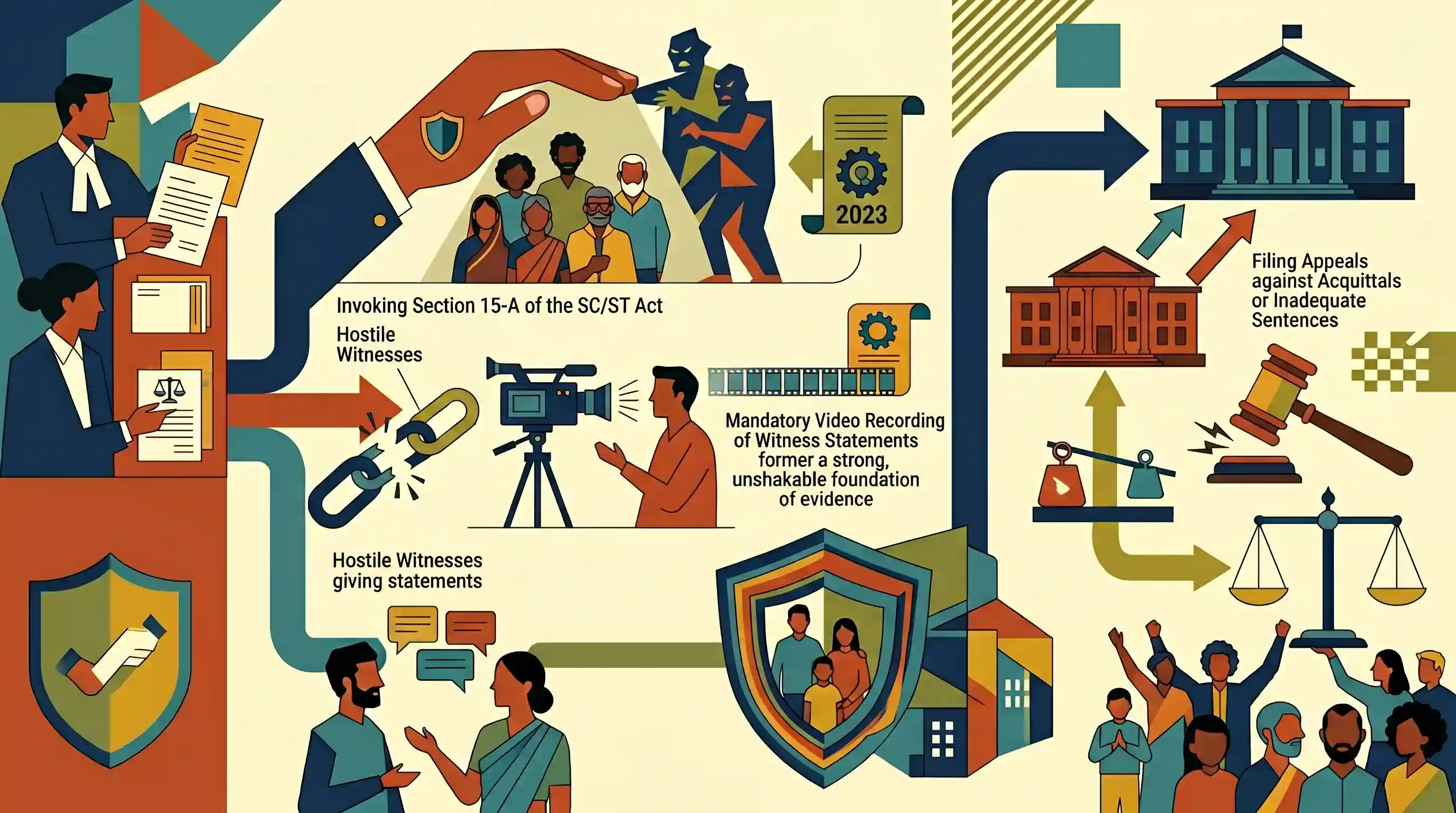
The article underscores the critical need to invoke Section 15-A of the SC/ST (Prevention of Atrocities) Act to protect victims and prevent witnesses from turning hostile. A review by Andhra Pradesh's Directorate of Prosecution emphasized the mandatory video recording of witness statements under the Bharatiya Nagarik Suraksha Sanhita (BNSS) 2023 to bolster evidence credibility. Officials also stressed the importance of utilizing the Witness Protection Scheme 2018 and filing appeals against acquittals or inadequate sentences to deliver comprehensive justice to marginalized communities.
Key Points
- Section 15-A of the SC/ST Act must be invoked strictly to protect victims and prevent witnesses from turning hostile due to intimidation or pressure.
- The Bharatiya Nagarik Suraksha Sanhita (BNSS) 2023 mandates video recording of witness statements during both investigation and trial stages to enhance evidence credibility.
- Authorities are urged to systematically file appeals in cases of acquittals or inadequate sentences to ensure justice for marginalized communities.
- Effective implementation of the Witness Protection Scheme 2018 is essential for the active and safe participation of witnesses in criminal proceedings.
Important Terms
Section 15A (SC/ST Act)

A 2014 amendment-introduced provision mandating state protection for victims and witnesses. It guarantees their right to participate in all proceedings (e.g., bail, parole) and mandates video-recording of trials.
UPSC context
GS-II (Social Justice/Vulnerable Sections); tests understanding of procedural rights meant to prevent witness intimidation and ensure active victim participation.
Bharatiya Nagarik Suraksha Sanhita (BNSS) 2023
The 2023 legislation replacing the CrPC, emphasizing digital modernization. It mandates audio-video recording of witness statements and introduces Section 398 to provide statutory backing for witness protection.
UPSC context
GS-II (Governance/Criminal Justice Reform); central to evaluating the shift toward technology-driven investigations and transparency in India's legal architecture.
Witness Protection Scheme 2018
India's first nationwide framework providing physical security, identity concealment, and relocation for witnesses. It categorizes threats into A (high-life risk), B (safety/property), and C (moderate harassment).
UPSC context
GS-II (Criminal Justice System); vital for discussions on systemic reforms to improve low conviction rates and protect judicial integrity.
Special Courts (SC/ST Act)
Dedicated courts mandated by Section 14 of the SC/ST Act for speedy trials. They are empowered to take direct cognizance of offences and must aim for trial completion within two months.
UPSC context
GS-II (Judiciary/Vulnerable Sections); focuses on specialized judicial mechanisms designed to expedite justice for marginalized communities.
Directorate of Prosecution
A statutory administrative body (under Section 20 of BNSS) that supervises public prosecutors, scrutinizes acquittal judgments for investigative lapses, and coordinates between police and the judiciary.
UPSC context
GS-II (Governance/Criminal Justice); highlights the role of an independent prosecutorial wing in ensuring accountability and effectively managing state appeals.
Prelims Trap
Under the SC/ST Act, the victim's right to be heard is restricted only to the final trial proceedings, excluding bail hearings.
Section 15-A grants a mandatory statutory right for victims and dependents to be heard at ANY proceeding, explicitly including bail, discharge, parole, and conviction hearings.
Static Concepts Connected
What are the key statutory protections under the SC/ST (Prevention of Atrocities) Act?
- Anticipatory Bail Bar: Section 18 bars the application of anticipatory bail for the accused, though Supreme Court guidelines permit it if no prima facie case is made out.
- Special Courts: Mandates the establishment of Exclusive Special Courts and Special Public Prosecutors at the district level to ensure speedy trials.
- Victim Rights: Section 15-A imposes a duty on the State to protect witnesses and ensures victims are heard at all stages of proceedings.
How does the Witness Protection Scheme 2018 classify threat perception?
- Category A: High threat extending to the life of the witness or their family members during the investigation, trial, or thereafter.
- Category B: Threat affecting safety, reputation, or property of the witness or family during the investigation or trial.
- Category C: Moderate threat limited to harassment or intimidation of the witness during the court proceedings.
Cross-Topic Patterns
BNSS tech-mandates + e-Courts Project
The BNSS mandate for audio-video recording of witness statements aligns with Phase III of the e-Courts project, integrating digital transparency directly into criminal procedure and the Inter-operable Criminal Justice System (ICJS).
Article 39A + NALSA's evolving mandate
NALSA’s role in formulating the Witness Protection Scheme demonstrates its evolution from merely providing free legal aid to actively securing equitable trial conditions and physical safety for vulnerable witnesses.

Expect a multi-statement question in Prelims 2026 merging BNSS video-recording mandates with victim rights under the amended SC/ST Act.
Linked PYQs · 3
Linked PYQs · 3
- 2019MainsGS2
Performance of welfare schemes that are implemented for vulnerable sections is not so effective due to absence of their awareness and active involvement at all stages of policy process. Discuss.
- 2023PrelimsGS1
With reference to India, consider the following pairs: Action The Act under which it is covered 1. Unauthorized wearing of police or military uniforms : The Official Secrets Act, 1923 2. Knowingly misleading or otherwise interfering with a police officer or military officer when engaged in their duties : The Indian Evidence Act, 1872 3. Celebratory gunfire which can endanger the personal safety of others : The Arms (Amendment) Act, 2019 How many of the above pairs are correctly matched?
- 2023PrelimsGS1
Consider the following statements: 1. According to the Constitution of India, the Central Government has a duty to protect States from internal disturbances. 2. The Constitution of India exempts the States from providing legal counsel to a person being held for preventive detention. 3. According to the Prevention of Terrorism Act, 2002, confession of the accused before the police cannot be used as evidence. How many of the above statements are correct?
