Agricultural Import Duties and Structural Flaws in Crop Procurement
Source:Indian Express ↗
Why It Matters
Highlights the limitations of the current MSP regime and reactive trade policies in agriculture, providing a strong argument for transitioning to Direct Benefit Transfers (DBT) for equitable farmer income support, a frequent theme in GS3.
Summary
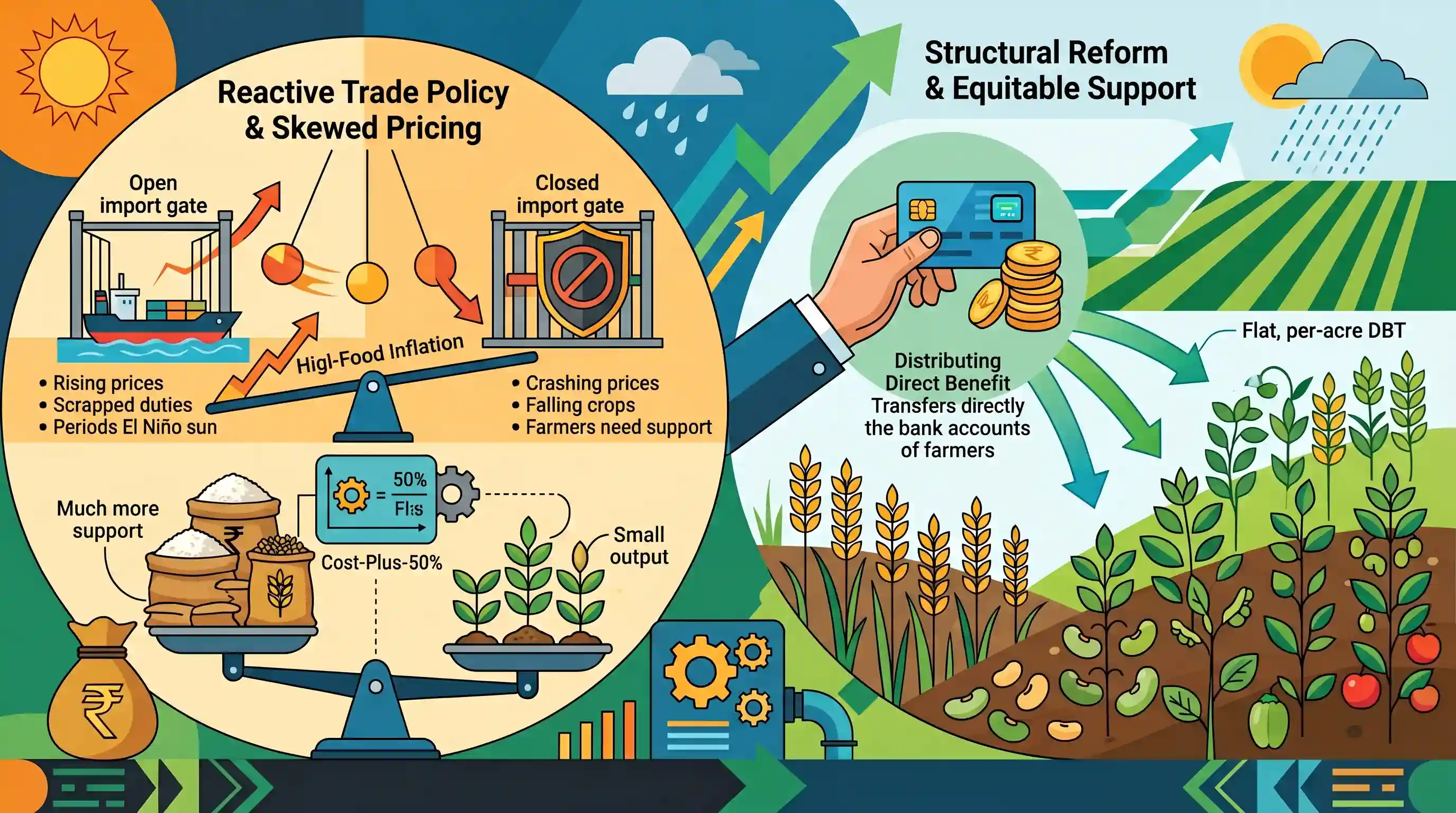
The government's decision to impose a 30% import duty on yellow peas aims to arrest the decline in domestic pulses prices below the MSP, but it fails to address the root structural issues in India's agricultural procurement policy. While intended to incentivize farmers during the rabi sowing season, the move highlights the reactive nature of India's trade and pricing policies—which oscillate between scrapping duties during high inflation (e.g., during El Niño) and imposing them when domestic prices crash. The core problem remains a skewed MSP regime heavily biased towards rice and wheat, leading to excessive buffer stocks for cereals while leaving pulses vulnerable. The article suggests replacing the mechanical cost-plus-50% MSP formula with a flat, per-acre Direct Benefit Transfer (DBT) to provide equitable minimum income support without distorting crop choices or market dynamics.
Key Points
- The 30% import duty on yellow peas is a reactive measure to prevent domestic pulses (like chana and masoor) from falling below MSP during the crucial harvesting and sowing seasons.
- High imports, triggered by earlier duty-free policies to combat El Niño-induced inflation, have crashed domestic pulse prices.
- India's agricultural policy is structurally flawed, heavily favoring the procurement of rice and wheat, which leads to massive overstocking while neglecting pulses.
- The article recommends shifting from price support (MSP) to a Direct Benefit Transfer (DBT) system, providing farmers with a flat per-acre minimum income that does not distort crop choices.
Important Terms
Minimum Support Price (MSP)

A guaranteed price set by the government to purchase crops directly from farmers, ensuring price stability and protecting against market crashes.
UPSC context
GS Paper III (Agriculture). Central to debates on farm subsidies, income security, and market distortions.
Direct Benefit Transfer (DBT)
A mechanism to transfer subsidies and welfare payments directly into beneficiaries' bank accounts, aiming to eliminate leakages, intermediaries, and corruption.
UPSC context
GS Papers II and III. Evaluates governance efficiency and the reform of the subsidy delivery system.
Buffer Stock
Strategic reserves of food grains (primarily wheat, rice, and pulses) held by the government to manage shortages, stabilize prices, and ensure food security.
UPSC context
GS Paper III (Food Security). Tests understanding of PDS, FCI’s role, and price intervention strategies.
Price Support Scheme (PSS)
A component of the PM-AASHA scheme where central nodal agencies physically procure pulses, oilseeds, and copra at MSP from farmers.
UPSC context
GS Paper III (Agriculture). Focuses on specific procurement mechanisms for non-cereal crops to promote diversification.
Cropping Pattern
The spatial and temporal arrangement of various crops in a region, influenced by soil, climate, and government policies like MSP and subsidies.
UPSC context
GS Paper III (Agriculture). Covers crop diversification, sustainability, and distortions caused by cereal-centric policies.
Commission for Agricultural Costs and Prices (CACP)
An advisory body under the Ministry of Agriculture that recommends MSP for 23 crops after analyzing production costs and market factors.
UPSC context
GS Paper III (Agriculture). Relevant for institutional framework, pricing logic, and Swaminathan Commission recommendations.
Prelims Trap
"Procurement of pulses at MSP by the government is open-ended and unlimited, similar to wheat and paddy."
Wheat and paddy procurement is open-ended. However, for pulses and oilseeds under PM-AASHA, procurement is generally capped (historically 25% of marketable surplus).
Static Concepts Connected
How does the procurement mechanism differ between cereals and pulses in India?
- Cereals (Wheat/Rice): Procurement is open-ended; agencies like FCI buy all offered grains matching Fair Average Quality (FAQ) norms at the mandated MSP.
- Pulses and Oilseeds: Procured primarily under umbrella schemes like PM-AASHA (via NAFED). Procurement is not unlimited and is typically capped at 25% of the state's marketable surplus.
What are the structural reasons for India's persistent deficit in pulses?
- Policy Bias: Assured open-ended procurement for wheat and rice heavily skews cropping patterns away from pulses, despite higher MSP hikes for the latter.
- Rainfed Dependence: Pulses are largely cultivated in rainfed, marginal lands, making yields highly volatile and risky compared to heavily irrigated cereals.
- Price Volatility: Reactive trade policies (e.g., duty-free imports during inflation, abrupt duties during gluts) create extreme market and price uncertainty for domestic growers.
Cross-Topic Patterns
Agri subsidies and WTO's AoA
Shifting from MSP (trade-distorting "Amber Box" price support) to a flat per-acre DBT (decoupled income support) helps India align with WTO's Agreement on Agriculture "Green Box" exemptions.
Pulses and climate-resilient agriculture
Beyond inflation, correcting the MSP bias against pulses is critical for climate adaptation. Their nitrogen-fixing ability and low water footprint make them essential for sustainable, rainfed farming.

Expect a 2026 prelims statement testing the capped procurement limits of pulses under PM-AASHA versus the open-ended procurement of cereals.
Linked PYQs · 5
Linked PYQs · 5
- 2018MainsGS3
What do you mean by Minimum Support Price (MSP)? How will MSP rescue the farmers from the low income trap?
- 2015MainsGS3
In what way could replacement of price subsidy with Direct Benefit Transfer (DBT) change the scenario of subsidies in India ? Discuss.
- 2013MainsGS3
What are the different types of agriculture subsidies given to farmers at the national and at state levels ? Critically analyse the agricultural subsidy regime with reference to the distortions created by it.
- 2023MainsGS3
What are the direct and indirect subsidies provided to farm sector in India? Discuss the issues raised by the World Trade Organization (WTO) in relation to agricultural subsidies.
- 2020PrelimsGS1
Consider the following statements: 1. In the case of all cereals, pulses and oil-seeds, the procurement at Minimum Support Price (MSP) is unlimited in any State/UT of India. 2. In the case of cereals and pulses, the MSP is fixed in any State/UT at a level to which the market price will never rise. Which of the statements given above is/are correct?
