Import duty cuts on edible oils to manage food inflation
Source:The Hindu ↗
આ શા માટે મહત્વનું છે
Understanding the trade-offs in fiscal interventions like import duty cuts is crucial for analyzing food inflation management, agricultural market dynamics, and India's trade policy vulnerabilities.
સારાંશ
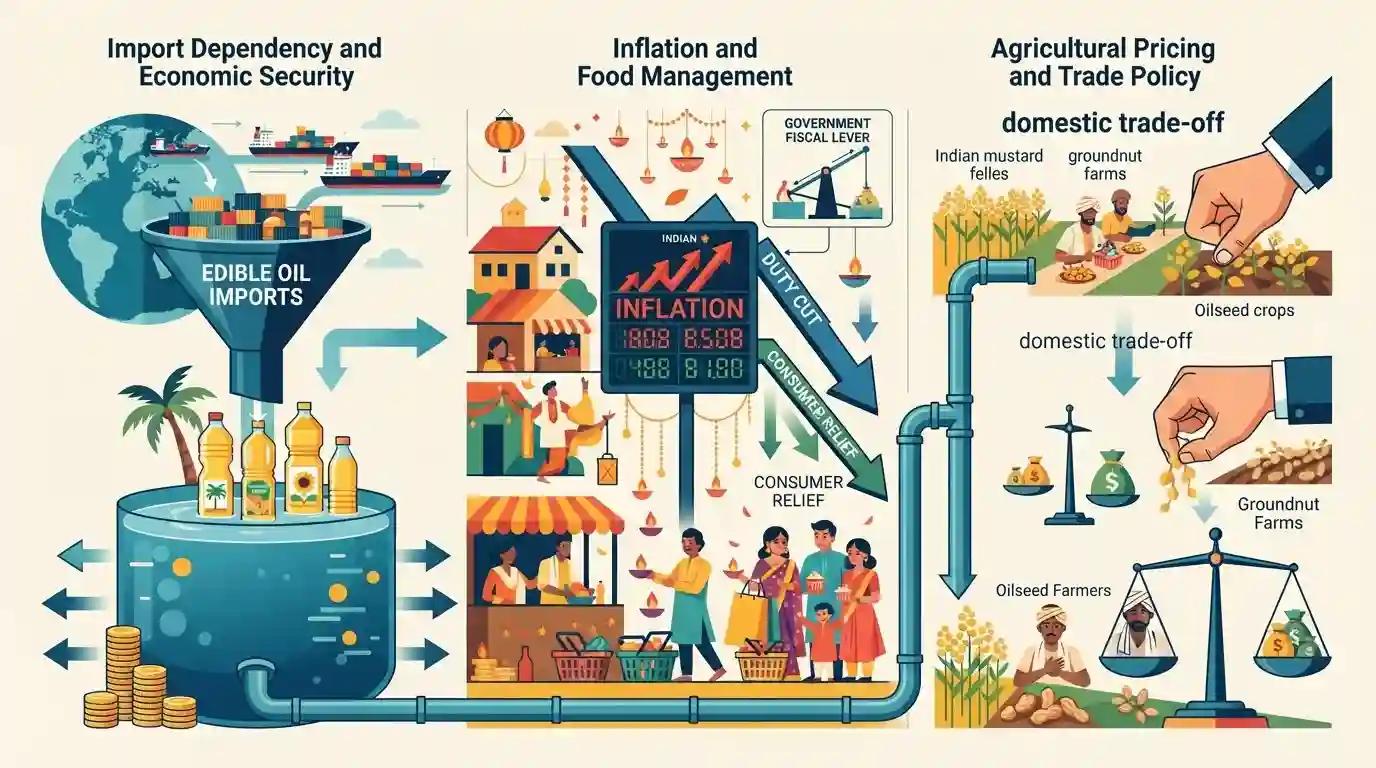
The article explains the rationale and implications of government decisions to cut import duties on edible oils ahead of festive seasons. It discusses how import duty adjustments serve as a fiscal tool to tame retail food inflation, the high degree of import dependency for edible oils in India, and the consequential trade-offs between consumer relief and domestic agricultural protection.
મુખ્ય મુદ્દા
- The government periodically adjusts import duties on edible oils to manage domestic food inflation, especially ahead of festive seasons when demand surges.
- India imports a significant portion of its edible oil consumption (such as palm oil, soybean oil, and sunflower oil), creating a structural demand-supply gap.
- While duty cuts provide immediate relief to consumers by lowering retail prices, they can adversely impact domestic oilseed farmers by reducing price realizations and affecting incentives for local cultivation.
- Balancing consumer price stability with domestic producer protection remains a key policy challenge in agricultural trade management.
મહત્વપૂર્ણ શબ્દો
World Trade Organization

A global international organization dealing with the rules of trade between nations, providing a framework for negotiating trade agreements and resolving trade disputes under international law.
UPSC context
UPSC Prelims/Mains (GS Paper II/III): Tests understanding of international trade norms, agreements, and India’s commitments under the Agreement on Agriculture.
Reserve Bank of India
India's central banking institution, which controls the monetary policy of the Indian rupee and regulates the banking system to maintain financial stability and price stability.
UPSC context
UPSC Prelims/Mains (GS Paper III): Tests knowledge of monetary policy, inflation management, and economic governance in India.
પ્રિલિમ્સ ટ્રેપ
import duty cuts on edible oils apply uniformly across crude and refined varieties to maximize consumer relief
Aspirants often assume duty cuts apply uniformly to all oil varieties; in reality, tariff differentials between crude and refined oils are deliberately maintained to protect domestic refiners.
સંલગ્ન સ્થિર ખ્યાલો
What are the key structural challenges and policy instruments regarding India's edible oil sector?
- High Import Dependency: India imports roughly 60% of its total edible oil consumption, making it the world's largest importer of vegetable oils.
- NMEO-OP Mission: National Edible Oil Mission-Oil Palm (NMEO-OP) targets expanding domestic cultivation to reduce structural import dependence.
- Tariff Differentials: Duty differentials between crude and refined oils are intentionally maintained to safeguard domestic processing and refining industries.
આંતર-વિષય પેટર્ન
Edible Oil Mission + Food Inflation Management
Measures like the NMEO-OP link agricultural self-reliance goals with fiscal interventions like import duty adjustments to tame inflation.
Import Tariffs + Domestic Processing Protection
Tariff adjustments on crude versus refined oils reflect WTO-compliant trade mechanisms used to protect domestic refining capacities.

Edible oil import dependency + NMEO-OP + tariff differentials (crude vs. refined) is a classic multi-statement prelims trap combo.
સંલગ્ન PYQ · 3
સંલગ્ન PYQ · 3
- 2018PrelimsGS1
Consider the following statements: 1. The quantity of imported edible oils is more than the domestic production of edible oils in the last five years. 2. The Government does not impose any customs duty on all the imported edible oils as a special case. Which of the statements given above is/are correct?
- 2019PrelimsGS1
Among the agricultural commodities imported by India, which one of the following accounts for the highest imports in terms of value in the last five years?
- 2024MainsGS3
What are the causes of persistent high food inflation in India? Comment on the effectiveness of the monetary policy of the RBI to control this type of inflation.
