Comparative Economic Impact of US Tariffs on India and China
Source:Indian Express ↗
Why It Matters
Understanding the nuances of global trade wars and protectionism is crucial for analyzing India's economic resilience and framing strategies to leverage shifting global supply chains.
Summary
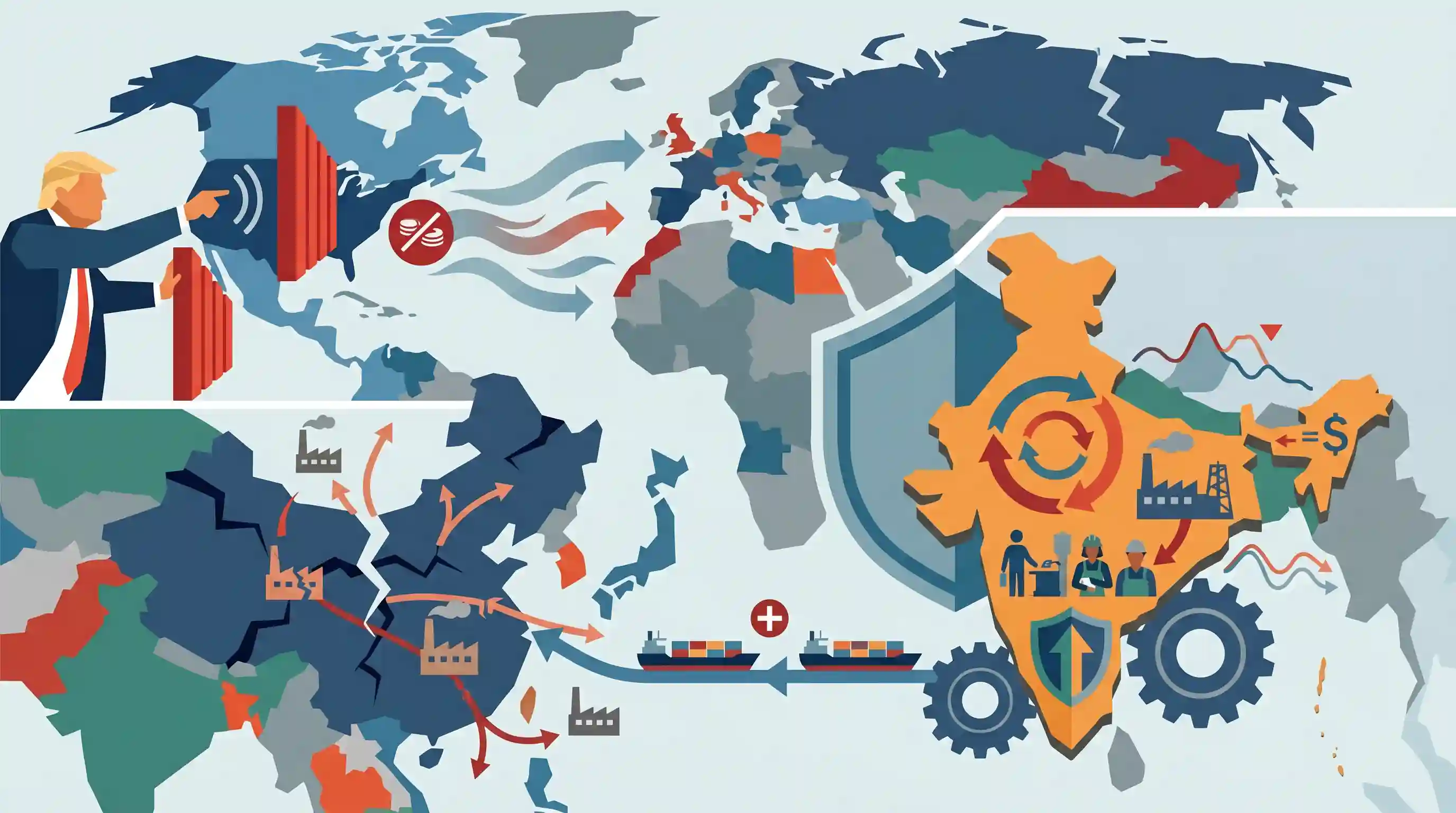
The article analyzes the potential economic impact of Donald Trump's proposed global tariffs on India, arguing that India will be less severely affected than export-heavy nations like China. India's reliance on domestic consumption and the ongoing 'China Plus One' supply chain shift provide a buffer against protectionist shocks, even though global trade disruptions still pose secondary macroeconomic challenges.
Key Points
- A potential second Trump administration's aggressive tariff policies could trigger a wave of global protectionism and trade wars.
- India is better insulated against direct tariff shocks because its economy is driven more by domestic demand than by merchandise exports, unlike China.
- Steeper US tariffs on Chinese goods may continue to encourage the 'China Plus One' supply chain diversification, potentially benefiting Indian manufacturing in specific sectors.
- Despite lower direct vulnerability, India still faces macroeconomic risks from secondary effects like global inflation, currency volatility, and slowed global economic growth.
Important Terms
China Plus One strategy

A business strategy where companies diversify supply chains by establishing manufacturing hubs in countries like India or Vietnam while maintaining Chinese operations to reduce overdependence and geopolitical risks.
UPSC context
GS Paper II/III: Global supply chains and India's manufacturing potential as a global hub.
Protectionism
Economic policy of restricting imports through tariffs, quotas, or regulations to shield domestic industries and workers from foreign competition, often leading to trade tensions.
UPSC context
GS Paper III: Effects of liberalization on the economy and challenges to global trade.
Tariffs
A tax or duty imposed by a government on imported goods at customs, intended to protect domestic industries by making foreign products more expensive.
UPSC context
GS Paper III: Indian Economy and issues relating to planning, mobilization of resources, and growth.
Macroeconomic Stability
A state where a national economy minimizes vulnerability to external shocks, characterized by low inflation, manageable debt, and stable growth indicators.
UPSC context
GS Paper III: Indian Economy and issues relating to growth, development, and employment.
Reciprocal Tariffs
Retaliatory duties imposed by a country that mirror or adjust to the tariff rates levied against its own exports by a trading partner.
UPSC context
GS Paper II: Effect of policies and politics of developed countries on India's interests.
Trade Surplus
An economic condition where a country's total value of exported goods and services exceeds its total value of imports over a specific period.
UPSC context
GS Paper III: External sector and India's bilateral trade relations.
Prelims Trap
India's high merchandise trade-to-GDP ratio makes its economy severely vulnerable to direct global tariff shocks.
Aspirants often assume India is highly export-dependent. In reality, India has a structurally low merchandise trade-to-GDP ratio, making it domestic-consumption driven and relatively insulated from direct tariff shocks.
Static Concepts Connected
How do global trade wars trigger imported inflation in emerging economies like India?
- Capital flight: Trade uncertainty often causes foreign investors to pull capital from emerging markets, leading to domestic currency depreciation.
- Costlier critical imports: A weaker Rupee makes structurally inelastic imports, such as crude oil and edible oils, significantly more expensive.
- Domestic price cascades: These elevated import costs cascade into broader domestic retail inflation, potentially forcing the central bank to hike interest rates.
What are the primary instruments of trade protectionism?
- Tariff barriers: Direct taxes or duties imposed on imported goods to increase their price, such as basic customs duties or retaliatory tariffs.
- Non-tariff barriers (NTBs): Restrictions not involving taxes, including import quotas, strict licensing requirements, and stringent sanitary or phytosanitary (SPS) standards.
- Countervailing duties: Targeted tariffs designed specifically to offset export subsidies provided by the exporting nation's government.
Cross-Topic Patterns
WTO fragmentation driving bilateral FTAs
As unilateral US tariffs weaken WTO dispute mechanisms, India is pivoting aggressively toward bilateral FTAs (e.g., UAE CEPA, Australia ECTA) to secure guaranteed market access for labor-intensive exports.
Tariff wars catalyzing PLI success
The US-China tariff war synergizes directly with India's Production Linked Incentive (PLI) schemes, as Western firms mandate a 'China Plus One' strategy for electronics and API supply chains.

Expect a 2026 Prelims multi-statement question linking global trade wars to Rupee depreciation, imported inflation, and RBI action.
Linked PYQs · 2
Linked PYQs · 2
- 2025MainsGS3
What are the challenges before the Indian economy when the world is moving away from free trade and multilateralism to protectionism and bilateralism? How can these challenges be met?
- 2018MainsGS3
How would the recent phenomena of protectionism and currency manipulations in world trade affect macroeconomic stability of India?
