Bombay High Court Directs Relocation of MMR Dumping Grounds
Source:Indian Express ↗
Why It Matters
Highlights the critical governance and infrastructural challenges of urban solid waste management in Indian metropolises, linking municipal failures directly to the violation of constitutional rights (Article 21) to a clean environment.
Summary
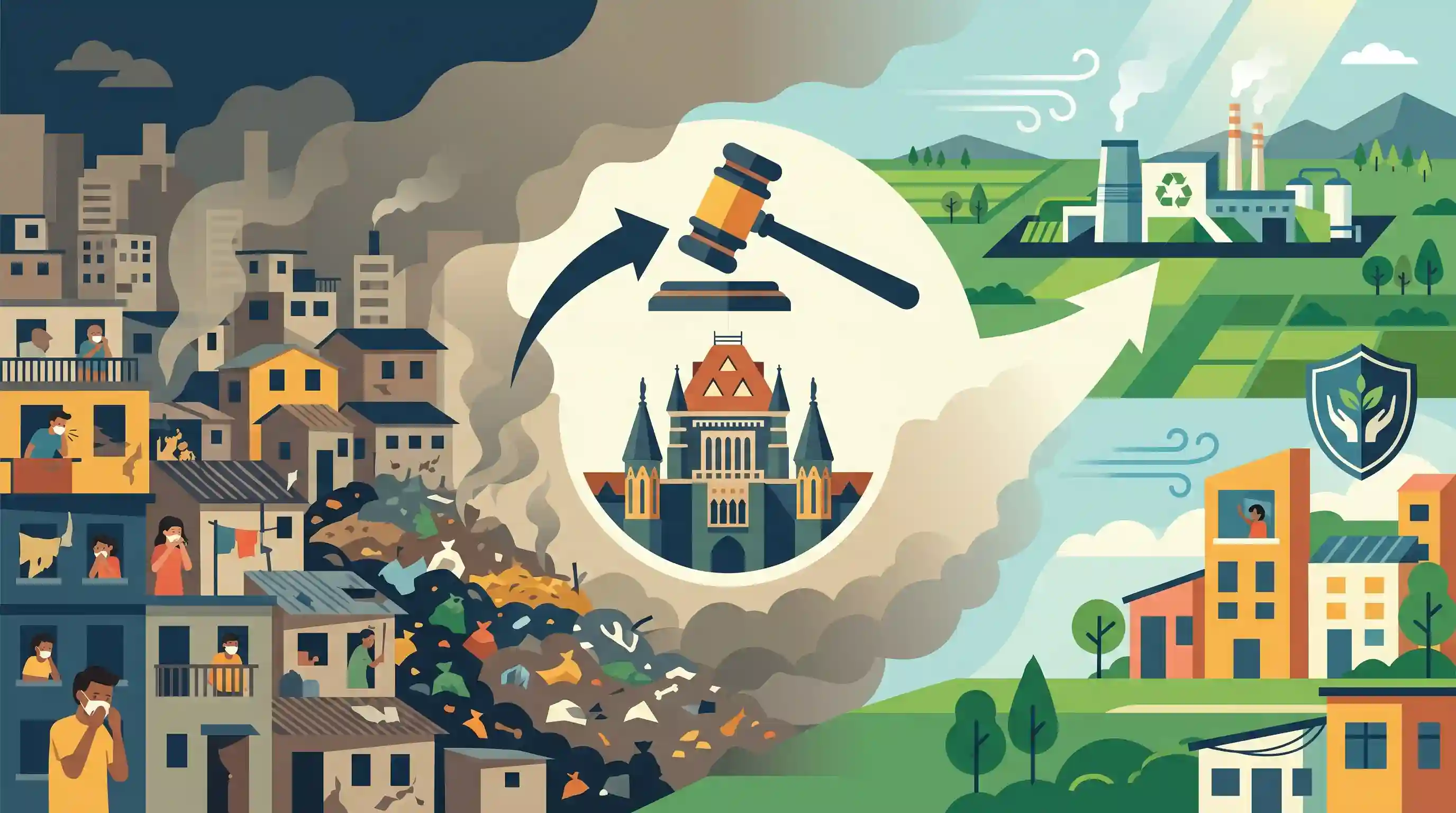
The Bombay High Court has directed the Maharashtra government and Brihanmumbai Municipal Corporation (BMC) to address the severe health and environmental impacts of locating municipal dumping grounds within densely populated areas. Responding to a PIL concerning the Kanjurmarg facility, the Court mandated the identification of permanent, scientifically equipped waste management sites located away from human habitation. The bench underscored that localized waste pollution contributes extensively to city-wide haze and air quality degradation, firmly stating that municipal failure to manage solid waste effectively violates the citizens' fundamental right to a clean environment.
Key Points
- The Bombay High Court directed the Maharashtra government and civic bodies to find permanent, scientifically managed dumping grounds away from human habitation in the MMR.
- The directive came in response to a PIL by NGO Vanashakti regarding the severe pollution caused by the Kanjurmarg dumping ground.
- The Court noted that pollution, smoke, and odour from these grounds spread via air currents, significantly contributing to Mumbai's overall haze and air pollution.
- Failing to resolve these issues was termed a 'gross failure of the municipal machinery' and a violation of citizens' fundamental right to a clean and pollution-free environment.
Important Terms
Solid Waste Management Rules, 2016

Central regulations mandating waste segregation at source (biodegradable, dry, and domestic hazardous) and scientific disposal to replace the 2000 rules.
UPSC context
GS Paper 3: Environment and Pollution; tests knowledge of statutory frameworks for urban waste management and environmental degradation.
Article 21 (Right to a Clean Environment)
A constitutional provision guaranteeing the 'Right to Life,' judicially expanded to include the right to a clean and pollution-free environment essential for human dignity.
UPSC context
GS Paper 2: Indian Constitution (Fundamental Rights); tests the evolution of judicial interpretation in protecting civil liberties.
Public Interest Litigation (PIL)
A legal mechanism enabling citizens or NGOs to seek judicial redress for public causes, particularly environmental protection and human rights of marginalized groups.
UPSC context
GS Paper 2: Governance/Judiciary; tests the role of the judiciary in ensuring administrative accountability and public welfare.
Kanjurmarg Landfill
A major waste-disposal site in Mumbai criticized for high methane levels and health impacts on nearby residents and the Thane Creek mangrove ecosystem.
UPSC context
GS Paper 3: Environment; an example of urbanization challenges and the ecological cost of municipal waste mismanagement.
Vanashakti
A Mumbai-based environmental NGO that uses legal advocacy and litigation to protect wetlands, mangroves, and wildlife corridors from urban degradation.
UPSC context
GS Paper 2: Role of NGOs/Civil Society; highlights the impact of non-state actors in environmental governance.
Brihanmumbai Municipal Corporation (BMC)
India's wealthiest municipal body, tasked with managing Mumbai's civic infrastructure, waste collection, and implementation of environmental regulations within city limits.
UPSC context
GS Paper 2: Governance (Urban Local Bodies); tests the challenges of municipal administration in megacities.
Prelims Trap
The Indian Constitution explicitly guarantees the right to a clean and pollution-free environment under Article 21.
The right to a clean environment is an implied fundamental right, expanded by the judiciary through a broad interpretation of the Right to Life (Article 21). It is not explicitly written in the Constitution's text.
Static Concepts Connected
What are the key landfill siting criteria under the Solid Waste Management Rules, 2016?
- Distance from habitations: Landfills must be located at least 200 meters away from habitations, public parks, highways, and water bodies like ponds.
- Distance from rivers: The site must maintain a minimum distance of 100 meters from any navigable river or stream.
- Buffer zone mandate: A 'no-development' buffer zone must be maintained around solid waste processing and disposal facilities with an installed capacity exceeding 5 Tonnes Per Day (TPD).
How is the Right to a Clean Environment protected under the Indian Constitution?
- Judicial interpretation: The Supreme Court expanded Article 21 (Right to Life) to implicitly include the right to a clean, pollution-free environment (e.g., Subhash Kumar v. State of Bihar).
- DPSP directives: Article 48A directs the State to protect and improve the environment and safeguard forests and wildlife.
- Fundamental duties: Article 51A(g) imposes a duty on every citizen to protect and improve the natural environment, including forests and rivers.
Cross-Topic Patterns
Urban governance and 74th Amendment failure
The reliance on centralized dumping grounds exposes the failure of Urban Local Bodies (Schedule 12) to implement localized, decentralized waste segregation and processing at the ward level.
Landfill emissions and urban heat islands
Unscientific landfills undergo anaerobic decomposition, releasing methane. This highly combustible GHG causes frequent landfill fires, significantly compounding urban haze and localized heat island effects.

Expect a GS3 Mains question evaluating the enforcement of SWM Rules 2016 by ULBs, linking unscientific landfills to urban air pollution.
Linked PYQs · 4
Linked PYQs · 4
- 2018MainsGS3
What are the impediments in disposing the huge quantities of discarded solid wastes which are continuously being generated? How do we remove safely the toxic wastes that have been accumulating in our habitable environment?
- 2015MainsGS2
Does the right to clean environment entail legal regulations on burning crackers during Diwali? Discuss in the light of Article 21 of the Indian Constitution and Judgement(s) of the Apex Court in this regard.
- 2022MainsGS2
“The most significant achievement of modern law in India is the constitutionalization of environmental problems by the Supreme Court.” Discuss this statement with the help of relevant case laws.
- 2021MainsGS1
What are the environmental implications of the reclamation of water bodies into urban land use ? Explain with examples.
