IMF Slashes Global Growth Forecast Amid Tariff Escalations
Source:The Hindu ↗
Why It Matters
Provides critical real-world data and context on the macroeconomic fallout of rising global protectionism. Aspirants must understand how global tariff wars impact India's growth trajectory, capital flows, and debt management, and how multilateral institutions (like the IMF) view the collapse of the 80-year-old free-trade system.
Summary
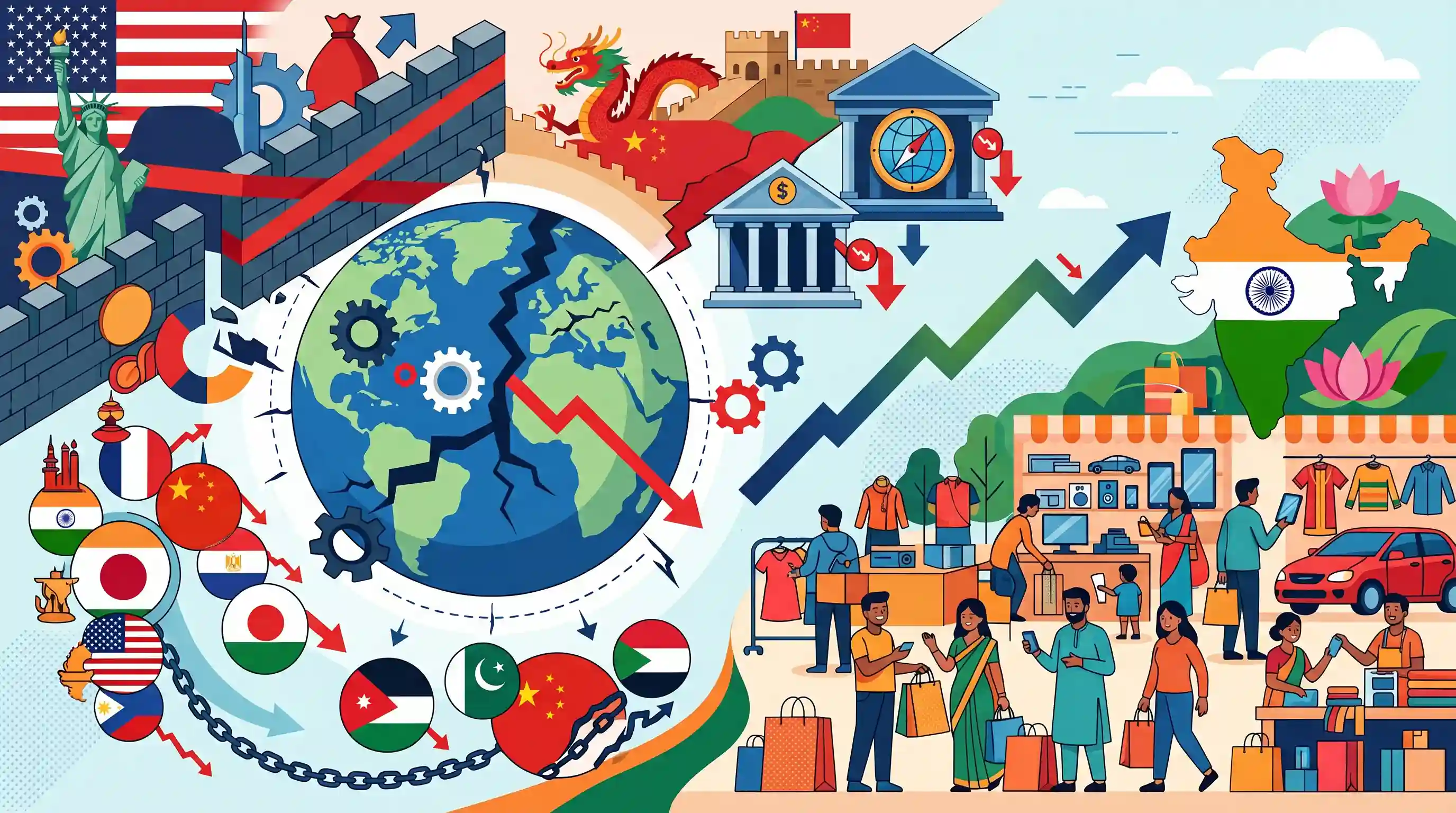
The International Monetary Fund (IMF) has sharply downgraded its global economic growth forecasts for 2025 and 2026, pointing to significant disruptions triggered by aggressive U.S. tariff policies and massive retaliatory measures by China. With global growth projected to fall to 2.8% in 2025, major economies are poised for steep slowdowns. India's growth projection for FY26 was slightly reduced to 6.2%, though it retains resilience due to domestic private consumption. The IMF's Chief Economist cautioned that the post-WWII multilateral economic order is being fundamentally 'reset', raising the probability of a global downturn to 30% and threatening emerging markets with volatile capital flows and debt distress.
Key Points
- The IMF slashed its 2025 global growth projection to 2.8% (down 0.5 percentage points) and 2026 projection to 3.0%, citing severe disruptions from US President Donald Trump's near-universal tariff policy.
- India's FY26 growth outlook was trimmed by 0.3 percentage points to 6.2% due to global uncertainty, though it remains buttressed by robust private consumption in rural areas.
- Major economies face steep downgrades: US growth is projected to slow to 1.8% and China to 4%, as effective tariff rates hit 100-year highs (US tariffs on China reached 145%-245%, with Beijing retaliating at 125%).
- The IMF Chief Economist stated that the 80-year-old global economic system is being 'reset', nearly doubling the risk of a global downturn to 30%.
- The surge in protectionism threatens emerging economies with heightened risks, including debt servicing challenges, abrupt shifts in capital flows, and exchange rate volatility.
Important Terms
International Monetary Fund (IMF)

A 191-nation global organization (est. 1944) that fosters monetary cooperation, ensures financial stability, and provides short-to-medium-term financial assistance to countries facing balance-of-payments difficulties.
UPSC context
GS Paper 2: International Institutions; GS Paper 3: Indian Economy. Key for global financial governance.
World Economic Outlook (WEO)
A flagship IMF report published twice yearly that provides comprehensive analysis and growth projections for the global economy, identifying risks like trade tensions and inflation.
UPSC context
GS Paper 3: Indian Economy. Essential for monitoring global growth trends and external shocks.
April 2 Tariff Policy (Universal Tariffs)
A protectionist trade regime featuring a baseline 10% universal duty and higher 'reciprocal' tariffs on specific goods (up to 50%), aimed at reducing trade deficits.
UPSC context
GS Paper 3: Effects of Liberalization. Tests impact of protectionism on global trade and India.
Post-WWII Multilateral Economic Order
The framework of rules and institutions (IMF, World Bank, WTO) established after 1945 to ensure open trade and financial stability, now facing a fundamental 'reset'.
UPSC context
GS Paper 2: Global Groupings. Vital for analyzing shifts from globalization to economic fragmentation.
Private Consumption
The total market value of goods and services purchased by households. It acts as a primary growth driver and domestic buffer for the Indian economy.
UPSC context
GS Paper 3: Growth and Development. Key to India's domestic-demand-driven economic resilience.
Debt Distress
A condition where a country is unable to meet its debt obligations, often triggered in emerging markets by volatile capital outflows and currency depreciation.
UPSC context
GS Paper 3: Indian Economy. Focuses on fiscal stability and external sector vulnerabilities.
Prelims Trap
"Global protectionism and tariffs typically increase foreign capital inflows into emerging markets as they become safe havens."
Global uncertainty and tariff wars actually trigger a "flight to safety" toward US dollar assets, leading to abrupt capital flight (outflows) from emerging economies, not inflows.
Static Concepts Connected
What are the key flagship reports published by the IMF?
- World Economic Outlook: Provides biannual analysis and growth projections of global macroeconomic developments, as referenced in the news.
- Global Financial Stability Report: Assesses global financial markets and identifies potential systemic vulnerabilities and risks to financial stability.
- Fiscal Monitor: Analyzes public finance developments, fiscal policies, and government debt levels across member countries.
How does sudden capital flight impact an emerging economy like India?
- Currency Depreciation: Mass selling of domestic assets increases demand for foreign currency, weakening the domestic exchange rate (e.g., Rupee falls against the Dollar).
- Imported Inflation: A weaker currency makes essential imports like crude oil and edible oils costlier, driving up domestic inflation.
- Debt Servicing Distress: External commercial borrowings (ECBs) denominated in foreign currencies become significantly more expensive for domestic firms to service and repay.
Cross-Topic Patterns
Protectionism vs. WTO dispute paralysis
Unilateral 145%+ tariffs bypass WTO rules, directly tying to the ongoing paralysis of the WTO's Appellate Body due to the US blocking judge appointments over the last several years.
Private consumption as a macroeconomic anchor
India's growth resilience relies heavily on Private Final Consumption Expenditure (~60% of GDP), contrasting sharply with export-led East Asian models which are highly vulnerable to global tariff wars.

Expect a multi-statement prelims question linking global tariff hikes to India's FPI flight, imported inflation, and RBI forex actions.
Linked PYQs · 2
Linked PYQs · 2
- 2025MainsGS3
What are the challenges before the Indian economy when the world is moving away from free trade and multilateralism to protectionism and bilateralism? How can these challenges be met?
- 2016MainsGS2
The broader aims and objectives of WTO are to manage and promote international trade in the era of globalization. But the Doha round of negotiations seem doomed due to differences between the developed and the developing countries." Discuss in the Indian perspective.
