IMF Projects India Growth Amid Global Trade Fragmentation
Source:The Hindu ↗
Why It Matters
The article provides key macroeconomic data points (GDP projections) and highlights the role of domestic growth drivers (manufacturing and services) in insulating India from global protectionist trends (like US tariffs). This is directly relevant to GS3 topics concerning the Indian Economy, as well as Prelims questions regarding indices and reports published by international bodies like the IMF.
Summary
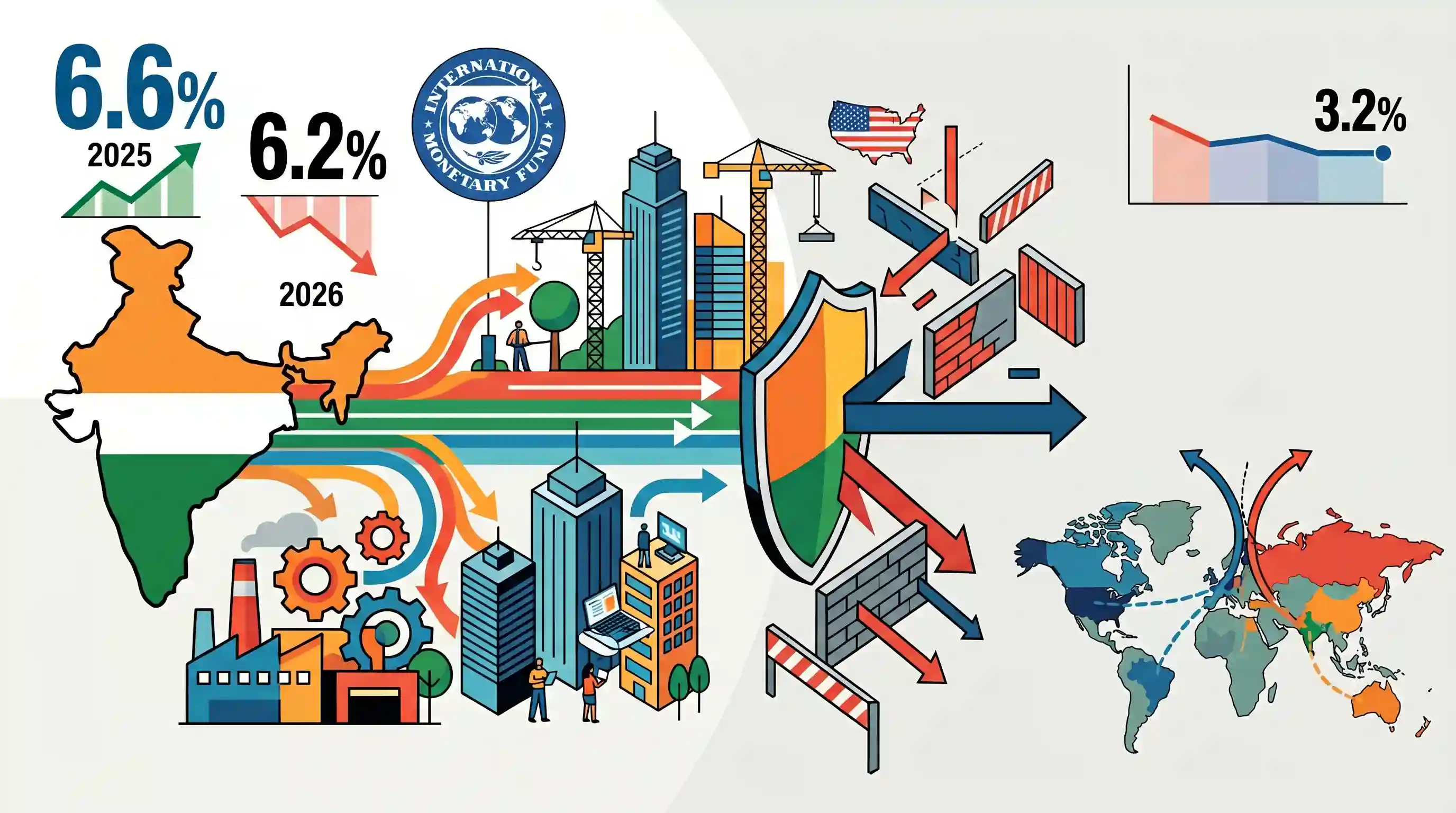
The International Monetary Fund (IMF) has retained its growth projection for India at 6.6% for 2025, while lowering the 2026 forecast to 6.2%. This resilience in 2025 is largely attributed to a strong first quarter driven by manufacturing, construction, and services, which generated a robust carryover effect. According to the IMF, this domestic momentum has enabled India to successfully absorb and offset the negative impacts of recent US protectionist tariffs. Global growth is expected to remain relatively slow at 3.2% in 2025, emphasizing the importance of India's internal growth drivers amidst rising international trade fragmentation.
Key Points
- The IMF's World Economic Outlook projects India's GDP growth at 6.6% for 2025, downgrading the 2026 forecast slightly to 6.2%.
- Strong first-quarter growth (7.8%) driven by manufacturing, services, and construction created a 'carryover effect' supporting the 2025 projection.
- India's robust domestic momentum has helped the country offset the adverse impacts of a protectionist US tariff regime.
- Global economic growth is projected to remain subdued at 3.2% in 2025 and 3.1% in 2026 amid rising trade fragmentation.
Important Terms
International Monetary Fund (IMF)

A UN specialized agency established in 1945 to foster global monetary cooperation, secure financial stability, facilitate international trade, and provide financial assistance to members facing balance-of-payments crises.
UPSC context
GS Paper 2/3: Important International Institutions; their mandate, governance, and role in global economic stability.
World Economic Outlook (WEO)
The IMF's flagship report published twice yearly, providing analysis and projections for the global economy, individual countries, and regional growth trends.
UPSC context
GS Paper 3: Economic Growth and Development; key reports used for benchmarking India's macroeconomic performance.
Geo-economic Fragmentation
The policy-driven reversal of global economic integration into competing blocs, often motivated by geopolitical tensions, leading to restricted trade, capital flows, and technology sharing.
UPSC context
GS Paper 2/3: International Relations and Effects of Liberalization; tests understanding of modern threats to globalization.
Protectionism
Economic policy of restraining trade between states through methods such as tariffs, quotas, and subsidies to shield domestic industries from foreign competition.
UPSC context
GS Paper 3: External Sector and Trade; challenges to free trade and the World Trade Organization (WTO).
Carryover Effect
A statistical phenomenon where strong economic growth at the end of one year (or start of another) ensures a high annual growth rate for the following period, even if momentum slows.
UPSC context
GS Paper 3: Indian Economy; understanding quarterly vs annual growth dynamics and macroeconomic forecasting.
GDP Growth Rate
The annual percentage increase in the value of all final goods and services produced within a country, adjusted for inflation (Real GDP).
UPSC context
GS Paper 3: Indian Economy and issues relating to planning, mobilization of resources, and growth.
Prelims Trap
"Carryover effect in GDP forecasting refers to transferring unspent budgetary funds to the next fiscal year."
It is a mathematical/statistical phenomenon, not a fiscal one. Strong economic performance at the end of one period statistically elevates the baseline of the next.
Static Concepts Connected
What are the flagship publications released by the International Monetary Fund (IMF)?
- World Economic Outlook: Analyzes global economic developments, provides GDP growth projections, and highlights macroeconomic risks.
- Global Financial Stability Report: Assesses global financial markets, emerging market financing conditions, and systemic vulnerabilities.
- Fiscal Monitor: Analyzes public finance developments, fiscal policies, and government debt levels globally.
What is trade fragmentation and how does it impact developing economies?
- Geoeconomic Fragmentation: The reversal of global integration, shifting from multilateral WTO frameworks to bilateral, politically aligned trade blocs.
- Protectionist Barriers: Advanced economies imposing restrictive tariffs to shield domestic industries from global competition (e.g., US tariffs).
- Growth Impact: Reduces export-led growth avenues, forcing developing nations to rely on domestic consumption and structural self-reliance.
Cross-Topic Patterns
Protectionism & Deglobalization trend
India's reliance on domestic momentum to offset US tariffs mirrors the broader deglobalization trend, heavily challenging traditional export-led growth models for developing nations.
GDP Estimation & Base Effects
The 'carryover effect' conceptually aligns with 'base effects', highlighting how mathematical baselines influence headline macroeconomic indicators, a recurring theme in UPSC Prelims.

Expect a 2026 Prelims statement differentiating the statistical 'carryover effect' from fiscal roll-overs, alongside IMF report matching.
Linked PYQs · 4
Linked PYQs · 4
- 2014PrelimsGS1
Which of the following organizations brings out the publication known as 'World Economic Outlook'?
- 2018MainsGS3
How would the recent phenomena of protectionism and currency manipulations in world trade affect macroeconomic stability of India?
- 2025MainsGS3
What are the challenges before the Indian economy when the world is moving away from free trade and multilateralism to protectionism and bilateralism? How can these challenges be met?
- 2023MainsGS3
Faster economic growth requires increased share of the manufacturing sector in GDP, particularly of MSMEs. Comment on the present policies of the Government in this regard.
