IMF Global Growth Projections and Inflation Warnings
Source:The Hindu ↗
Why It Matters
As a flagship multilateral publication, the World Economic Outlook is essential for tracking global economic trends. The IMF's warnings on rising trade protectionism and sticky inflation highlight systemic risks that directly impact India's macroeconomic stability, export prospects, and the RBI's monetary policy trajectory.
Summary
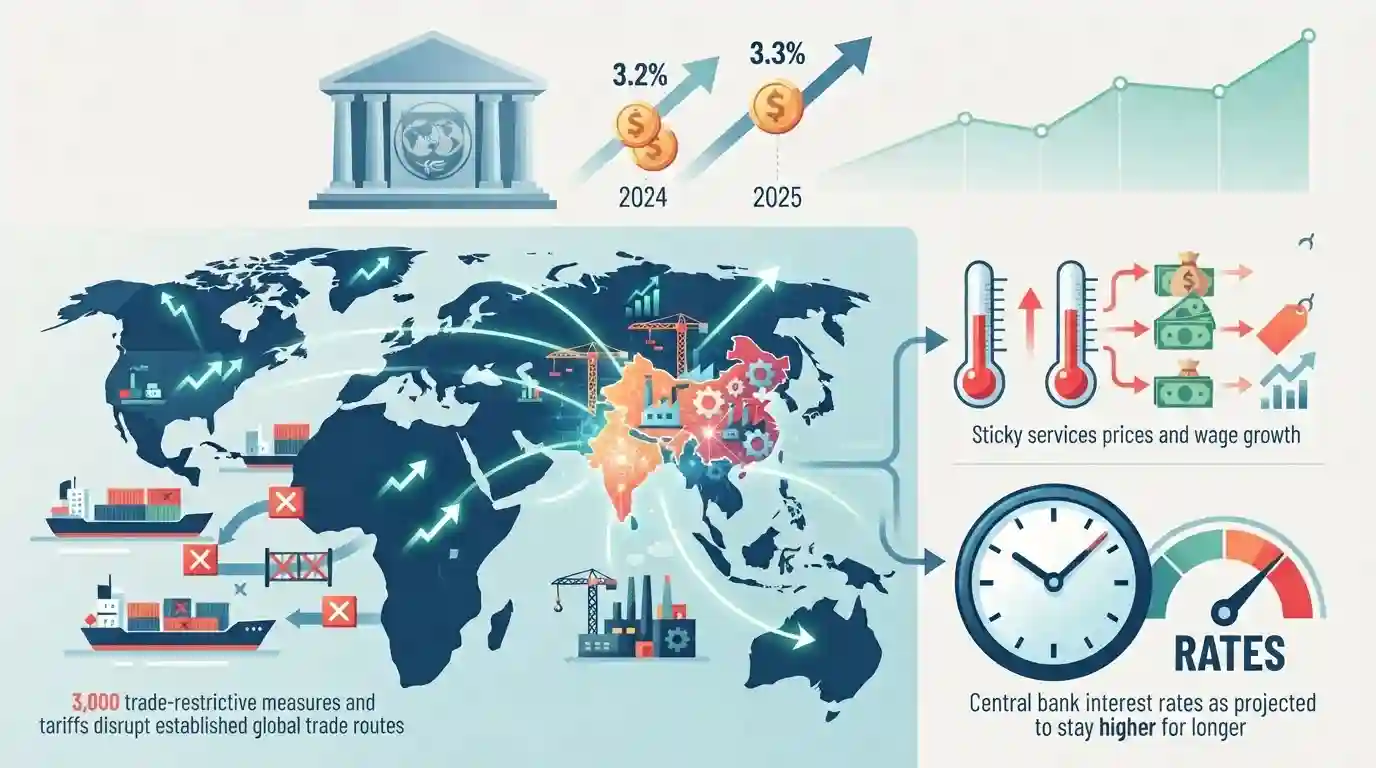
The IMF maintained its global economic growth forecast for 2024 at 3.2% in its World Economic Outlook update, projecting 3.3% for 2025. While recognizing Asia, particularly India and China, as the main engine of global growth, the IMF warned of persistent inflation risks stemming from sticky services prices and wage growth. The organization highlighted a concerning surge in global trade protectionism, with over 3,000 trade-restrictive measures implemented in the past year. Such tariffs and trade tensions raise import costs and create supply chain disruptions, which could delay the global normalization of inflation and keep interest rates higher for longer.
Key Points
- The IMF's World Economic Outlook update maintained the global growth forecast at 3.2% for 2024, forecasting 3.3% for 2025.
- India and China are recognized as the primary engines of activity in Asia, with China's 2024 projection revised upward to 5.0%.
- The IMF warned of a massive surge in trade protectionism, noting over 3,000 trade-restrictive measures globally in the past year, up from 1,000 in 2019.
- Service sector inflation, combined with escalating trade tensions and tariffs, risks delaying the return to inflation targets and prolonging high interest rates.
- 2024 growth forecasts were downgraded for the US (to 2.6%) and Japan (to 0.7%), while the Euro area showed signs of a modest economic recovery.
Important Terms
International Monetary Fund (IMF)

The IMF is an international organization of 190 member countries that promotes global macroeconomic stability. It monitors global economies, provides policy advice, and offers financial assistance to nations facing balance-of-payments crises.
UPSC context
GS-2 (International Institutions) and GS-3 (Economy). Tests knowledge of global financial governance, IMF reports, and balance-of-payments crisis management.
World Economic Outlook (WEO)
The World Economic Outlook is a flagship report published biannually by the IMF. It analyzes global economic developments, projecting GDP growth rates, inflation trends, and macro-financial conditions for advanced and developing economies.
UPSC context
GS-3 (Economy) and Prelims. Tests awareness of major international indices, publishers, and global macroeconomic trends affecting India.
US Federal Reserve
The US Federal Reserve (the Fed) is the central banking system of the United States. It formulates US monetary policy and adjusts interest rates to maintain maximum employment and stable prices.
UPSC context
GS-3 (Economy). Tests understanding of external sector dynamics, as Fed rate changes impact global liquidity, FPI flows, and the Rupee.
Trade Protectionism
Trade protectionism is an economic policy where governments restrict international trade using tariffs, import quotas, and non-tariff barriers to shield domestic industries from foreign competition.
UPSC context
GS-3 (Economy) & GS-2 (IR). Tests understanding of globalization, WTO principles, trade wars, and impacts on domestic growth.
Prelims Trap
The World Economic Outlook (WEO) is a flagship report published by the World Bank.
UPSC frequently swaps report publishers. The WEO is the IMF's flagship macroeconomic report, whereas the World Bank publishes the similarly named 'Global Economic Prospects'.
Static Concepts Connected
What drives 'Sticky Inflation' in an economy?
- Service Prices: Services are less tradable than goods and highly labor-intensive, making their prices slower to adjust to monetary tightening.
- Wage-Price Spiral: Rising living costs prompt demands for higher wages, which businesses pass on to consumers as higher prices, embedding inflation.
- Inflation Expectations: When consumers and businesses entrench expectations of high inflation, long-term contracts and pricing strategies adapt, making it harder to reverse.
What are the common tools of trade protectionism?
- Tariff Barriers: Direct taxes or customs duties imposed on imported goods to reduce their domestic price competitiveness.
- Non-Tariff Barriers: Use of quotas, complex licensing, or strict Sanitary and Phytosanitary (SPS) measures to restrict imports without direct taxes.
- Trade Remedies: Aggressive or retaliatory use of anti-dumping and countervailing duties under the guise of WTO-compliant domestic industry protection.
Cross-Topic Patterns
Protectionism and Atmanirbhar Bharat
The surge in global trade-restrictive measures provides the geopolitical context for India's PLI schemes and the broader shift towards self-reliance to insulate domestic supply chains.
Sticky inflation and FPI outflows
Persistent global inflation keeping US rates 'higher for longer' directly impacts India's balance of payments by triggering Foreign Portfolio Investment (FPI) capital flight and currency depreciation.

Expect a multi-statement prelims question linking trade protectionism to cost-push inflation and 'sticky' services pricing in 2026.
Linked PYQs · 4
Linked PYQs · 4
- 2014PrelimsGS1
Which of the following organizations brings out the publication known as 'World Economic Outlook'?
- 2024MainsGS3
What are the causes of persistent high food inflation in India? Comment on the effectiveness of the monetary policy of the RBI to control this type of inflation.
- 2018MainsGS2
What are the key areas of reform if the WTO has to survive in the present context of "Trade War', especially keeping in mind the interest of India?
- 2016PrelimsGS1
'Global Financial Stability Report' is prepared by the
