IMF Upgrades India GDP Growth Forecast in Global Economic Outlook
Source:Indian Express ↗
Why It Matters
This article highlights India's macroeconomic resilience and growth decoupling amidst global fragmentation, geopolitical conflicts, and energy price volatility, serving as a core topic for GS3 Indian Economy and international economic organizations.
Summary
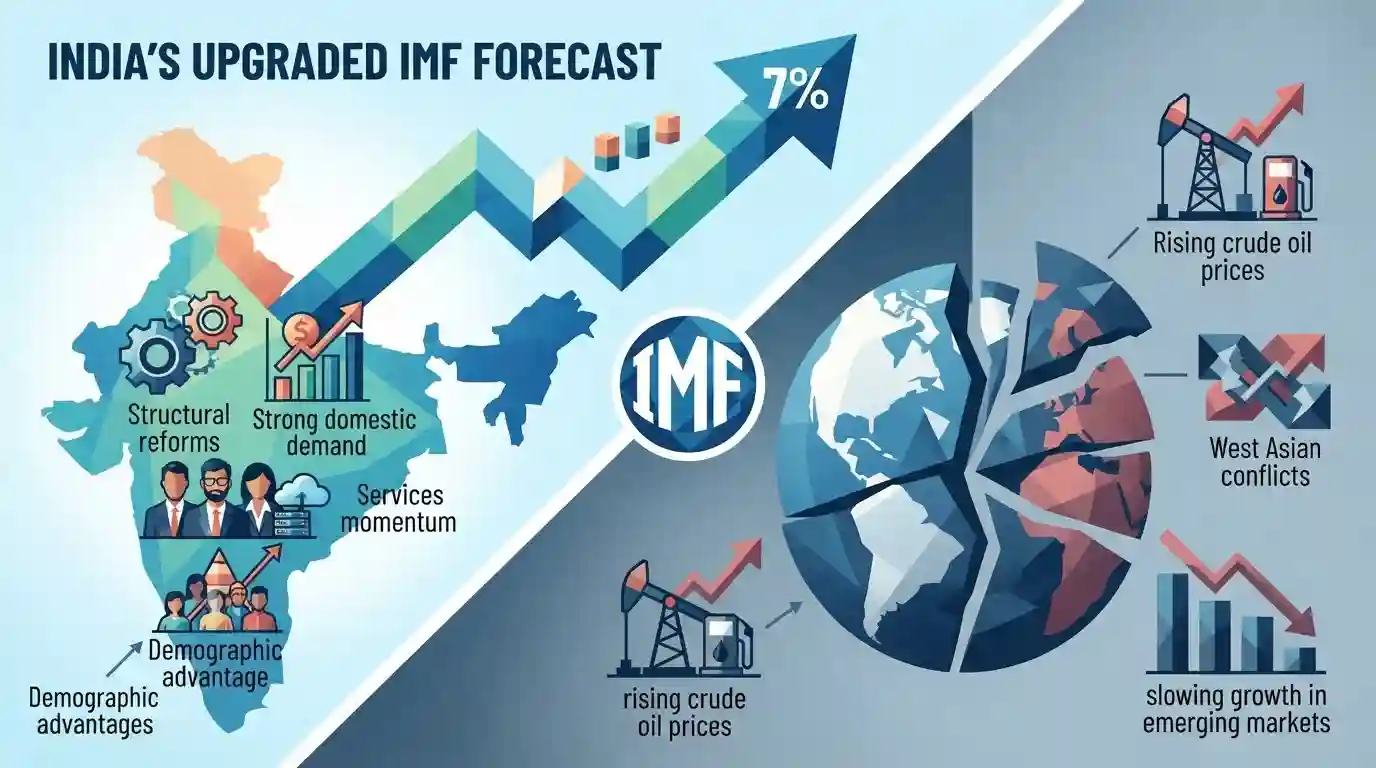
The International Monetary Fund (IMF) has upgraded India's GDP growth forecast to 7% for 2026-27, driven by strong domestic demand, services momentum, demographic advantages, and structural reforms. However, the IMF's World Economic Outlook warns of a fragmented global economy impacted by West Asian conflicts, rising crude oil prices, and slowing growth across several emerging markets and developing countries.
Key Points
- The International Monetary Fund (IMF) raised India's GDP growth forecast to 7% for 2026-27 (and 7% for 2027-28), citing robust domestic demand, resilient services activity, demographic dynamics, and structural reforms.
- The upward revision for India contrasts with a sluggish and fragmented global economic outlook (projected at 3.1% in 2026), weighed down by geopolitical conflicts in West Asia, energy shocks, and contractions in key commodity-producing nations.
- The IMF assumes crude oil prices will average $95.74 per barrel in 2026, marking a 41% increase from 2025 due to ongoing supply disruptions.
- Emerging markets and developing economies face downward growth revisions (down to 3.7% in 2026) due to slowdowns or economic contractions in China, Russia, Brazil, and West Asian oil producers.
Prelims Trap
The IMF independently collects all domestic primary production data to compute national GDP forecasts without consulting central banks.
Aspirants often assume that IMF forecasts are binding or calculated independently using exclusive primary field data, whereas they are macroeconomic projections derived in consultation with member central banks and national statistical offices.
Static Concepts Connected
What are the core flagship publications and financial assistance facilities of the International Monetary Fund (IMF)?
- Flagship Reports: World Economic Outlook (WEO) is published biannually, analyzing global economic developments and trends.
- Lending Facilities: Extended Fund Facility (EFF) and Stand-By Arrangement (SBA) provide medium-term and short-term financial assistance to member countries facing balance of payments issues.
- SDR Allocation: Special Drawing Rights (SDRs) serve as an international reserve asset allocated to member countries in proportion to their IMF quotas.
Cross-Topic Patterns
Global Growth Forecasts vs Domestic Fiscal Consolidation
The IMF's growth upgrades contrast sharply with its warnings on debt vulnerabilities in developing countries, linking macro growth forecasts directly to the Fiscal Responsibility and Budget Management (FRBM) roadmap and external debt sustainability.

IMF growth projections for India paired with global fragmentation risks are high-probability material for Prelims statements or Mains GS-3.
Linked PYQs · 3
Linked PYQs · 3
- 2019MainsGS3
Do you agree with the view that steady GDP growth and low inflation have left the Indian economy in good shape? Give reasons in support of your arguments.
- 2022MainsGS3
Economic growth in the recent past has been led by increase in labour productivity." Explain this statement. Suggest the growth pattern that will lead to creation of more jobs without compromising labour productivity.
- 2024MainsGS3
Examine the pattern and trend of public expenditure on social services in the post-reforms period in India. To what extent this has been in consonance with achieving the objective of inclusive growth?
