IMF Upgrades India FY26 GDP Growth Forecast Amid Easing Trade Tensions
Source:Indian Express ↗
Why It Matters
GDP forecasts by major institutions like the IMF are key indicators of India's economic trajectory. Understanding how external factors, such as global trade tensions, impact domestic growth is critical for macroeconomic policy analysis in the UPSC syllabus.
Summary
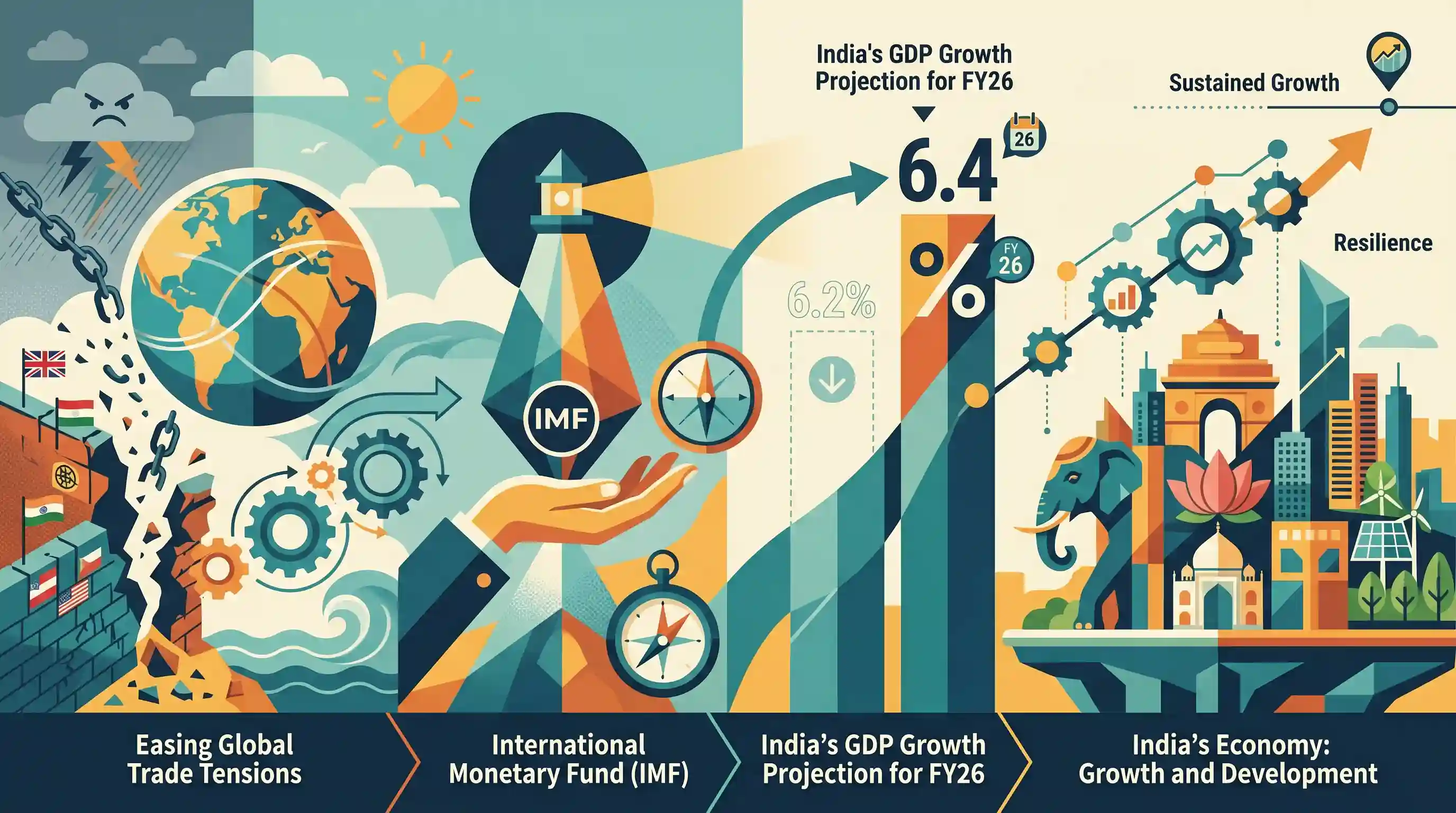
The International Monetary Fund (IMF) has raised India's GDP growth projection for FY26 to 6.4%, up from earlier estimates. The key driver for this optimistic outlook is the easing of global trade tensions, which has improved the broader international economic environment. This upgrade underscores the resilience of the Indian economy and its ability to sustain growth amidst evolving global trade dynamics.
Key Points
- The International Monetary Fund (IMF) has upgraded India's GDP growth forecast for the fiscal year 2026 to 6.4%.
- The upward revision is primarily attributed to an easing of global trade tensions.
- This forecast highlights India's macroeconomic resilience and favorable growth prospects despite external uncertainties.
Important Terms
International Monetary Fund (IMF)

A Bretton Woods institution fostering global monetary cooperation, financial stability, and sustainable growth. It provides financial assistance to members facing balance of payments crises.
UPSC context
GS-II: International Institutions; GS-III: Effects of liberalization on the economy. Often tested on governance and BoP role.
Gross Domestic Product (GDP)
The total monetary value of all finished goods and services produced within a country's borders over a specific period, serving as a primary indicator of economic health.
UPSC context
GS-III: Indian Economy and issues relating to planning, mobilization of resources, growth, and development.
World Economic Outlook (WEO)
A flagship report published twice a year (April and October) by the IMF, providing global economic analysis and growth projections for member countries.
UPSC context
GS-II: Important International institutions and their reports. Prelims frequently asks about report-releasing agencies.
Trade Tensions
Economic conflicts between nations involving retaliatory tariffs, quotas, or protectionist measures that disrupt global supply chains and depress international trade volumes.
UPSC context
GS-III: External sector, trade policy, and the impact of global geopolitical dynamics on India's growth.
Economic Resilience
The capacity of a national economy to absorb external shocks—such as trade disruptions or geopolitical conflicts—and maintain stable growth through strong domestic fundamentals.
UPSC context
GS-III: Indian Economy and growth sustainability. Tests understanding of domestic vs. external drivers of development.
Fiscal Year (FY)
The 12-month period used for government accounting and budgeting; in India, it runs from April 1 to March 31.
UPSC context
Prelims/GS-III basics: Essential for understanding budgetary cycles and economic data reporting periods in India.
Prelims Trap
"The World Economic Outlook, which projects global GDP growth, is published bi-annually by the World Bank."
The World Economic Outlook (WEO) is a flagship publication of the International Monetary Fund (IMF), not the World Bank. Aspirants frequently mix up Bretton Woods reports.
Static Concepts Connected
How is a member's quota determined in the IMF?
- Formula variables: Calculated using a weighted formula: GDP (50%), openness (30%), economic variability (15%), and international reserves (5%).
- Voting & Access: A country's quota directly dictates its voting weight, maximum access to IMF financing, and its share of SDR allocations.
What are the core determinants of Potential GDP?
- Capital accumulation: Steady expansion of physical infrastructure, machinery, and overall fixed capital stock.
- Labor force: The size, demographic dividend, and skill level of the available workforce.
- Technological progress: Improvements in total factor productivity (TFP) ensuring maximum non-inflationary output over the long term.
Cross-Topic Patterns
Growth metrics & IMF Quota reform
Sustained high GDP growth bolsters India's diplomatic push for re-evaluating IMF quotas to accurately reflect the current economic weight of the Global South.
Trade tensions & CAD stability
Easing global trade friction directly mitigates supply chain shocks, reducing the risk of imported inflation and severe Current Account Deficit (CAD) widening.

Expect a multi-statement Prelims question mixing IMF WEO report facts with the structural determinants of Potential GDP in 2026.
Linked PYQs · 5
Linked PYQs · 5
- 2023MainsGS3
Faster economic growth requires increased share of the manufacturing sector in GDP, particularly of MSMEs. Comment on the present policies of the Government in this regard.
- 2025MainsGS3
What are the challenges before the Indian economy when the world is moving away from free trade and multilateralism to protectionism and bilateralism? How can these challenges be met?
- 2018MainsGS3
How would the recent phenomena of protectionism and currency manipulations in world trade affect macroeconomic stability of India?
- 2020MainsGS3
Define potential GDP and explain its determinants. What are the factors that have been inhibiting India from realizing its potential GDP?
- 2016PrelimsGS1
'Global Financial Stability Report' is prepared by the
