IMF Assessment of India National Accounts Data
Source:The Hindu ↗
Why It Matters
Reliable macroeconomic data is the bedrock of fiscal and monetary policymaking. Statistical gaps, particularly concerning the informal sector, outdated CPI/WPI bases, and discrepancies in GDP approaches, risk misdiagnosing economic health and misaligning inflation targeting or resource allocation.
Summary
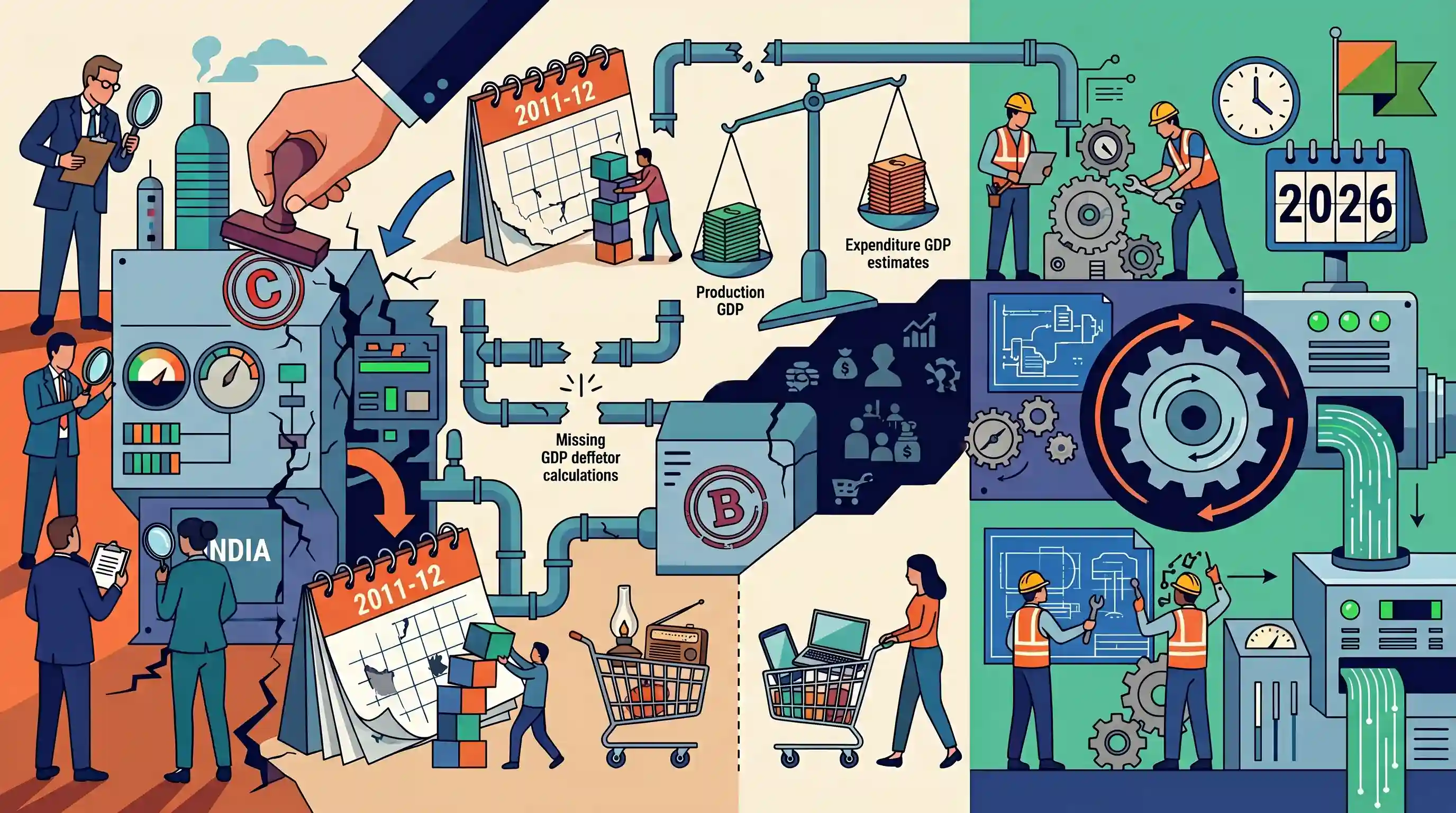
The IMF's Article IV assessment has flagged major deficiencies in India's macroeconomic data architecture, assigning a 'C' grade to its GDP and national accounts frameworks. Key vulnerabilities highlighted include the reliance on an outdated 2011-12 base year, the absence of Producer Price Indices for robust GDP deflator calculations, and significant discrepancies between production and expenditure-side GDP estimates. These gaps obscure the true state of the informal economy and hamper accurate policymaking. Similarly, India's CPI framework received a 'B' grade owing to an obsolete consumption basket that fails to reflect contemporary spending patterns. To address these systemic gaps, MoSPI is overhauling statistical methodologies and base years, with the rollout of updated indices anticipated in mid-2026.
Key Points
- The IMF assigned India a 'C' grade for its GDP and national accounts data, the second-lowest rating in its Article IV assessment.
- India's national accounts and CPI base years (2011-12) are significantly outdated compared to global standards.
- Methodological concerns include using Wholesale Price Indices (WPI) instead of Producer Price Indices (PPI) as data sources for GDP deflators.
- A substantial statistical discrepancy exists between production and expenditure approaches in measuring India's GDP, pointing to inadequate tracking of the informal sector and expenditure data.
- India lacks seasonally adjusted GDP and national accounts data.
- The CPI received a 'B' grade due to its outdated consumption basket and weights. MoSPI plans to update base years and methodologies, projecting a new series by mid-2026.
Important Terms
International Monetary Fund (IMF)

A United Nations specialized agency that monitors global financial stability and conducts economic surveillance of its 190 member countries.
UPSC context
GS II/III: International Relations and Economy; tests knowledge of global financial governance and economic monitoring.
Article IV Consultation
An annual bilateral discussion between the IMF and a member country to assess economic health, risks, and policy recommendations.
UPSC context
GS III: Economy; tests understanding of international economic oversight and its impact on domestic policy credibility.
Ministry of Statistics and Programme Implementation (MoSPI)
The nodal Indian ministry responsible for the coverage and quality of national statistics, including GDP, CPI, and IIP calculations.
UPSC context
GS III: Economy; essential for understanding the institutional framework of India's macroeconomic data collection.
Base Year
A benchmark year (currently 2011-12 in India) used as a reference point for measuring real economic growth by adjusting for inflation.
UPSC context
GS III: Economy; core concept for national income accounting and understanding the 'Real' vs 'Nominal' GDP.
GDP Deflator
The ratio of nominal GDP to real GDP, measuring the level of prices of all new, domestically produced, final goods and services.
UPSC context
GS III: Economy; a comprehensive inflation measure tested in Prelims and used for growth analysis in Mains.
Producer Price Index (PPI)
An index measuring the average change over time in the selling prices received by domestic producers for their output.
UPSC context
GS III: Economy; often contrasted with CPI/WPI as a more robust tool for measuring inflationary pressure at the production stage.
National Accounts Statistics (NAS)
A comprehensive macroeconomic database provided by MoSPI that tracks India's production, consumption, savings, and investment aggregates.
UPSC context
GS III: Economy; the primary data framework for assessing sectoral contributions and overall economic health.
Prelims Trap
"India uses the Producer Price Index (PPI) as the primary metric to calculate its GDP deflator."
India actually relies heavily on the WPI for its GDP deflator. The IMF explicitly flagged the absence of a PPI as a major methodological gap.
Static Concepts Connected
How does the GDP Deflator differ from the Consumer Price Index (CPI)?
- Coverage: The GDP deflator includes prices of all domestically produced goods and services, whereas the CPI includes only a representative basket of goods consumed by households.
- Imports: CPI includes prices of imported consumer goods. The GDP deflator exclusively measures domestic production, excluding all imports.
- Dynamic Weights: The CPI uses fixed weights based on a base year basket. The GDP deflator allows weights to change dynamically each year based on actual production.
What causes "statistical discrepancies" in India's GDP estimation?
- Production Approach: Estimates economic output by calculating the Gross Value Added (GVA) at basic prices across all economic sectors.
- Expenditure Approach: Calculates GDP by adding up total spending in the economy: Consumption + Investment + Government Spending + (Exports - Imports).
- The Mismatch: Arises when expenditure data (often estimated or delayed, especially for the informal sector) fails to mathematically match the production-side GVA, requiring a balancing figure.
Cross-Topic Patterns
Article IV + Sovereign Credit Ratings
IMF’s critique of India's statistical architecture under Article IV consultations directly impacts sovereign rating agencies (like Moody's and Fitch) when they assess India's institutional strength, macroeconomic stability, and data transparency.
Outdated CPI + RBI Monetary Policy
An obsolete CPI base year (2012) over-weights food inflation. This complicates the RBI's inflation-targeting mandate, potentially keeping interest rates misaligned with actual contemporary consumption and hindering monetary policy transmission.

Expect a 2026 Prelims multi-statement question contrasting WPI, PPI, and the GDP Deflator, paired with the IMF's Article IV mandate.
Linked PYQs · 4
Linked PYQs · 4
- 2021MainsGS3
Explain the difference between computing methodology of India's Gross Domestic Product (GDP) before the year 2015 and after the year 2015.
- 2020MainsGS3
Define potential GDP and explain its determinants. What are the factors that have been inhibiting India from realizing its potential GDP?
- 2020PrelimsGS1
Consider the following statements: 1. The weightage of food in Consumer Price Index (CPI) is higher than that in Wholesale Price Index (WPI). 2. The WPI does not capture changes in the prices of services, which CPI does. 3. Reserve Bank of India has now adopted WPI as its key measure of inflation and to decide on changing the key policy rates. Which of the statements given above is/are correct?
- 2010PrelimsGS1
With reference to India, consider the following statements : 1. The Wholesale Price Index (WPI) in India is available on a monthly basis only. 2. As compared to Consumer Price Index for Industrial Workers (CPI(IW)), the WPI gives less weight to food articles. Which of the statements given above is/are correct ?
