International Monetary Fund Bailouts and State Sponsored Terrorism
Source:Indian Express ↗
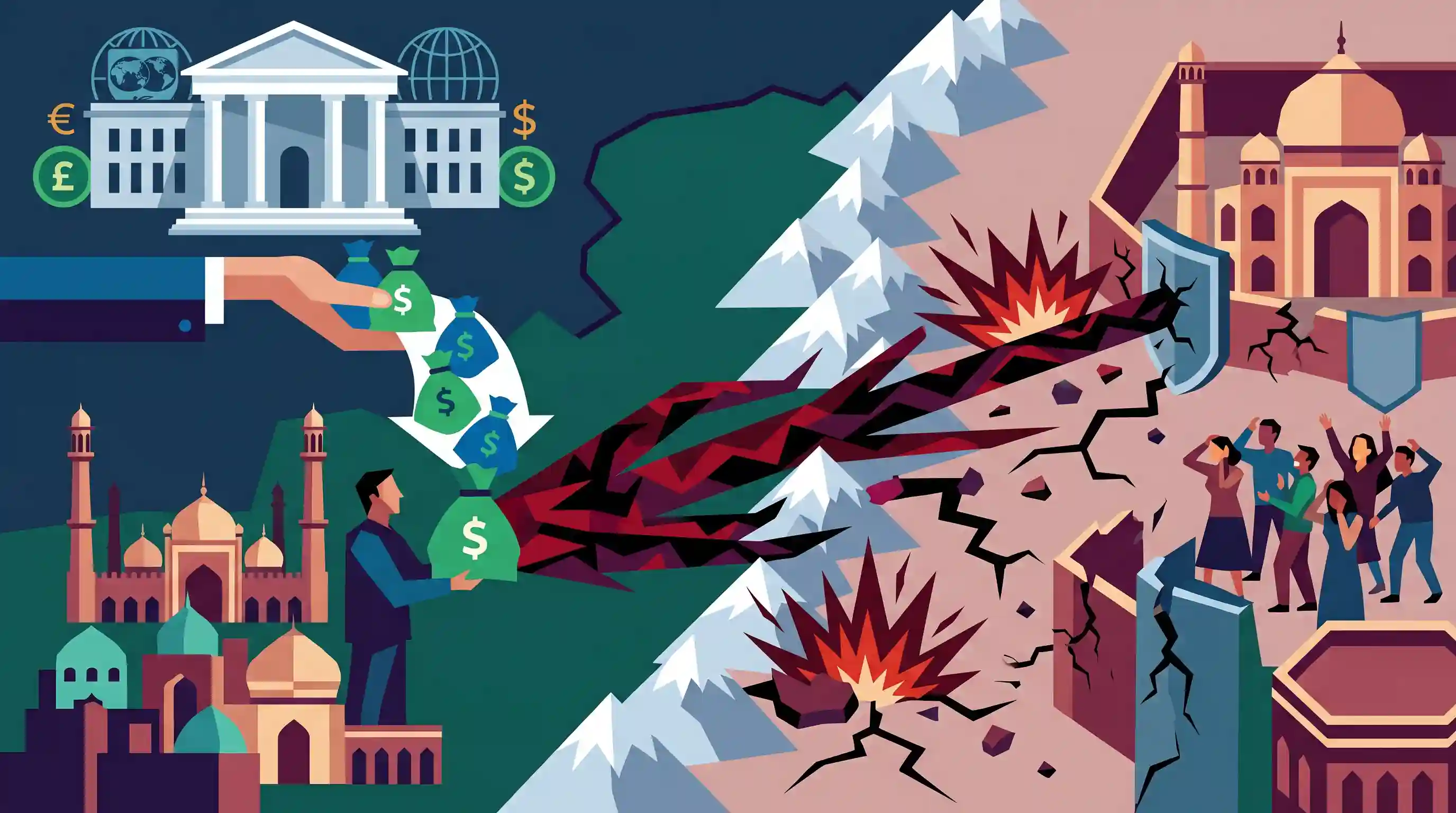
Why It Matters
This issue perfectly intersects GS2 (International Relations/Institutions) and GS3 (Internal Security), requiring aspirants to analyze the implications of international economic bailouts for states that simultaneously pose acute cross-border terrorism threats to India.
Summary
The article critiques the global financial system's approach to Pakistan, highlighting the paradox of the International Monetary Fund (IMF) extending a financial bailout to the country amidst its economic crisis, even as it continues to enable cross-border terrorism against India, most recently manifested in the Pahalgam terror attack. It underscores the geopolitical discomfort in decoupling economic stabilization from accountability for state-sponsored terrorism and terror financing, raising strategic concerns for India's internal security and foreign policy in managing its neighborhood.
Key Points
- Pakistan has sought and received financial bailouts from the International Monetary Fund (IMF) to stabilize its crippling economic and balance-of-payments crisis.
- Concurrently, Pakistan continues to orchestrate or harbour elements responsible for cross-border terrorism against India, as evidenced by the recent Pahalgam terror attack.
- The article highlights the strategic paradox and "uncomfortable balancing act" wherein global financial institutions rescue a state economy without penalising its continued use of terrorism as an instrument of state policy.
- For India, this underscores the challenge of managing a volatile neighborhood and reinforces the need to leverage forums like the FATF to firmly link international financial assistance to verifiable actions against terror financing.
Important Terms
International Monetary Fund (IMF)

A global organization that provides financial stability and emergency loans (bailouts) to countries facing balance-of-payments crises, often requiring strict economic reforms as conditionality.
UPSC context
GS Paper II: Important International institutions. Focuses on governance, voting rights (quotas), and the geopolitical implications of lending policies.
Financial Action Task Force (FATF)
The global watchdog for money laundering and terrorist financing that sets standards and monitors countries via 'Grey' and 'Black' lists to protect the international financial system.
UPSC context
GS Paper III: Money laundering and its prevention. Tests understanding of international pressure on state-backed terror financing.
Extended Fund Facility (EFF)
An IMF lending instrument that provides financial assistance to countries facing serious medium-term balance-of-payments problems due to structural weaknesses, typically requiring longer-term engagement and deeper reforms.
UPSC context
GS Paper III: Indian Economy. Relevant for understanding external debt management and comparative analysis of neighbor nations' economic crises.
Cross-Border Terrorism
The use of violence by non-state actors or state-sponsored groups originating from one country to target civilians or security forces in another country across international borders.
UPSC context
GS Paper III: Security challenges and their management in border areas. A core topic regarding India-Pakistan relations.
Fungibility (of Funds)
The economic property where one unit of a good or money is interchangeable with another. In geopolitics, it refers to how general financial aid can indirectly fund prohibited activities.
UPSC context
GS Paper II/III: International Relations and Terror Financing. Tests the ability to analyze how bailouts impact regional security.
Operation Sindoor
A 2025 Indian military operation involving calibrated precision strikes on terror infrastructure across the border, launched in retaliation for the Pahalgam terror attack to deter future aggression.
UPSC context
GS Paper III: Security Challenges. Represents India’s proactive 'zero-tolerance' doctrine and calibrated response to cross-border attacks.
Prelims Trap
"IMF structural adjustment loans mandate verifiable actions against terror financing before fund disbursement."
IMF conditions are strictly macroeconomic (fiscal deficits, forex reserves). It is the FATF, not the IMF, that oversees anti-money laundering and terror financing (AML/CFT) standards.
Static Concepts Connected
What are the key differences between the IMF and FATF mandates?
- IMF Mandate: Stabilize the international monetary system and resolve balance-of-payments crises through strict macroeconomic conditionalities.
- FATF Mandate: An intergovernmental watchdog setting global standards (AML/CFT) to combat money laundering and terrorist financing.
- The Disconnect: While FATF 'grey-listing' harms a country's financial reputation, the IMF does not explicitly enforce security or anti-terror actions as direct bailout conditions.
What are the core features of Special Drawing Rights (SDRs)?
- Nature: An international reserve asset created by the IMF to supplement member countries' official reserves; it is not a currency.
- Currency Basket: Valued daily based on a basket of five currencies: US Dollar, Euro, Chinese Renminbi, Japanese Yen, and British Pound.
- Utility: Provides liquidity to struggling economies; members can exchange SDRs for freely usable currencies in times of crisis.
Cross-Topic Patterns
FATF status impacting sovereign debt
A nation's FATF grey/black list status directly impacts its international sovereign credit ratings, forcing reliance on IMF emergency quotas over open-market bond issuance.
Asymmetric warfare & multilateral bailouts
Pakistan's use of cross-border terror acts as low-cost asymmetric warfare, inadvertently subsidized by global financial rescues. This poses a unique challenge to India's conventional deterrence strategy.

Expect a multi-statement Prelims question contrasting the strictly macroeconomic conditionalities of the IMF with the AML/CFT mandate of the FATF.
Linked PYQs · 4
Linked PYQs · 4
- 2016MainsGS2
Increasing cross-border terrorist attacks in India and growing interference in the internal affairs of several member-states by Pakistan are not conducive for the future of SAARC (South Asian Association for Regional Cooperation)." Explain with suitable examples.
- 2015MainsGS2
Terrorist activities and mutual distrust have clouded India-Pakistan relations. To what extent the use of soft power like sports and cultural exchanges could help generate goodwill between the two countries? Discuss with suitable examples.
- 2020MainsGS3
Analyze internal security threats and transborder crimes along Myanmar, Bangladesh and Pakistan borders including Line of Control (LoC). Also discuss the role played by various security forces in this regard.
- 2022PrelimsGS1
"Rapid Financing Instrument" and "Rapid Credit Facility" are related to the provisions of lending by which one of the following?
