IMEC Corridor Progress and India Strategic Interests in West Asia
Source:The Hindu ↗
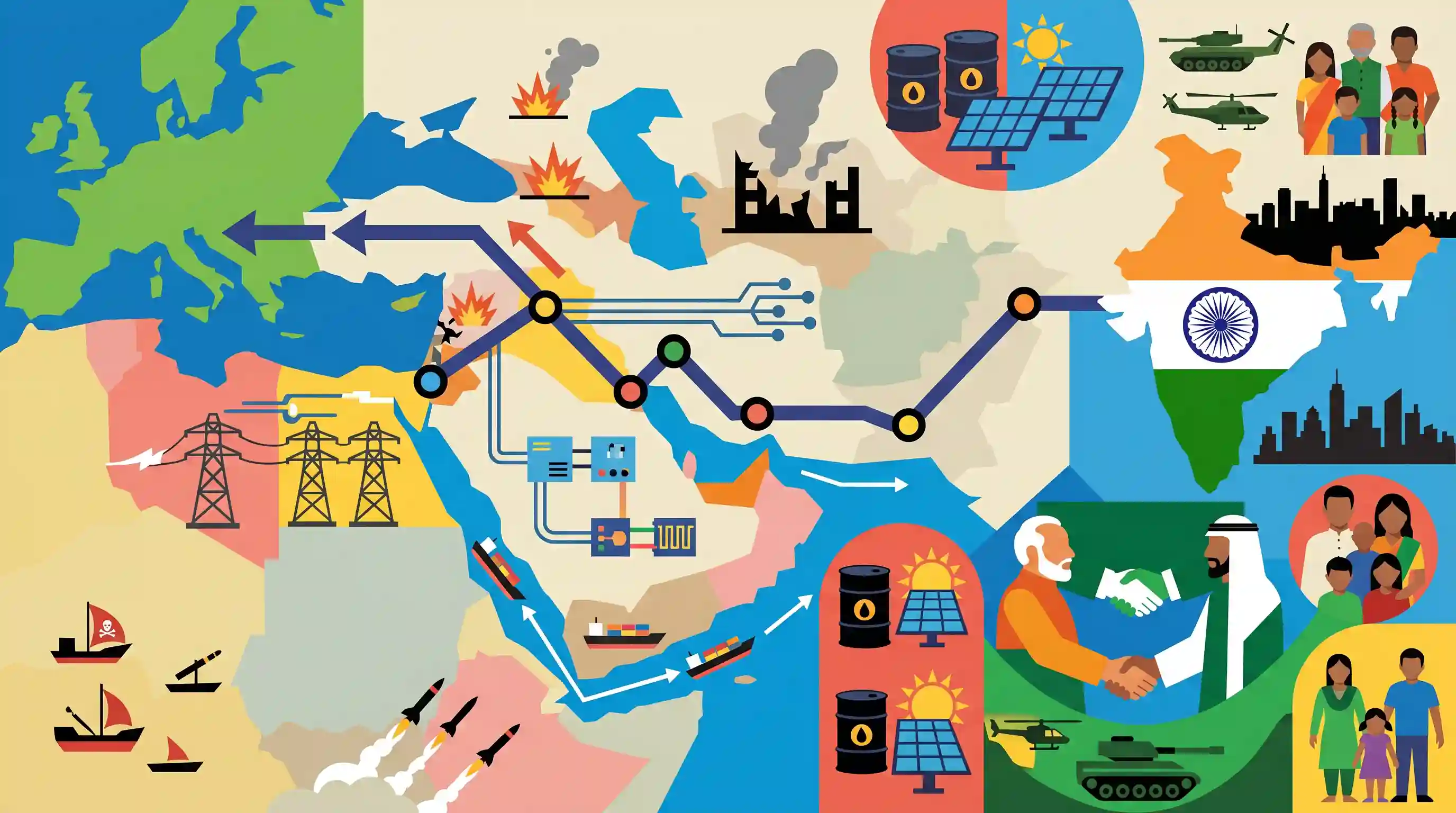
Why It Matters
West Asia is critical for India's energy security and diaspora remittances. Connectivity projects like IMEC represent India's strategic push to establish alternative supply chains and geopolitical influence, making the region's stability and India's diplomatic balancing act highly relevant for UPSC GS2 (International Relations).
Summary
The India-Middle East-Europe Economic Corridor (IMEC) continues to progress despite ongoing conflicts in West Asia, according to Foreign Secretary Vikram Misri. Ahead of Prime Minister Narendra Modi's visit to Saudi Arabia, Misri emphasized that IMEC's pillars, such as electricity grids, are being developed in a distributed manner with select partners. The visit highlights the deepening India-Saudi Arabia strategic partnership, which is anchored in energy security, defense cooperation, and the welfare of the Indian diaspora. The engagement also reflects India's careful diplomatic balancing act in the region amidst the Israel-Palestine war and shared concerns over maritime security in the Red Sea.
Key Points
- IMEC's implementation is continuing despite the Israel-Palestine conflict, with work proceeding on specific pillars like electricity grid interconnections in a distributed manner.
- Prime Minister Modi's visit to Saudi Arabia underscores the strategic importance of Riyadh for India's energy security and the welfare of a large Indian expatriate community.
- India maintains a delicate diplomatic balancing act in West Asia, engaging with various stakeholders including Israel, Palestine, Jordan, Egypt, and Saudi Arabia.
- Shared regional security concerns, including maritime safety in the Red Sea and threats from Houthi rebels, feature prominently in India-Saudi diplomatic engagements.
Important Terms
India-Middle East-Europe Economic Corridor (IMEC)

A multimodal connectivity project (shipping and rail) linking India, the Middle East, and Europe to reduce transit times by 40%. It includes energy and digital pillars.
UPSC context
GS-II (International Relations - Connectivity) and GS-III (Infrastructure). Tests strategic alternatives to China's BRI and global supply chain resilience.
Houthi Rebels
An Iran-backed Zaydi Shia militant group in Yemen. Their attacks on commercial ships in the Red Sea have disrupted major trade routes between Asia and Europe.
UPSC context
GS-II (International Relations - Regional Conflicts). Tests understanding of non-state actors and their impact on India's maritime trade interests.
Strategic Partnership Council (SPC)
Established in 2019, this high-level bilateral body co-chaired by India’s PM and Saudi Arabia's Crown Prince oversees cooperation in security, economy, and investment.
UPSC context
GS-II (Bilateral Relations). Tests the mechanisms of India-Saudi diplomatic and economic institutional engagement.
Bab-el-Mandeb Strait
A strategic maritime choke point connecting the Red Sea to the Gulf of Aden. It is vital for India's trade with Europe and energy security.
UPSC context
GS-I (Geography - Major Choke Points) and GS-II (Strategic IR). Tests awareness of geographical vulnerabilities in global trade.
Maritime Security
The protection of Sea Lanes of Communication (SLOCs) from piracy and conflict. India's Navy ensures this via "Mission-Based Deployments" in the Indian Ocean and Red Sea.
UPSC context
GS-III (Internal Security - Maritime threats). Tests the Indian Navy's role as a 'Net Security Provider' in the region.
Prelims Trap
IMEC is exclusively a rail and shipping network aimed at replacing the Suez Canal.
IMEC is multi-modal and multi-domain. It integrates clean hydrogen pipelines, cross-border electricity grids, and undersea digital cables alongside traditional transit networks.
Static Concepts Connected
What are the major maritime chokepoints relevant to India's West Asia trade?
- Bab el-Mandeb: Connects the Red Sea to the Gulf of Aden; crucial for Suez Canal traffic and currently threatened by Houthi rebel attacks.
- Strait of Hormuz: Located between Oman and Iran; a vital global artery for oil transit, heavily utilized for India's energy imports from Saudi Arabia and the UAE.
- Suez Canal: Artificial waterway in Egypt connecting the Mediterranean and Red Seas. IMEC strategically aims to reduce absolute dependency on this single route.
How is the India-Saudi Arabia Strategic Partnership Council (SPC) structured?
- Establishment: Formed in 2019, making India the fourth country to sign such an elevated partnership agreement with Riyadh.
- Dual Pillars: Operates via two tracks: Political, Security, Social, & Cultural cooperation; and Economy & Investments.
- Top-Level Leadership: The council is directly headed by the Prime Minister of India and the Crown Prince of Saudi Arabia.
Cross-Topic Patterns
IMEC vs. China's Belt & Road
IMEC connects with the broader Western-backed 'Partnership for Global Infrastructure and Investment' (PGII) as a financially sustainable, transparent alternative to China's debt-heavy Belt and Road Initiative (BRI).
Red Sea crisis & imported inflation
Houthi disruptions in the Red Sea directly impact India's macroeconomic stability by severely inflating freight and insurance costs, offering a classic case study of 'imported inflation' in economics.
Cross-border green grids and OSOWOG
IMEC's electricity grid and hydrogen pipeline pillars directly link to India's OSOWOG (One Sun One World One Grid) vision, pivoting traditional oil diplomacy towards renewable energy integration.

Expect a multi-statement prelims question integrating IMEC’s non-transport pillars (grids, hydrogen) with Red Sea maritime chokepoints.
Linked PYQs · 2
Linked PYQs · 2
- 2025MainsGS2
"Energy security constitutes the dominant kingpin of India's foreign policy, and is linked with India's overarching influence in Middle Eastern countries.” How would you integrate energy security with India's foreign policy trajectories in the coming years?
- 2025PrelimsGS1
India is one of the founding members of the International North-South Transport Corridor (INSTC), a multimodal transportation corridor, which will connect
