Southwest Monsoon Break And Bay Of Bengal Cyclonic Circulation
Source:Indian Express ↗
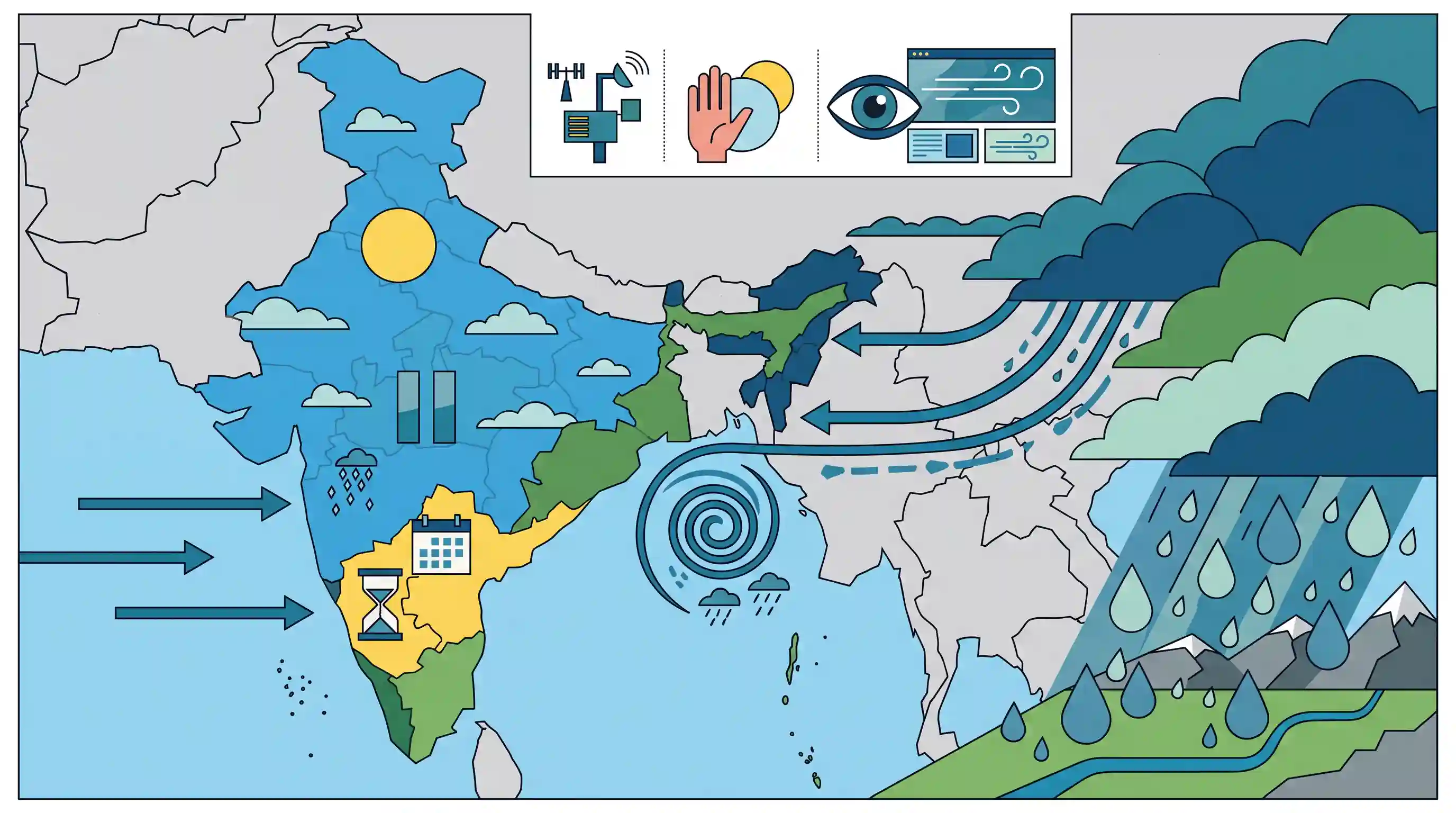
Why It Matters
The article highlights a real-time example of a 'break in the monsoon'—a major concept in Indian Climatology (GS1) where precipitation ceases over central and southern plains while shifting to the Himalayan foothills and the Northeast. Understanding these intra-seasonal variabilities and local cyclonic circulations is critical for answering questions on geographic distribution of rainfall, water resource management, and climate change.
Summary
The India Meteorological Department (IMD) has forecast a week-long 'monsoon break' across the South Peninsula, Northwest, and Central India, even as a fresh cyclonic circulation over the north Bay of Bengal brings heavy rainfall to East and Northeast India.
Key Points
- The India Meteorological Department (IMD) has forecast a week-long break in the Southwest Monsoon across major parts of India, including the South Peninsula, Northwest India, and Central India.
- During this nationwide rain break, the cumulative rain deficit has notably dropped from a high of 40% in June to 15% in early July.
- Simultaneously, a fresh cyclonic circulation is expected to develop over the north Bay of Bengal and adjoining Bangladesh around July 14, 2026.
- This cyclonic system will cause localized heavy to very heavy precipitation in East and Northeast India, including states like Meghalaya, Arunachal Pradesh, Assam, Manipur, Nagaland, and Mizoram.
- IMD Director General Mrutyunjay Mohapatra clarified that the impact of this cyclonic circulation will remain confined to the eastern and northeastern parts of the country, leaving the ongoing monsoon break elsewhere unaffected.
Important Terms
India Meteorological Department (IMD)

India's principal national agency under the Ministry of Earth Sciences, responsible for meteorological observations, weather forecasting, seismology, and issuing early warning alerts for severe weather hazards.
UPSC context
GS Paper I & III; tests institutional mechanisms for weather monitoring, disaster warning, and climate adaptation.
Break in Monsoon
A prolonged dry spell during the Southwest Monsoon season (typically July-August) when rainfall sharply reduces across central and plains regions while increasing along the Himalayan foothills.
UPSC context
GS Paper I (Physical Geography); tests understanding of monsoonal variations, precipitation dynamics, and impact on agriculture.
Monsoon Trough
A low-pressure trough acting as a key component of the Intertropical Convergence Zone (ITCZ) over India, whose latitudinal movement dictates rainfall distribution across the subcontinent.
UPSC context
GS Paper I (Physical Geography); tests core climatology concepts, ITCZ oscillations, and monsoonal pressure systems.
Cyclonic Circulation
An atmospheric circulation system characterized by the rapid inward movement of air masses converging towards a low-pressure center, rotating counterclockwise in the Northern Hemisphere.
UPSC context
GS Paper I (Physical Geography); tests understanding of atmospheric wind patterns, pressure belts, and cyclogenesis principles.
Prelims Trap
A break in the Southwest Monsoon leads to dry conditions across the entire Indian subcontinent, with rainfall ceasing nationwide.
While the plains experience a dry spell, the northward shift of the monsoon trough to the Himalayan foothills causes heavy, torrential rainfall in those areas.
Static Concepts Connected
What physical mechanisms trigger a 'Break' in the Southwest Monsoon?
- Trough Migration: The monsoon trough shifts northwards from the Indo-Gangetic plains toward the Himalayan foothills, drying central India.
- Orographic Rainfall: While the plains remain dry, the sub-Himalayan regions and Northeast India receive intense, localized torrential rainfall.
- Coastal Wind Shift: Winds along the west coast blow parallel to the Western Ghats, suppressing the orographic lifting needed for rainfall.
How does the IMD define and classify India's monsoon rainfall?
- LPA Baseline: The Long Period Average benchmark is 868.6 mm (87 cm), based on the updated 1971–2020 climatological baseline.
- Normal Band: Monsoon rainfall is classified as 'Normal' if the actual regional/national precipitation is between 96% and 104% of LPA.
- Deficient Category: Seasonal rainfall falling below 90% of the LPA is classified as deficient, triggering drought monitoring mechanisms.
Cross-Topic Patterns
Monsoon breaks & agricultural inflation
Extended dry spells in July disrupt Kharif sowing cycles, prompting the activation of crop contingency plans and triggering spikes in food inflation.
Trough dynamics & landslide vulnerability
The northward migration of the trough concentrates torrential rainfall over fragile sub-Himalayan terrains, triggering devastating landslides and downstream flooding.

IMD's revised LPA baseline (1971-2020) and the localized physical mechanisms of monsoon breaks are highly likely 2026 Prelims targets.
Linked PYQs · 3
Linked PYQs · 3
- 2011PrelimsGS1
La Nina is suspected to have caused recent floods in Australia. How is La Nina different from El Nino? 1. La Nina is characterised by unusually cold ocean temperature in equatorial Indian Ocean whereas El Nino is characterised by unusually warm ocean temperature in the equatorial Pacific Ocean. 2. El Nino has adverse effect on south-west monsoon of India, but La Nina has no effect on monsoon climate. Which of the statements given above is/are correct?
- 2017PrelimsGS1
With reference to 'Indian Ocean Dipole (IOD)' sometimes mentioned in the news while forecasting Indian monsoon, which of the following statements is/are correct? 1. IOD phenomenon is characterised by a difference in sea surface temperature between tropical Western Indian Ocean and tropical Eastern Pacific Ocean. 2. An IOD phenomenon can influence an El Nino's impact on the monsoon. Select the correct answer using the code given below:
- 2014MainsGS1
Most of the unusual climatic happenings are explained as an outcome of the El-Nino effect. Do you agree?
