IMD forecasts below-normal rainfall for July after weak June
Source:Indian Express ↗
Why It Matters
The article directly ties into the core Geography syllabus concerning the Indian Monsoon and the complex climatic phenomena (like El Nino and MJO) that influence it. It also bridges GS1 Geography and GS3 Economy by highlighting the vulnerability of Indian agriculture (Kharif crops) to monsoon deficits.
Summary
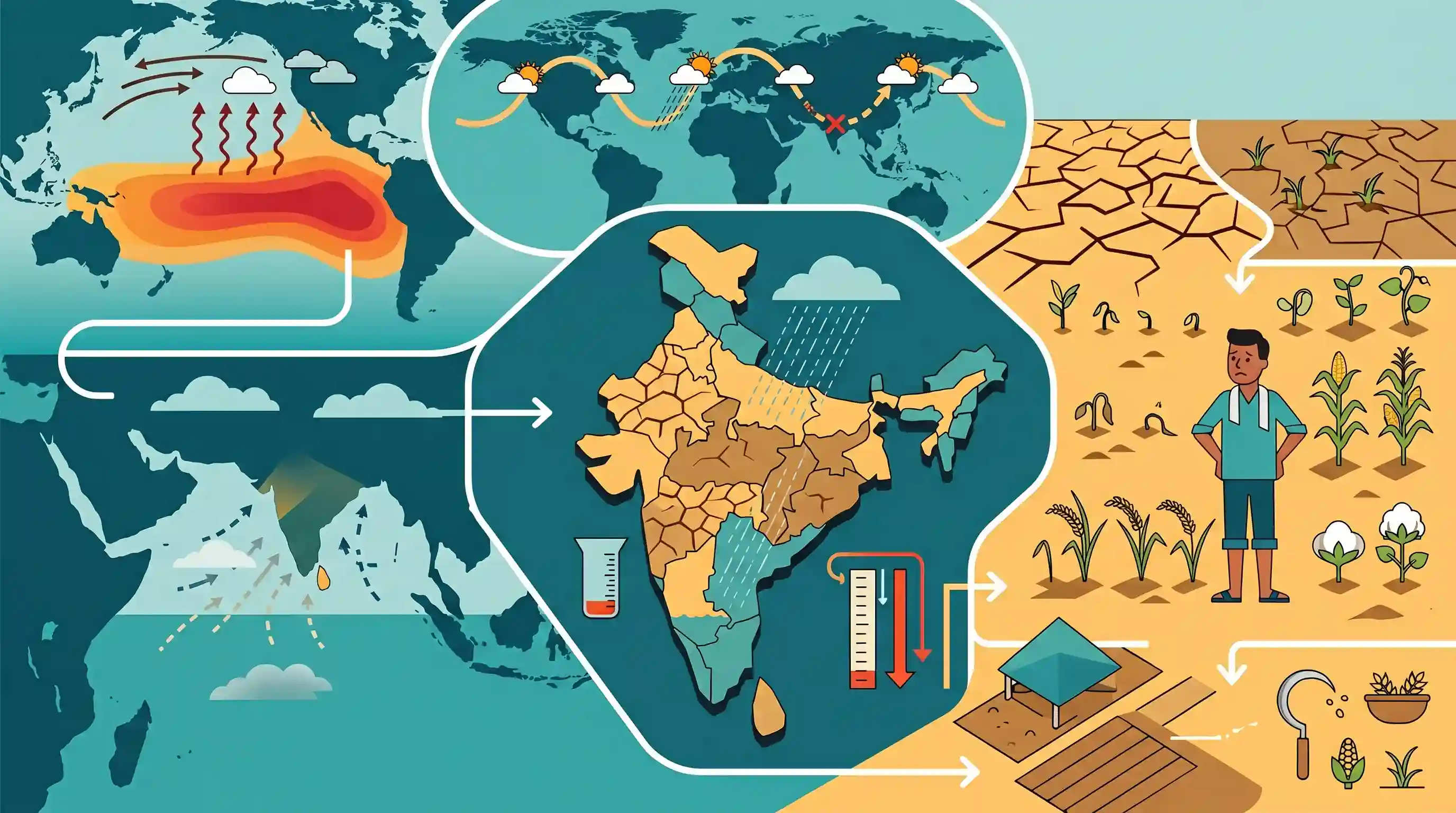
The India Meteorological Department (IMD) has forecast below-normal rainfall for July, following a significant 40% deficit in June, making it the fifth driest June on record since 1901. This shortfall is largely driven by developing El Nino conditions in the Pacific, an absence of low-pressure systems, weak monsoonal flow, and the lack of a favorable Madden-Julian Oscillation (MJO). The deficit raises concerns for the agriculture sector, particularly regarding the delayed sowing and potential productivity loss of Kharif crops.
Key Points
- The IMD has forecast below-normal rainfall for July, predicting it will be less than 94% of the Long Period Average (LPA).
- June experienced a severe 40% rainfall deficit, recording only 99.5 mm instead of the expected 165.3 mm, marking the fifth driest June since 1901.
- The monsoon shortfall is primarily attributed to a developing El Nino in the Pacific region, which is expected to strengthen in July.
- Other contributing factors include weak monsoonal flow, an absence of low-pressure systems, and unfavorable external systems such as the Madden-Julian Oscillation (MJO).
- The persistent rainfall deficit is expected to negatively impact the sowing and yield of Kharif crops, with potential ramifications for the agriculture sector.
Important Terms
India Meteorological Department (IMD)

The principal government agency under the Ministry of Earth Sciences responsible for weather forecasting, seismology, and cyclone warnings; it manages the vital annual monsoon forecasts.
UPSC context
GS Paper 1 (Geography) and GS Paper 3 (Disaster Management); tests knowledge of institutional climate governance.
El Niño
Periodic warming of sea surface temperatures in the central/eastern tropical Pacific that typically weakens the Indian Southwest Monsoon, leading to rainfall deficits and droughts.
UPSC context
GS Paper 1 (Geography/Climatology); frequently tested regarding its impact on Indian agriculture and the Walker Circulation.
Madden-Julian Oscillation (MJO)
An eastward-moving tropical atmospheric disturbance that circles the equator every 30-60 days. Its 'active' phase enhances monsoon rainfall, while its 'suppressed' phase causes dry spells.
UPSC context
GS Paper 1 (Climatology); tests understanding of intra-seasonal monsoon variability and atmospheric wave patterns.
Kharif Crops
Monsoon-season crops sown in June–July and harvested in September–October (autumn), such as rice, maize, and cotton. They are heavily dependent on the Southwest Monsoon.
UPSC context
GS Paper 3 (Agriculture/Economy); critical for questions on cropping patterns, food security, and rural distress.
Southwest Monsoon
The seasonal wind system (June–September) providing ~75% of India's annual rainfall; it is the primary driver of the country's agricultural economy and water resources.
UPSC context
GS Paper 1 (Geography); core topic for climate mechanisms, rainfall distribution, and socio-economic impacts.
Prelims Trap
"The Madden-Julian Oscillation (MJO) is a stationary ocean temperature anomaly in the Indian Ocean."
Aspirants confuse MJO with IOD or ENSO. MJO is an eastward-moving intra-seasonal band of clouds and wind, not a stationary temperature dipole.
Static Concepts Connected
How does the Madden-Julian Oscillation (MJO) differ from ENSO?
- Periodicity: MJO is an intra-seasonal fluctuation (every 30-60 days), whereas ENSO is an inter-annual phenomenon occurring every 2 to 7 years.
- Nature of movement: MJO is a traveling, eastward-moving wave of clouds and rainfall traversing the tropics. ENSO is a stationary oceanic-atmospheric anomaly anchored in the Pacific.
- Monsoon impact: When the MJO's active (wet) phase is positioned over the Indian Ocean, it brings low-pressure systems that can enhance monsoon rains, potentially countering El Nino.
How does the IMD use the Long Period Average (LPA) for monsoon forecasting?
- LPA Definition: LPA is the benchmark average rainfall recorded over a 50-year period (currently 1971-2020, which is approx 86.8 cm for India).
- Categorisation: Rainfall is 'Normal' at 96-104% of LPA, 'Below Normal' at 90-96% of LPA, and 'Deficient' when it falls below 90% of the LPA.
Cross-Topic Patterns
Monsoon deficit + Food Inflation
A Kharif sowing delay directly impacts food prices, linking Climatology to the RBI's inflation targeting mandate and India's recent export bans on agricultural commodities like non-basmati rice.
El Nino + Marine Ecosystems
The same equatorial Pacific warming that suppresses India's monsoon (El Nino) simultaneously triggers mass coral bleaching events, linking Indian geography directly to global biodiversity threats.

Expect a multi-statement Prelims question testing the simultaneous impacts of El Nino, IOD, and MJO on the Indian Monsoon's distribution.
Linked PYQs · 5
Linked PYQs · 5
- 2017PrelimsGS1
With reference to 'Indian Ocean Dipole (IOD)' sometimes mentioned in the news while forecasting Indian monsoon, which of the following statements is/are correct? 1. IOD phenomenon is characterised by a difference in sea surface temperature between tropical Western Indian Ocean and tropical Eastern Pacific Ocean. 2. An IOD phenomenon can influence an El Nino's impact on the monsoon. Select the correct answer using the code given below:
- 2014MainsGS1
Most of the unusual climatic happenings are explained as an outcome of the El-Nino effect. Do you agree?
- 2015MainsGS1
How far do you agree that the behaviour of the Indian monsoon has been changing due to humanizing landscapes? Discuss.
- 2019PrelimsGS1
With reference to the cultivation of Kharif crops in India in the last five years, consider the following statements: 1. Area under rice cultivation is the highest. 2. Area under the cultivation of jowar is more than that of oilseeds. 3. Area of cotton cultivation is more than that of sugarcane. 4. Area under sugarcane cultivation has steadily decreased. Which of the statements given above are correct?
- 2013PrelimsGS1
Consider the following crops : 1. Cotton 2. Groundnut 3. Rice 4. Wheat Which of these are Kharif crops?
