IMD Issues Red Alert For Heavy Rain Across Gujarat Districts
Source:deshgujarat ↗
આ શા માટે મહત્વનું છે
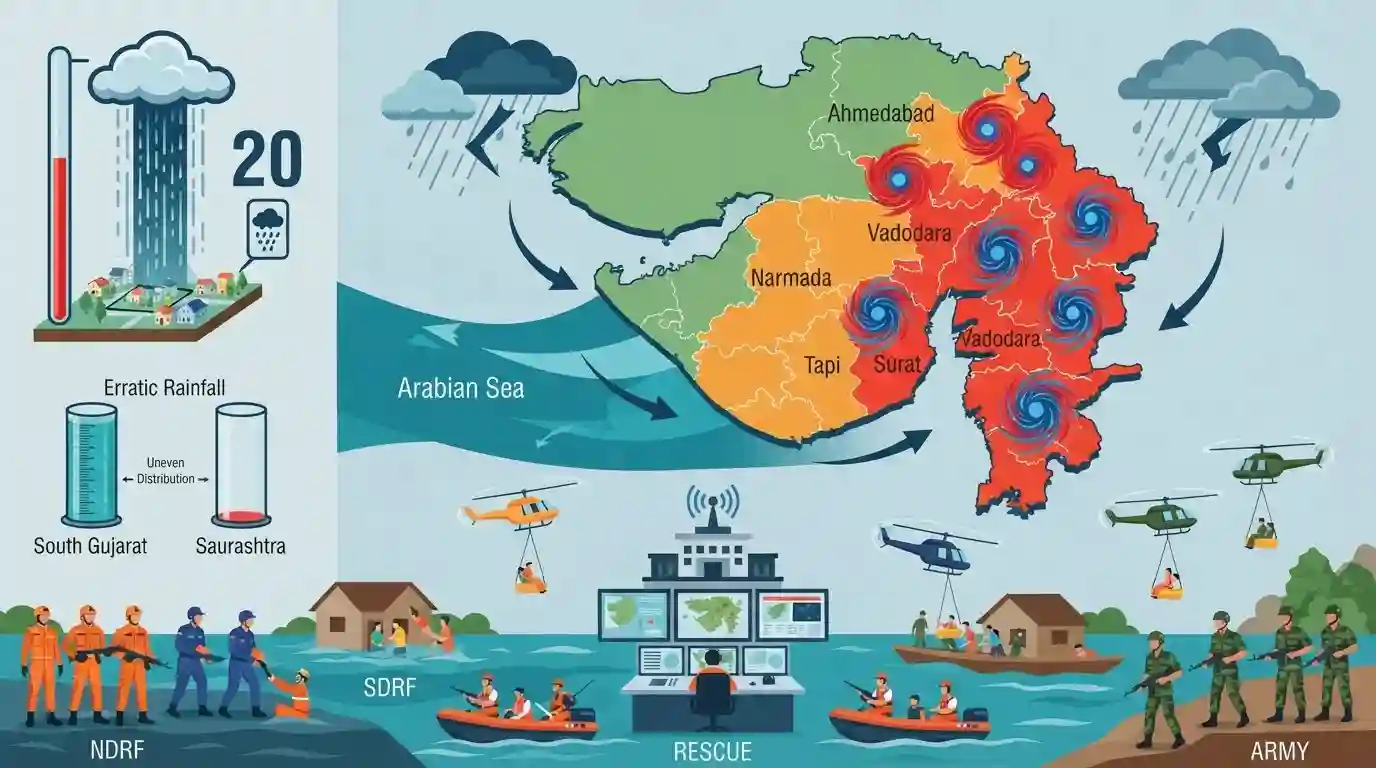
It highlights the increasing frequency of erratic monsoon patterns and localized extreme weather events linked to climate change. The article also demonstrates the practical application of India's disaster management framework, emphasizing inter-agency coordination (NDRF, SDRF, Army) in large-scale flood mitigation and evacuation efforts.
સારાંશ
The India Meteorological Department (IMD) has issued a 'Red Alert' for extremely heavy rainfall on July 31 across eight districts in Gujarat, including Ahmedabad, Vadodara, Surat, Narmada, and Tapi. This comes amid severe flooding in South Gujarat, which has already prompted large-scale rescue and evacuation operations by the NDRF, SDRF, Coast Guard, and Army, overseen by the State Emergency Operation Centre (SEOC). The state's monsoon season has been characterized by highly erratic rainfall distribution, with some southern districts nearing their seasonal average while parts of Saurashtra remain dry. The situation is exacerbated by extreme localized events, such as Dholka receiving 20 inches of rain in a two-hour window, underscoring the growing intensity of monsoon anomalies.
મુખ્ય મુદ્દા
- The IMD issued a Red Alert for extremely heavy rainfall on July 31 across eight Gujarat districts, including Ahmedabad, Vadodara, Surat, Narmada, Tapi, and Dang.
- Severe flooding in South Gujarat has necessitated massive rescue operations, with over 9,600 people rescued and 53,600 evacuated.
- Disaster response is being actively coordinated by the SEOC, involving multiple agencies like the NDRF, SDRF, Coast Guard, and the Indian Army.
- Gujarat is experiencing highly uneven monsoon rainfall distribution, with South Gujarat nearing 100% of its seasonal average while regions like Devbhumi Dwarka remain largely dry.
- Extreme, localized precipitation events were recorded, notably Dholka receiving an unprecedented 20 inches of rain in just two hours.
મહત્વપૂર્ણ શબ્દો
India Meteorological Department (IMD)

India's principal agency under the Ministry of Earth Sciences for meteorological observations, weather forecasting, and early warnings against severe phenomena like heavy rainfall and cyclones.
UPSC context
GS-I (Geography) & GS-III (Disaster Management). Tests understanding of monsoon forecasting, climate anomalies, and early-warning systems.
National Disaster Response Force (NDRF)
A specialized multi-skilled force established under the Disaster Management Act, 2005, functioning under the Ministry of Home Affairs to swiftly rescue and respond during severe natural or man-made disasters.
UPSC context
GS-III (Disaster Management). Essential for evaluating India’s statutory framework, rapid response capacity, and central crisis management.
State Disaster Response Force (SDRF)
The primary state-level operational force created under the Disaster Management Act, 2005. Raised by state governments, they act as the immediate first responders during localized and severe disasters.
UPSC context
GS-III (Disaster Management). Tests knowledge of the decentralized structure of disaster governance and state-led relief capacity.
State Emergency Operation Centre (SEOC)
A 24/7 centralized communication and control hub that manages disaster monitoring, coordinates emergency response efforts, and directs multi-agency resource allocation across districts during a state crisis.
UPSC context
GS-III (Disaster Management). Evaluates administrative preparedness, real-time state crisis coordination, and emergency communication protocols.
Indian Coast Guard (ICG)
An armed force under the Ministry of Defence responsible for coastal security, maritime law enforcement, and providing crucial humanitarian assistance and disaster relief (HADR) during extreme coastal and riverine floods.
UPSC context
GS-III (Security & Disaster Management). Relevant for assessing multi-agency relief operations and coastal emergency response.
પ્રિલિમ્સ ટ્રેપ
The National Disaster Response Force (NDRF) operates under the administrative control of the Ministry of Defence during state-level flood relief operations.
The NDRF is a specialized force constituted under the Disaster Management Act, 2005, and operates under the administrative control of the Ministry of Home Affairs (MHA), not the Ministry of Defence.
સંલગ્ન સ્થિર ખ્યાલો
What is the statutory framework of Disaster Management in India?
- DM Act 2005: Enacted to provide for effective management of disasters; established NDMA (headed by Prime Minister) and SDMAs (headed by Chief Ministers).
- NDRF Mandate: Constituted under Section 44 of the Act as a specialized response force, operating under the Ministry of Home Affairs.
- SEOC Role: A multi-agency command hub at state levels to coordinate immediate relief, resource allocation, and communication during emergencies.
How are the IMD's color-coded weather alerts classified?
- Green Alert: Signifies normal weather; no warning or special action is required by authorities or the public.
- Yellow Alert: Indicates potentially bad weather; authorities should keep track of updates as conditions might deteriorate.
- Orange Alert: Warns of extremely bad weather; authorities and public must be prepared for disruptions and potential evacuations.
- Red Alert: Demands immediate action; issued during extreme weather events (e.g., rainfall >204.4 mm in 24 hours) posing severe risk to life.
આંતર-વિષય પેટર્ન
Urban Drainage + West-Flowing Rivers
Rapid urban sprawl in cities like Vadodara and Surat disrupts natural basins of west-flowing rivers, amplifying rainfall anomalies into severe urban flash floods.
Erratic Monsoon + Agrarian Security
Highly erratic rainfall distribution challenges crop-planning, making climate-resilient agriculture central to water governance in drought-prone Saurashtra.

DM Act 2005 statutory mandates, IMD's warning thresholds, and west-flowing river hydrology are highly likely to feature in a 2026 MCQ.
સંલગ્ન PYQ · 2
સંલગ્ન PYQ · 2
- 2026GPSC_PRELIMSGS1
Consider the following statements regarding climate change: 1. Floods and droughts are increasing in India. 2. There has been a sharp increase in the number of tropical cyclones in India. 3. Humidity levels are gradually increasing in the regions of central India. Which of the above statement/s is/are correct?
- 2021GPSC_PRELIMSGS1
Match the column: | Waterfall | District | |---|---| | 1. Zanzhari Waterfall | a. Narmada | | 2. Zharwani Waterfall | b. Aravalli | | 3. Girmall Waterfall | c. Tapi | | 4. Chimer Waterfall | d. Dangs | Code:
