IMD Red Alert for Heavy Monsoons in Gujarat Districts
Source:deshgujarat ↗
Why It Matters
Understanding the synoptic mechanisms of the Indian monsoon (such as low-pressure areas, monsoon troughs, and shear zones) is central to the Geography syllabus. Additionally, knowledge of IMD warning protocols is important for Disaster Management and public administration topics.
Summary
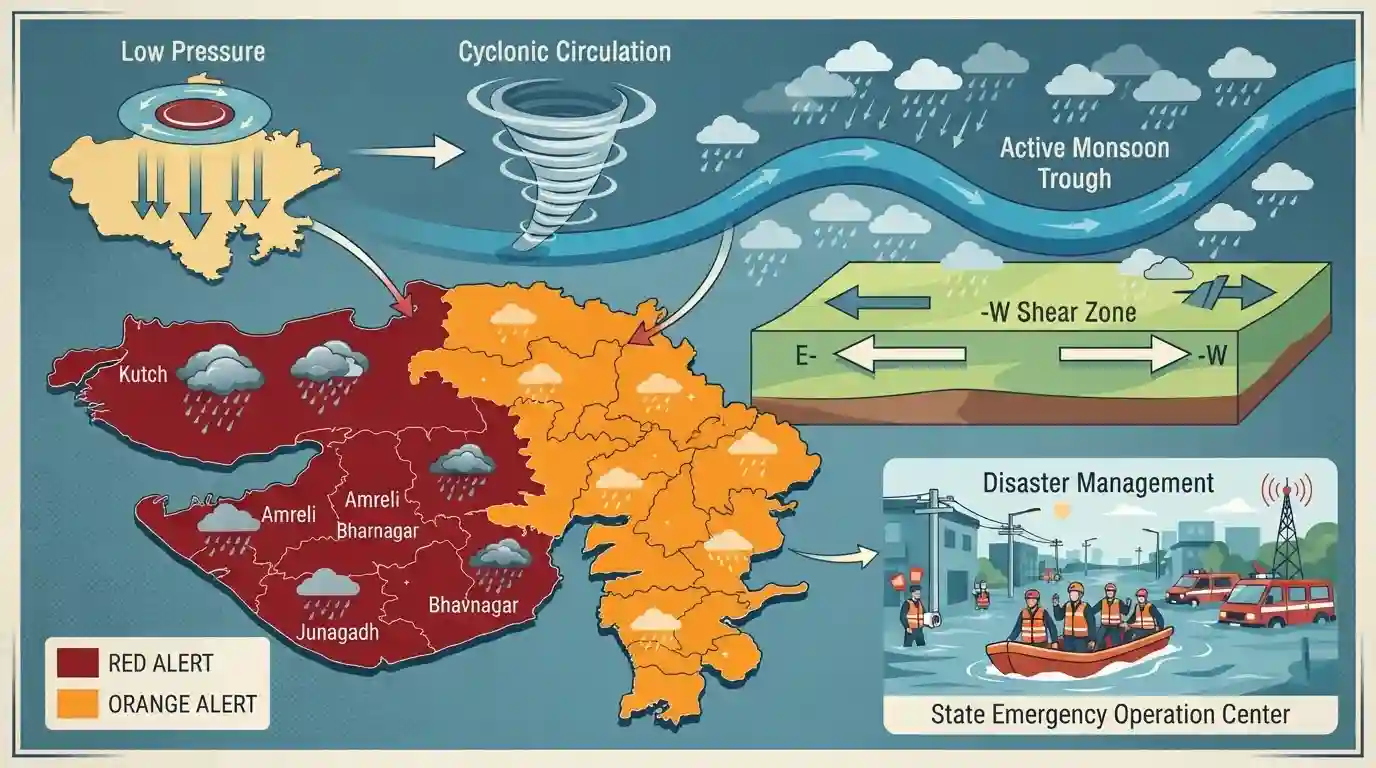
The India Meteorological Department (IMD) has issued a red alert for nine districts in Gujarat, predicting extremely heavy rainfall in the region over the next 24 hours. The extreme weather is being driven by a combination of a low-pressure area over southwest Rajasthan, a cyclonic circulation, a highly active monsoon trough, and an east-west shear zone. The State Emergency Operation Center is coordinating response efforts, and an orange alert remains in place for several other districts.
Key Points
- The IMD has issued a 'red alert' for nine districts in Gujarat, warning of extremely heavy rainfall on July 25 and 26.
- The heavy rains are attributed to a low-pressure area over southwest Rajasthan and an associated cyclonic circulation extending up to 5.8 km above mean sea level.
- The monsoon trough is highly active, passing through Nalia, Ahmedabad, and extending to the Eastcentral Bay of Bengal.
- An east-west shear zone running roughly along 20°N is further intensifying the monsoon conditions over the region.
- Authorities, including the relief commissioner, have directed local administrations to remain highly alert and coordinate with rescue teams.
Important Terms
India Meteorological Department (IMD)

The nodal agency under the Ministry of Earth Sciences responsible for meteorological observations, weather forecasting, climate services, and issuing early warnings for weather-related hazards like cyclones and floods.
UPSC context
GS Paper 1 & 3 (Geography/Disaster Management). Tests knowledge of India’s institutional framework for climate forecasting and disaster early warnings.
State Emergency Operation Centre (SEOC)
The primary state-level command and communication hub coordinating disaster response activities. It disseminates early warnings from central agencies to district authorities and coordinates with response forces.
UPSC context
GS Paper 3 (Disaster Management). Tests understanding of India's disaster management framework, state-level coordination, and institutional emergency response.
Red Alert
The highest severity level in the IMD’s colour-coded weather warning system. It indicates extremely bad weather conditions posing a significant risk to life, requiring immediate action by authorities and citizens.
UPSC context
GS Paper 3 (Disaster Management). Tests awareness of early warning protocols, risk communication, and preemptive disaster mitigation strategies.
Monsoon Trough
An elongated low-pressure area that develops during the southwest monsoon, acting as a part of the Inter-Tropical Convergence Zone. Its oscillation dictates the spatial distribution and intensity of monsoon rainfall.
UPSC context
GS Paper 1 (Geography). A critical climatological concept tested in questions analyzing the mechanism, variability, and spatial distribution of the Indian monsoon.
Cyclonic Circulation
A weather system characterized by the rapid, inward movement of air around a low-pressure area. It rotates counterclockwise in the Northern Hemisphere, often driving storm formation and intense precipitation.
UPSC context
GS Paper 1 (Geography). Tests foundational climatology concepts regarding atmospheric pressure systems, wind movements, and cyclone formation mechanisms.
East-West Shear Zone
A vertical atmospheric zone characterized by opposing winds in the middle troposphere. It acts as an active monsoon feature that facilitates the interaction of high-speed winds, concentrating heavy rainfall.
UPSC context
GS Paper 1 (Geography). Important for understanding advanced Indian monsoon dynamics and the specific meteorological factors driving localized extreme rainfall.
Prelims Trap
"A southward shift of the monsoon trough leads to a 'break' phase in the monsoon."
A 'break' in the monsoon actually occurs when the trough shifts *northward* to the Himalayan foothills, drying the plains but causing heavy rain in the Northeast.
Static Concepts Connected
How does the position of the Monsoon Trough dictate rainfall distribution?
- Nature: It is a semi-permanent, elongated low-pressure zone extending from Northwest India to the Bay of Bengal.
- Active phase: When the trough is positioned southward over the central plains, it brings widespread heavy rainfall to the core monsoon zone.
- Break phase: When the trough shifts northward to the Himalayan foothills, rainfall stops in the plains but intensifies in the Northeast and Himalayas.
What do the IMD's color-coded weather warnings signify?
- Yellow (Watch): Advises authorities and the public to 'Be updated' about potentially worsening weather conditions.
- Orange (Alert): Signifies 'Be prepared' for heavy to very heavy rainfall, with potential for power outages and traffic disruptions.
- Red (Warning): Means 'Take action' immediately. Indicates extremely heavy rainfall posing a significant risk to life, property, and infrastructure.
Cross-Topic Patterns
Extreme rainfall + Urban Flooding
The increasing frequency of localized extreme precipitation events directly feeds into GS3 Disaster Management questions on urban flooding and inadequate municipal drainage systems.
Warming seas + Monsoon trough volatility
Rising Arabian Sea temperatures increase moisture feed to inland low-pressure areas, linking GS1 Climatology (monsoon mechanisms) with GS3 Climate Change impacts.

Expect a multi-statement Prelims question in 2026 linking IMD color codes, shifting monsoon troughs, and east-west shear zone dynamics.
Linked PYQs · 2
Linked PYQs · 2
- 2026GPSC_PRELIMSGS1
Consider the following statements regarding the winter atmospheric circulation over India: 1. Western Disturbances are shallow cyclonic depressions originating over the eastern Mediterranean Sea and traveling eastward across the Middle East. 2. The steering mechanism that brings these Western Disturbances to the Indian subcontinent is the Tropical Easterly Jet Stream. 3. The precipitation brought by these disturbances is highly beneficial for the Rabi crops in the northwestern plains of India. Which of the above statements are correct?
- 2026GPSC_PRELIMSGS1
Consider the following statements regarding climate change: 1. Floods and droughts are increasing in India. 2. There has been a sharp increase in the number of tropical cyclones in India. 3. Humidity levels are gradually increasing in the regions of central India. Which of the above statement/s is/are correct?
