IMD issues advisories across India as temperatures surge
Source:The Hindu ↗
Why It Matters
Heatwaves are becoming increasingly common and severe due to climate change, necessitating robust disaster preparedness, heat action plans, and early warning systems by the IMD. Understanding these mechanisms is crucial for civil servants responsible for managing public health and disaster mitigation strategies.
Summary
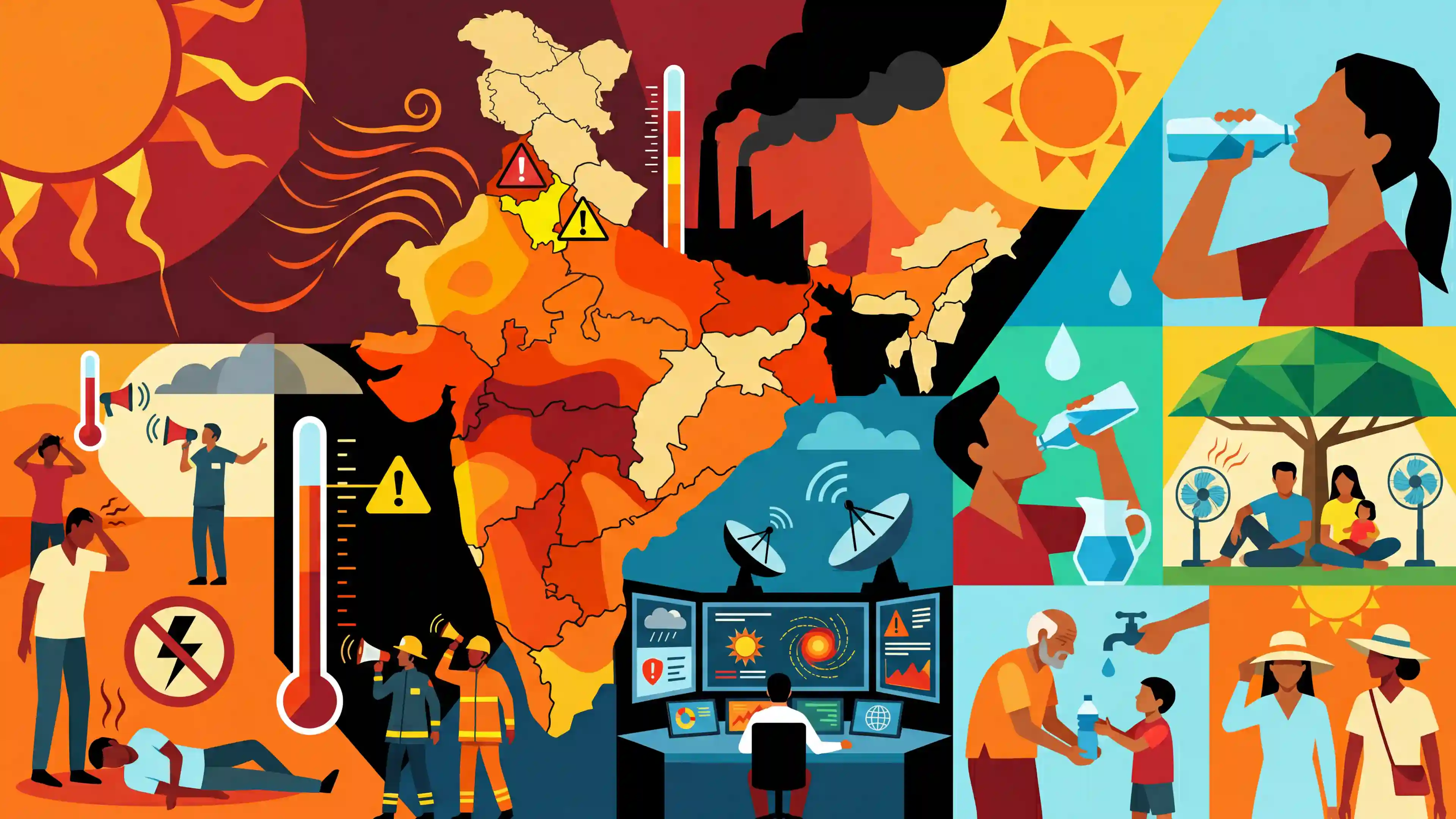
The India Meteorological Department (IMD) has issued extensive heatwave advisories as maximum temperatures range between 40°C and 44.5°C across northwest, central, and peninsular India. Driven by climate change, the surge in extreme temperatures has prompted guidelines urging citizens to stay hydrated, avoid peak sunlight, and protect vulnerable groups from heat exhaustion and stroke. The IMD has also issued specific color-coded warnings, including a yellow alert for Delhi, highlighting proactive disaster management efforts against escalating climate-induced extreme weather events.
Key Points
- The IMD released heatwave guidelines advising hydration, wearing breathable clothing, and avoiding sun exposure to prevent heat stroke and heat exhaustion.
- Maximum temperatures have surged between 40°C and 44.5°C in several Indian regions, with Sri Ganganagar, Rajasthan, recording the highest at 44.5°C.
- The frequency and intensity of these heatwaves are being exacerbated by broader climate change trends, leading to a developing heat stress scenario.
- The IMD has forecast further heatwave conditions across multiple northern and central states, and has issued a yellow alert in Delhi.
Important Terms
India Meteorological Department (IMD)

India’s principal government agency for meteorological observations and weather forecasting, functioning under the Ministry of Earth Sciences. It provides early warnings for cyclones, heatwaves, and monsoons.
UPSC context
GS Paper 3 (Disaster Management/S&T); essential for understanding India’s institutional framework for climate resilience and disaster mitigation.
Heatwave
A period of abnormally high temperatures where the maximum temperature reaches ≥40°C in plains or ≥30°C in hills, or shows a departure of 4.5°C–6.4°C from the normal.
UPSC context
GS Paper 1 (Geography) and GS Paper 3 (Disaster Management); tests knowledge of climatic phenomena and their socio-economic impacts.
Yellow Alert
An IMD warning level signifying 'Be Updated' or 'Be Aware.' It indicates that weather conditions are marginally bad and could worsen, potentially disrupting daily activities.
UPSC context
GS Paper 3 (Disaster Management); relates to early warning systems and the multi-stage response protocols of the NDMA and IMD.
Heat Stroke
A life-threatening medical emergency where the body's core temperature exceeds 40°C (104°F) due to prolonged exposure to high heat, causing potential organ failure or brain damage.
UPSC context
GS Paper 2 (Health) and GS Paper 3 (Disaster Management); highlights the public health vulnerability addressed in Heat Action Plans (HAPs).
Heat Action Plans (HAPs)
Comprehensive state or city-level strategies designed to reduce heat-related mortality and morbidity through early warnings, public awareness, and inter-agency coordination (e.g., cooling centers).
UPSC context
GS Paper 3 (Disaster Management); critical for questions on climate adaptation, urban planning, and administrative responses to extreme weather.
El Niño
The abnormal warming of surface waters in the central and eastern Pacific Ocean, which typically leads to suppressed monsoon rainfall and increased heatwave frequency in India.
UPSC context
GS Paper 1 (Geography); fundamental for understanding global climatic drivers affecting Indian weather patterns and agricultural cycles.
Prelims Trap
"Heatwaves are formally recognized as a 'notified disaster' under the Disaster Management Act, 2005."
Despite severe impacts, heatwaves are not centrally notified disasters under the DM Act, which restricts direct NDRF funding for them.
Static Concepts Connected
What are the specific IMD criteria for declaring a heatwave in India?
- Plains Threshold: Maximum temperature must reach at least 40°C.
- Coastal Threshold: Maximum temperature must reach at least 37°C.
- Hills Threshold: Maximum temperature must reach at least 30°C.
- Temperature Departure: Must be 4.5°C to 6.4°C above normal; a departure of >6.4°C classifies as a severe heatwave.
What do the four IMD colour-coded weather warnings signify?
- Green (Normal): No advisory is issued; no action is required.
- Yellow (Watch): Be updated; keep a watch on the developing weather situation.
- Orange (Alert): Be prepared; extreme weather may disrupt communication and transport.
- Red (Warning): Take action; extreme weather is imminent with significant risk to life and property.
Cross-Topic Patterns
Urban Heat Island (UHI) effect
Heatwaves intertwine with urbanization. Concrete surfaces and lack of green cover amplify local temperatures, making UHI a frequent crossover topic in GS-1 Geography and GS-3 Environment.
Labour productivity & heat stress
Climate-induced heatwaves severely impact India's informal, outdoor workforce. Connecting heat stress to ILO reports on lost working hours links physical geography directly to GS-3 economic impacts.

A 2026 Prelims question blending IMD's exact numerical heatwave criteria with their non-notified status under the DM Act is highly likely.
Linked PYQs · 3
Linked PYQs · 3
- 2022MainsGS1
Discuss the meaning of colour-coded weather warnings for cyclone prone areas given by India Meteorological Department.
- 2020MainsGS3
Discuss the recent measures initiated in disaster management by the Government of India departing from the earlier reactive approach.
- 2019MainsGS3
Disaster preparedness is the first step in any disaster management process. Explain how hazard zonation mapping will help disaster mitigation in the case of landslides.
