IMA Warnings on Healthcare Marketisation and Out of Pocket Costs
Source:The Hindu ↗
Why It Matters
Provides critical, authoritative data (e.g., OOP expenses driving 55 million into poverty) and institutional perspectives (from the IMA) on the pitfalls of healthcare marketisation and shortcomings of flagship schemes like AB-PMJAY. This is highly relevant for GS-2 answers regarding healthcare reforms, universal health coverage, and the debate between public vs. private healthcare systems.
Summary
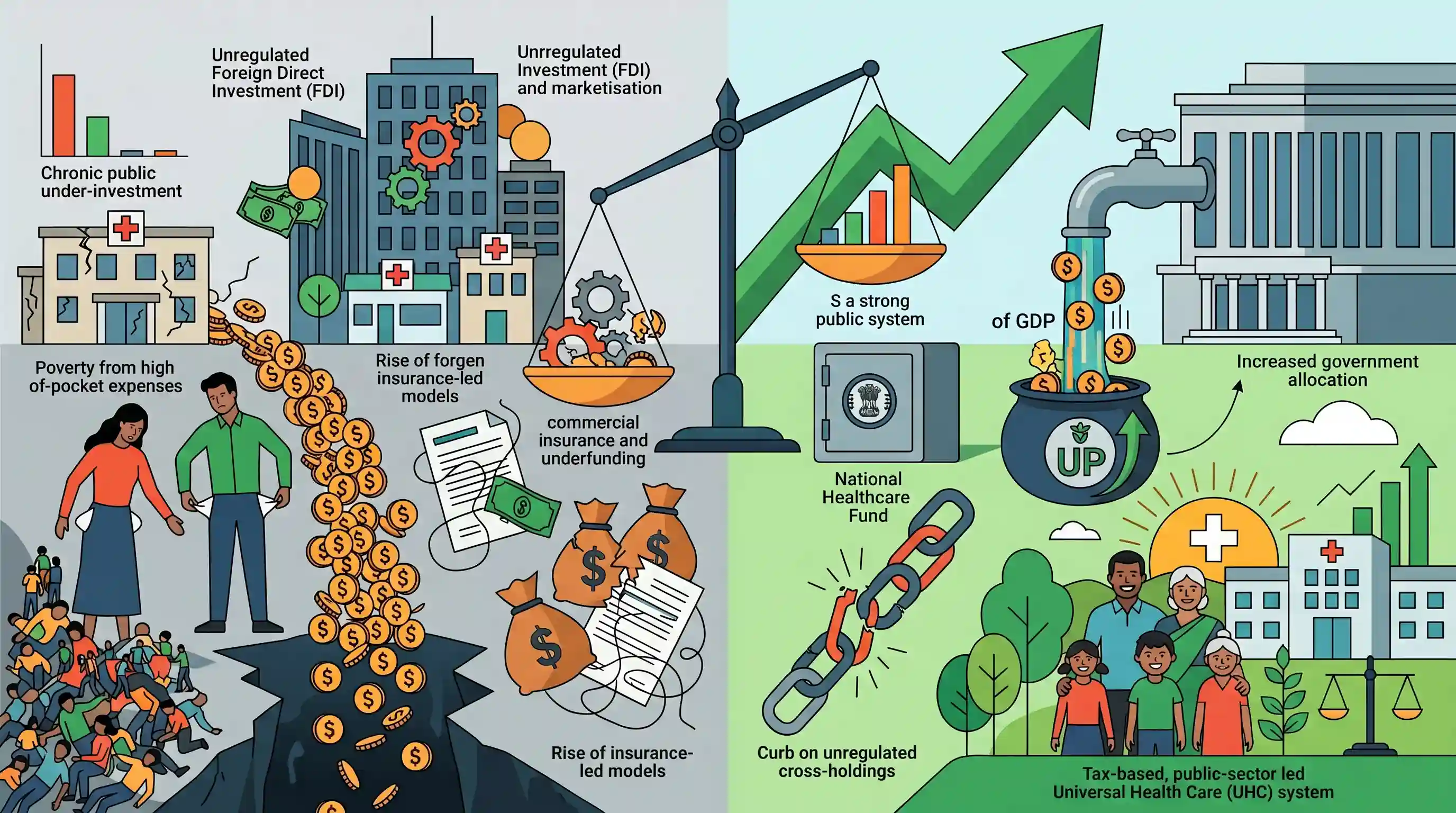
The Indian Medical Association (IMA) has released a policy document outlining severe threats to India's healthcare accessibility and affordability, primarily driven by chronic public under-investment, unregulated Foreign Direct Investment (FDI), and the rise of insurance-led healthcare models. The IMA highlighted that staggering out-of-pocket expenditures push 55 million people into poverty each year. To counter the adverse impacts of healthcare marketisation and corporatisation, the IMA recommended increasing the government's health allocation to 2.5% of GDP, curbing unregulated cross-holdings in the medical sector, and establishing a National Healthcare Fund. Furthermore, the IMA criticized the Ayushman Bharat PMJAY for its inadequate funding and unscientific rates, urging a shift toward a tax-based, public-sector-led Universal Health Care system rather than a commercial insurance model.
Key Points
- The Indian Medical Association (IMA) released 'IMA's blueprint for a healthier India', identifying under-investment, unregulated FDI, and insurance-driven price controls as key threats to affordable healthcare.
- IMA demands raising minimum government health allocation to 2.5% of GDP immediately, and to 5% by 2030 to align with the Viksit Bharat 2047 vision.
- Out-of-pocket (OOP) health expenditure in India remains excessively high (around ₹8 lakh crore in 2024), pushing approximately 55 million Indians into poverty annually.
- The IMA warned that unregulated FDI and cross-holdings in hospitals, diagnostics, and insurance promote marketisation and corporatisation, undermining medical autonomy and commercializing patient care.
- IMA strongly criticized Ayushman Bharat PMJAY for its 'grossly inadequate' budget (₹9,406 crore) and unscientific package rates, which render the scheme unviable for small and medium private hospitals.
- The association differentiates between Universal Health Care (equitable access) and Universal Health Coverage (financial protection), advocating for a tax-funded health system heavily reliant on public sector primary providers rather than an insurance-led model.
Important Terms
Ayushman Bharat PM-JAY

World's largest government-funded health assurance scheme providing ₹5 lakh annual cover per family for secondary and tertiary hospitalization to over 12 crore poor and vulnerable families.
UPSC context
GS Paper II: Government schemes for vulnerable sections; tests understanding of healthcare financing and social security architecture in India.
Indian Medical Association (IMA)
Established in 1928, it is the largest national voluntary organization of doctors of modern medicine in India, advocating for professional interests and public health policy reforms.
UPSC context
GS Paper II: Role of pressure groups and professional associations in policy-making and health governance.
Universal Health Coverage (UHC)
A global health goal ensuring all individuals receive essential health services—prevention to rehabilitation—without suffering financial hardship at the point of care.
UPSC context
GS Paper II: Issues relating to development and management of Social Sector/Services relating to Health; tests knowledge of SDG 3.8.
Out-of-Pocket Expenditure (OOPE)
Direct payments made by individuals to healthcare providers at the time of service, which are not covered by insurance or government subsidies.
UPSC context
GS Paper III: Indian Economy and issues relating to planning and mobilization of resources; critical metric for health equity.
National Health Policy (NHP) 2017
A policy framework aiming to increase public health spending to 2.5% of GDP by 2025 and shifting toward a preventive, promotive, and primary-care-led health system.
UPSC context
GS Paper II: Government policies and interventions; tests understanding of India's long-term health strategy and fiscal targets.
Catastrophic Health Expenditure
Health spending that exceeds a specific threshold (e.g., 10% or 25%) of a household's total income, often leading to medical impoverishment.
UPSC context
GS Paper II: Social Justice; tests analysis of how healthcare costs impact poverty and economic vulnerability.
Prelims Trap
"Out-of-Pocket Expenditure (OOPE) as a percentage of total health expenditure in India has steadily increased over the last decade."
While the IMA notes OOP pushes millions into poverty, National Health Accounts (NHA) data shows OOPE as a percentage of total health expenditure has actually declined from 62.6% in 2014-15 to ~39% in 2021-22.
Static Concepts Connected
What is the status and target for Out-of-Pocket Expenditure (OOPE) in India?
- Definition: Direct outlays by households to practitioners, pharmacies, and hospitals that are not covered by insurance.
- Recent Trends: NHA data shows OOPE declined from 62.6% in 2014-15 to around 39% in 2021-22, though absolute numbers remain high.
- NHP 2017 Target: The National Health Policy 2017 aims to decrease OOPE as a proportion of overall health expenditure to 30% by 2025.
What are the current FDI norms in India's hospital and healthcare sector?
- Greenfield Projects: 100% Foreign Direct Investment (FDI) is permitted under the automatic route for new (greenfield) hospital projects.
- Brownfield Projects: 100% FDI is allowed, but it is automatic only up to 74%; government approval is required beyond 74%.
- Medical Devices: 100% FDI is permitted under the automatic route for both greenfield and brownfield projects without restrictions.
Cross-Topic Patterns
Right to Health vs Corporatisation
The IMA's critique of insurance-led healthcare connects directly with state-level legislative initiatives (e.g., Rajasthan's Right to Health Act) emphasizing tax-funded public delivery over commercial insurance.
CCI + Healthcare M&A
IMA's warning on unregulated cross-holdings between hospitals, diagnostics, and insurers invites regulatory scrutiny, linking GS2 health concerns with GS3 statutory bodies like the Competition Commission of India (CCI).

Expect a GS2 Mains question critically evaluating 'insurance-led models vs tax-funded public healthcare' and PMJAY's structural flaws.
Linked PYQs · 2
Linked PYQs · 2
- 2024MainsGS2
In a crucial domain like the public healthcare system the Indian State should play a vital role to contain the adverse impact of marketisation of the system. Suggest some measures through which the State can enhance the reach of public healthcare at the grassroots level.
- 2015MainsGS2
Public health system has limitations in providing universal health coverage. Do you think that the private sector could help in bridging the gap? What other viable alternatives would you suggest?
